12 min
Interoperability is the foundation of data-driven healthcare, helping to improve patient care, operational efficiency, cost reduction, and regulatory compliance. By adopting interoperability standards, healthcare organizations can support data exchange across systems, applications, and devices, enabling real-time access to critical health information.
In this guide, we’ll discuss the basics of healthcare interoperability, why it’s important, and how your healthcare organization can start implementing it.
Healthcare interoperability FAQs
Healthcare interoperability is the ability of different digital health information systems, software applications, and devices to securely access, exchange, integrate, and cooperatively use clinical and administrative data across organizational, regional, and network boundaries.
Healthcare interoperability works by establishing shared digital rules for sending, organizing, and interpreting health data. These rules enable different computer systems to understand clinical information without human translation.
To see how interoperability works in practice, it helps to follow the flow of health information. At the most basic level, secure data exchange moves raw files—such as encrypted PDFs or secure emails—between facilities, but the receiving computer cannot search or analyze these files’ contents. Point-to-point system integrations go a step further by building custom bridges between two specific applications, but these connections are generally fragile and can break during software updates.
True interoperability solves the problems associated with other data-sharing methods by using open standards like HL7 FHIR and uniform medical code sets. For example, when a clinic transmits an updated patient chart, the receiving electronic health record (EHR) automatically recognizes new active prescriptions, adds them to that patient’s record, and screens for drug interactions.
An EHR integration is the embedding of a particular tool into a workflow so that different systems can work together as one. Interoperability, on the other hand, is the exchange of data and the ability of different systems to talk to one another. Interoperability helps facilitate EHR integrations.
Interoperability standards define how users structure, exchange, and interpret data across different systems. For data to flow smoothly across applications, it needs to speak a “common language,” which requires standardizing its format, no matter where it originates or where it’s going.
Data can come from provider notes in EHRs, as well as from pharmacies, labs, urgent care centers, imaging appointments, and even health insurance claims. Interoperability helps these sources to share a common data structure and map their information to the same standardized codes. That consistency is what lets healthcare organizations aggregate everything in a single location, creating a longitudinal patient record.
From a regulatory standpoint, interoperability is a federal mandate aimed at dismantling data silos. Landmark policies—such as the 21st Century Cures Act, ONC certification standards, and CMS interoperability rules—require providers, payers, and health IT developers to make electronic records securely accessible.
Federal rules also enforce penalties against organizations that knowingly block information exchange, including formal investigations, civil monetary penalties from HHS-OIG, or CMS reimbursement reductions. Prioritizing interoperability keeps organizations compliant and safeguards participation in Medicare and Medicaid programs.
Additionally, as healthcare organizations invest in artificial intelligence (AI) tools to improve care coordination and work efficiency, having access to comprehensive, clean data becomes increasingly important. Healthcare interoperability ensures that AI models receive consistent, multi-source patient information. When predictive algorithms and clinical assistants analyze standardized records from various sources, they can identify health patterns earlier, reduce administrative workload, and deliver recommendations that reflect each patient’s complete health history.
Healthcare interoperability relies on established privacy laws and cybersecurity safeguards to operate effectively. Under HIPAA, covered entities may exchange health records without patient authorization for treatment, payment, and health care operations (TPO). Organizations follow the “minimum necessary” rule for billing and administrative tasks, while direct clinical care allows full chart access to ensure patient safety. Heightened consent protections also apply to sensitive records, such as behavioral health and substance use disorder histories.
4 levels of healthcare interoperability
The Healthcare Information and Management Systems Society (HIMSS) identifies four progressive levels of health data interoperability:
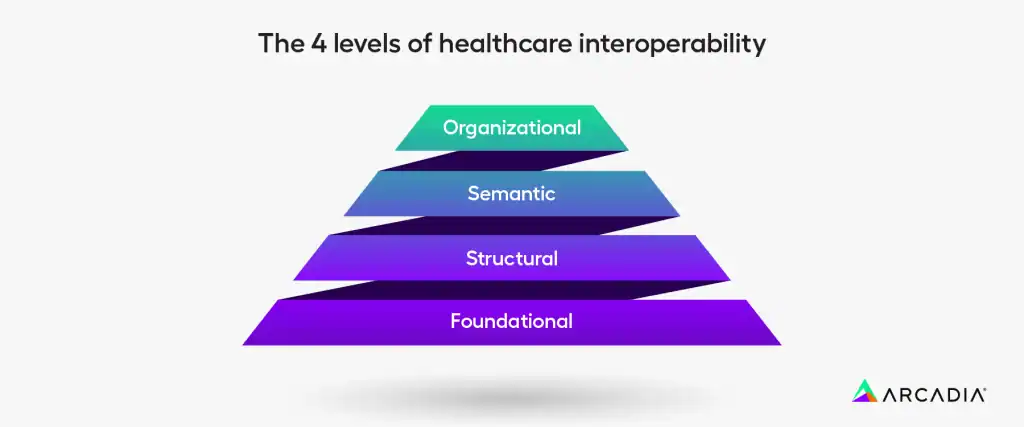
Foundational
Foundational interoperability describes the secure digital connection between two systems. It enables data to move from Point A to Point B safely and without being altered along the way. The receiving computer safely receives data over an encrypted connection, but it cannot yet read, organize, or interpret its contents.
Structural
Structural interoperability organizes the data layout so that both systems know where each piece of information belongs. While foundational interoperability delivers data, structural interoperability unpacks it into predictable spots—such as a standardized intake form where Field 1 is always “Full Name,” and Field 5 is “Allergies.” The receiving system does not have to guess how to file the data, though it may not yet fully understand the clinical nuance of what is written in those boxes.
Semantic
Semantic interoperability ensures that systems speak the same medical language and understand the clinical meaning of data, so nothing is lost in translation. For example, if Clinic A writes “high blood pressure” and Hospital B documents “essential hypertension,” semantic interoperability translates both entries into the same universal clinical concept. This level enables healthcare software at different facilities to calculate health risks across records.
Organizational
Organizational interoperability focuses on the policies, legal agreements, and everyday workflows that enable different healthcare groups to connect with one another. In addition to having the appropriate technology, hospitals and clinics must also agree on clear privacy rules, data ownership terms, and who is allowed to view records. In practice, this level creates a trusted pact between organizations that improves performance and patient outcomes. For instance, if a patient visits an emergency room far from home, clinicians there have immediate legal permission to view their outside records without waiting for phone calls, paperwork, or lawyer reviews.
Healthcare interoperability frameworks, networks, and exchange models
Practical data sharing relies on a mix of modern web standards, regional coalitions, and national governance agreements. Here are a few frameworks, networks, and exchange models that healthcare interoperability is based on:
HL7 Fast Healthcare Interoperability Resources (FHIR)
HL7 FHIR is an open technical standard that defines how healthcare data is structured and shared over the web. It breaks medical records down into discrete, modular building blocks called “Resources”—such as Patient, Observation, MedicationRequest, and Condition. By relying on modern web APIs, FHIR allows applications to request specific data points rather than downloading an entire chart at once, enabling third-party tools such as smartphone apps to integrate directly into clinical workflows.
Consolidated Clinical Document Architecture (C-CDA)
C-CDA is a widely used XML standard designed to package and exchange complete clinical summaries, such as Continuity of Care Documents (CCDs), hospital discharge records, and referral notes. C-CDA pairs structured, machine-readable data that an EHR can parse and import with a human-readable narrative. This way, even if an EHR system cannot fully ingest every structured code, care teams can still open and read the clinical note on their screen without losing context.
Health Information Exchanges (HIEs)
HIEs facilitate secure data exchange at the local, state, and regional levels. They allow providers, hospitals, and public health agencies to share critical patient information and ensure continuity of care across different healthcare settings. HIEs aggregate medical records from local participants—such as hospitals, independent clinics, diagnostic laboratories, and public health departments—into a single, shared patient history.
As independent interoperability solutions, HIEs complement broader national and vendor-specific frameworks by offering localized data-sharing capabilities. This diversity allows organizations to adopt flexible approaches without relying on a single interoperability standard or model.
Trusted Exchange Framework and Common Agreement (TEFCA)
TEFCA is a national initiative designed to establish a standardized framework for seamless data exchange across healthcare networks. It enables nationwide interoperability by providing common technical and governing standards, facilitating network-to-network data exchange through Qualified Health Information Networks (QHINs), and reducing complexity by standardizing how organizations connect and exchange data. This structure fosters more interconnected healthcare systems and eliminates data silos.
Carequality
Carequality functions as a “network of networks,” utilizing common rules and technical standards to facilitate interoperability. Unlike TEFCA, Carequality relies on a single Connectivity Agreement rather than formal network accreditation, offering a more flexible governance model for organizations seeking to participate in seamless health information exchange.
Vendor-Specific Data-Sharing Networks
Many EHR vendors offer proprietary healthcare interoperability solutions. These vendor-driven networks provide EHR-based integration, enabling seamless data exchange within their ecosystems. However, they often offer a narrower scope compared to broader frameworks like TEFCA.
Benefits of healthcare interoperability
Healthcare interoperability comes with various benefits for patients, providers, and payers. Here are just a few of the possible advantages for each group:
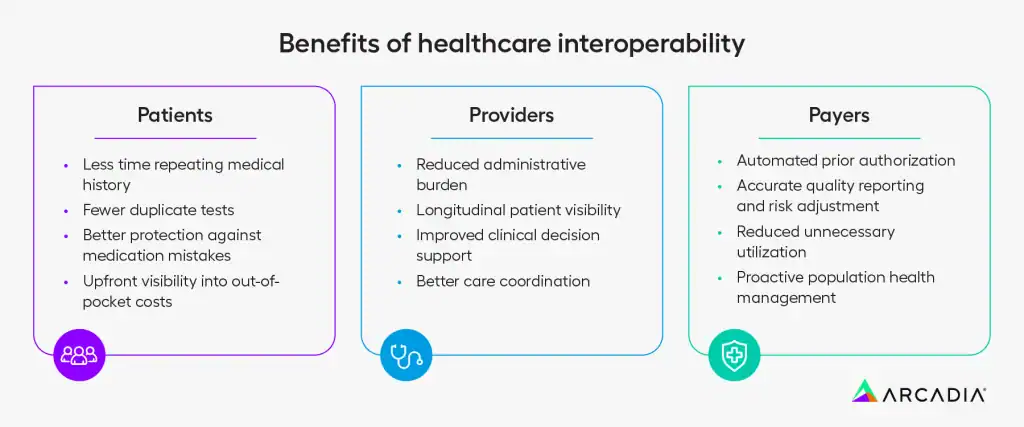
Benefits for patients
Healthcare interoperability improves patient outcomes by providing the following benefits:
- Less time repeating medical history: Patients avoid having to fill out forms for the same information or struggle to recall dates of past procedures, diagnoses, vaccines, and allergies every time they see a new specialist or visit urgent care.
- Fewer duplicate tests: When new doctors can pull up recent blood work, imaging, or pathology reports immediately, patients can avoid repeat needle sticks, extra radiation exposure, and unnecessary copays.
- Better protection against medication mistakes: Connected systems automatically check for dangerous drug interactions and allergies, so patients don’t have to worry about whether a new prescription might conflict with their existing medications.
- Upfront visibility into out-of-pocket costs: Healthcare interoperability enables providers to validate insurance coverage and check costs in real time during each appointment. Patients can discuss the exact cost of a prescription and ask about cheaper alternative medications before leaving the clinic.
Benefits for providers
For care teams, interoperability streamlines clinical workflows and strengthens decision-making by putting a patient’s complete medical history directly at their fingertips. It offers:
- Reduced administrative burden: Fewer manual record requests and less retyping of outside charts help lessen daily administrative load and support clinician well-being.
- Longitudinal patient visibility: Providers can review an entire individual’s medical history at the point of care, minimizing the need to track down faxes or piece together missing history during short appointments.
- Improved clinical decision support: Automated alerts for drug-disease interactions, preventive screening gaps, and clinical recommendations perform more effectively when supported by comprehensive patient data.
- Better care coordination: Real-time admission, discharge, and transfer notifications keep primary care physicians informed when their patients visit an emergency room or urgent care clinic, supporting timely follow-up care and better patient outcomes.
Benefits for payers
For health plan administrators and payers, interoperability accelerates operational workflows and optimizes care management by connecting clinical data directly with claims operations. Healthcare interoperability provides these benefits:
- Automated prior authorization: Standardized FHIR-based data exchange streamlines authorization requests, reducing turnaround times and administrative costs for both payers and practices.
- Accurate quality reporting and risk adjustment: Access to structured clinical data helps payers audit quality performance and reconcile risk adjustment profiles more efficiently.
- Reduced unnecessary utilization: Comparing active clinical records with billing claims enables payers to proactively identify duplicative services, avoid redundant testing, and reduce avoidable spending.
- Proactive population health management: By reviewing clinical and claims trends across a patient population, health plans can identify rising health risks early and offer supportive care management programs.
Challenges of healthcare interoperability
Healthcare organizations tend to encounter the following challenges when trying to implement interoperability standards:
- Legacy systems and technical debt: Many organizations run older on-premise software and proprietary databases that do not natively support modern web-based APIs, requiring translation bridges or platform upgrades.
- Departmental software diversity: Healthcare organizations rely on a range of tools tailored to specific clinical workflows, including laboratory information systems, imaging archives, pharmacy software, and billing solutions. Coordinating these specialized applications may require ongoing technical oversight that healthcare organizations aren’t equipped for.
- Patient identity matching: In the absence of a universal patient identifier in the U.S., systems match records using demographic details such as names, dates of birth, and addresses. Data entry variations and address changes can lead to duplicate records or difficult chart reconciliations.
- Semantic variability and local customization: Even when health systems adopt the same vocabulary standard, individual clinics often customize templates or use local shortcut codes, requiring data normalization to prevent information loss.
- Information blocking concerns: While federal rules prohibit unreasonable practices that restrict data access, competitive concerns and differing interpretations of organizational risk can still slow data sharing between unaffiliated networks.
- Data security and granular consent: Expanding data connections requires strong cybersecurity protocols to protect systems from emerging threats. Organizations also need to balance open data access with patient preferences regarding sensitive clinical records.
- Implementation and maintenance costs: Upgrading interfaces, maintaining FHIR endpoints, and conducting continuous security audits require sustained financial, technical, and engineering resources.
Despite these challenges, navigating healthcare interoperability rarely requires an overnight overhaul of an organization’s entire technical infrastructure. Successful healthcare organizations treat interoperability as an ongoing operational shift, starting by targeting a few pain points and gradually expanding their strategy as their capacity allows.
The future of healthcare interoperability
Interoperability is transforming healthcare by enabling real-time data exchange, improving care quality, and optimizing operational efficiency. By adopting interoperability frameworks such as HIEs, TEFCA, and FHIR alongside a platform that unifies clinical and claims data with analytics, not just connectivity, healthcare organizations can eliminate data silos and create a more connected, patient-centered ecosystem. With robust data connectivity and actionable insights, organizations can drive better population health management and improve value-based care strategies.
Healthcare’s future might be uncertain, but interoperability keeps organizations agile and adaptable. Learn how Arcadia can turn your data into clarity and power measurable outcomes.