ResourcesInsight

10 Value-Based Care Software Solutions to Consider in 2026

By Logan Masta, Director, Special Projects at Arcadia
Posted:
Value-Based Care

Adopting value-based care demands more than just a desire to invest in better patient outcomes. It also requires the technological capability to track and analyze data to measure how patients’ health changes as they receive care.

Value-based care software provides these features for organizations focused on VBC. This article answers the most frequently asked questions about VBC software and outlines the top providers to work with.

FAQs about value-based care software

What is value-based care?

To understand VBC software, it’s essential to first understand value-based care. This term refers to a payment model in which payers compensate providers based on patient health outcomes, rather than the quantity of services provided. Succeeding under this model requires comprehensive data tracking and analysis of patient health outcomes, which is where VBC software comes into play.

What is value-based care software?

Value-based care software describes tools that facilitate VBC by aggregating the healthcare data you need to measure patient health outcomes in a single platform. This information typically includes clinical data, claims information, patient insights, and financial metrics, providing a comprehensive understanding of how an organization is performing under the VBC model.

The aggregated data within VBC software helps health teams, including both providers and payers, make data-driven decisions that improve performance across cost and quality domains . In turn, provider organizations can excel in VBC contracts and earn higher payments.

Why should healthcare organizations prioritize value-based care?

The Centers for Medicare and Medicaid Services (CMS) recently launched models—such as the Advancing Chronic Care with Effective, Scalable Solutions (ACCESS) model and the Transforming Episode Accountability Model (TEAM)—to incentivize better care continuity and positive long-term patient health outcomes. It’s no longer enough for healthcare organizations to provide care based on the objectives of a single appointment. Instead, their efforts need to help patients navigate and improve their health holistically and for the long-term.

Furthermore, nearly 30% of all healthcare payments are now tied to models with downside risk (such as value-based care), in which providers may be financially penalized if they don’t meet performance targets. This trend is expected to accelerate through 2026, making it increasingly important to track healthcare data and patient outcomes using value-based care software.

Why do healthcare organizations need value-based care solutions?

Healthcare organizations need VBC software to access key insights about the effectiveness of their care and assess its long-term impact on patient outcomes. Having a dedicated tool for aggregating and analyzing this information makes it easy to identify opportunities for performance improvement and demonstrate to payers that providers’ care plans result in better long-term patient outcomes.

Additionally, certain solutions offer predictive financial modeling to help CFOs assess whether they can afford the downside risk of implementing VBC.

What features should healthcare organizations look for in value-based care software?

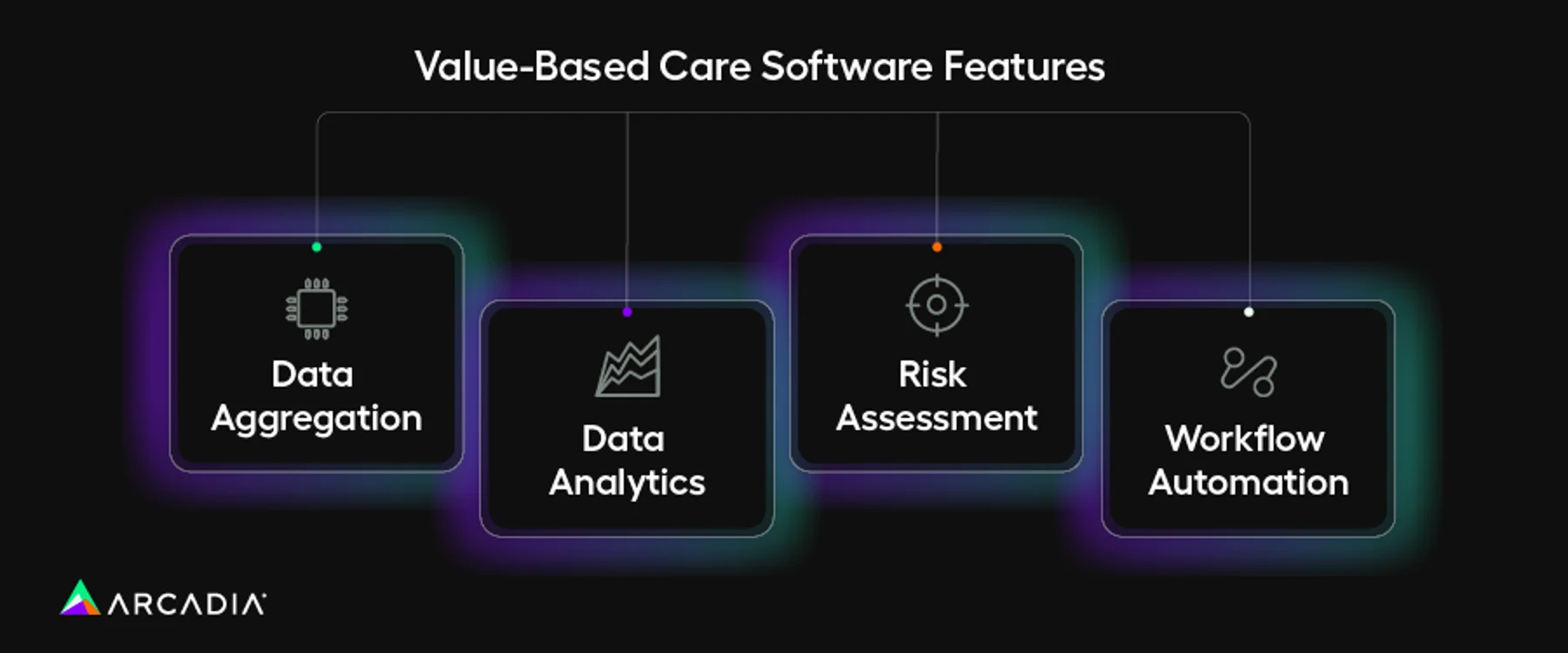
Ideally, your value-based care software should include these features:

The main features your value-based care software should include, also listed below
  • Data aggregation: Your VBC solution should aggregate essential data points, including quality metrics, HCC risk scores, care utilization, and costs in your population, patient engagement, and outreach metrics, in addition to other relevant information. Combining data from all of these sources provides a comprehensive understanding of how your care affects your population and whether it supports long-term patient outcomes.
  • Data analytics: In addition to collecting all relevant data, a VBC tool should help you easily assess and analyze your data, providing actionable insights to improve patient outcomes and your performance. Your solution may also include predictive capabilities that can forecast the impact of any care adjustments you’re considering making on patient and financial outcomes.
  • Risk assessment: Your software should help you pinpoint risk markers within your patient population (including social determinants of health) and use risk-stratification algorithms to identify patients who require the most immediate intervention. Based on these details, your organization can allocate resources precisely and effectively while keeping costs down.
  • Workflow automation: Choose a solution that will let you automate and streamline tedious processes so your teams can get back to the work that matters most—caring for patients. Seamlessly integrating workflows like patient outreach, risk assessment, care plan creation, and remote patient monitoring results in a more efficient team that facilitates better outcomes.

As VBC models become more prevalent, leveraging a dedicated value-based care platform is a necessity for organizations committed to delivering high-quality care and achieving financial sustainability. The right platform starts with data aggregation and ultimately guides healthcare organizations toward sustained improvements in patient outcomes and greater shared savings.

Top 10 value-based care solutions

Now that you’re familiar with what value-based care software is, let’s take a look at the top providers you should consider working with.

1. Arcadia

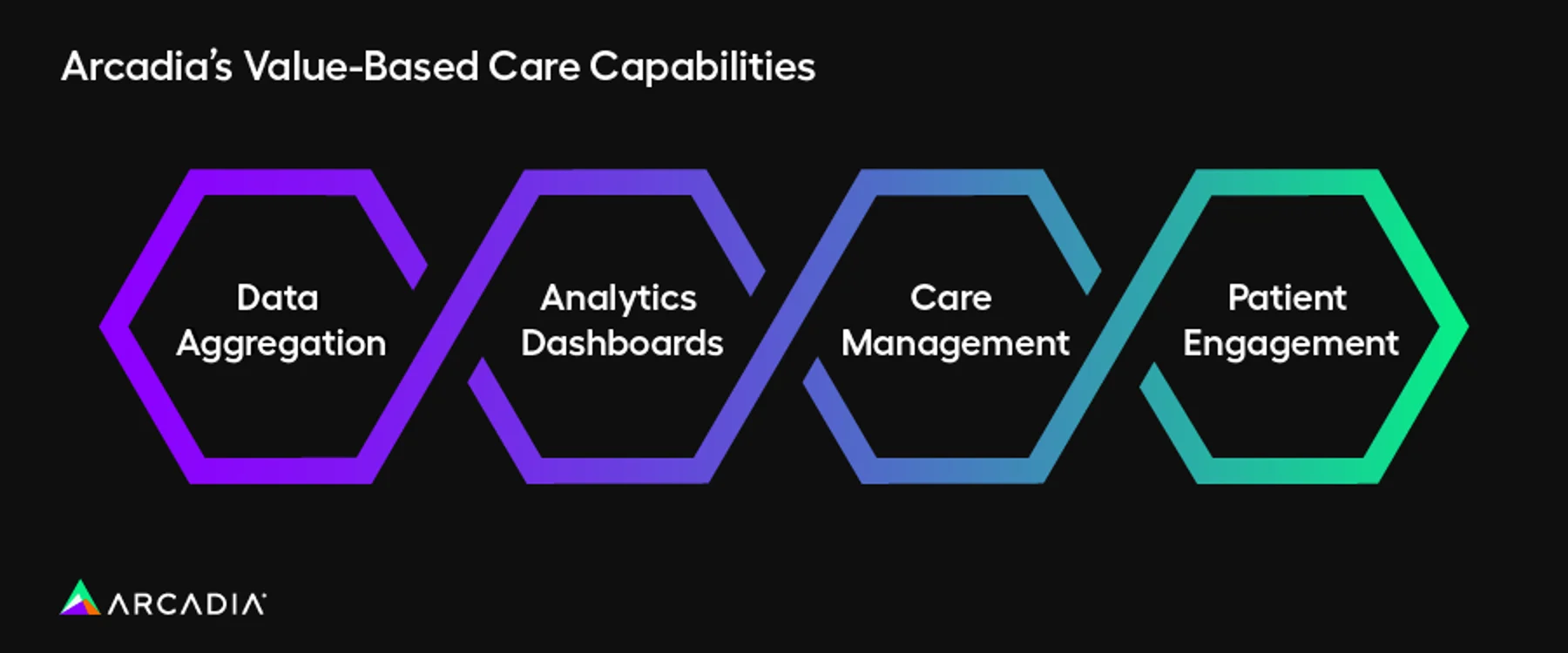
More than any other provider, Arcadia understands that the foundation of great patient care is a thorough understanding of healthcare data. Arcadia’s data platform includes features tailored to enable better value-based care, including:

The main capabilities of Arcadia’s platform for value-based care, also listed below
  • Data aggregation: Arcadia’s platform collects data from many different sources, including quality metrics, HCC risk scores, industry benchmarks, unified Social Determinants of Health (SDoH), point-of-care information, electronic health records (EHRs), and other trusted resources like claims.
  • Analytics dashboards: Based on the data above, Arcadia’s value-based care software can help healthcare organizations visualize patient data and evaluate VBC performance in a centralized platform. Stratify patients, identify high-risk individuals, and generate reports that summarize these details for stakeholders.
  • Care management: Optimize your care management processes and create patient care plans with Arcadia’s Care Management capabilities. Automate your workflows, improve care coordination and collaboration, and seamlessly route patients to the care they need to improve their outcomes, at scale.
  • Patient engagement: Segment your patients using algorithms and insights derived from your data to efficiently target patient groups for personalized communications. This way, your team can engage patients in their health without the high-touch involvement of a dedicated care manager.

Aside from value-based care software, Arcadia also offers a host of other solutions that simplify workflows for healthcare organizations. Whether you want to lower costs, improve interoperability, or manage risk, Arcadia has all of the tools your team needs to succeed.

2. Atropos Health

Atropos Health aims to close evidence gaps in healthcare and life sciences by providing on-demand evidence from real-world data. Its solution is extremely helpful for value-based care, as it:

  • Reveals best practices backed by thousands of national healthcare studies to strengthen your VBC strategies.
  • Provides evidence on specific outcomes of interest and subpopulation demographics to facilitate meaningful action.
  • Helps you measure the success of your interventions to deliver higher quality care that results in better patient outcomes.

3. HealthHelper

One trade-off of VBC is that it may lead to higher costs for healthcare organizations that don’t meet their patient-outcome goals. HealthHelper can assist with that issue by helping primary care providers optimize revenue and reduce costs in both fee-for-service (FFS) and VBC arrangements. Its capabilities include:

  • Optimizing provider schedules and appointments
  • Providing insights and data for every workflow
  • Closing care gaps with data from EHRs and monitoring care follow-up

4. Snowflake

Snowflake aims to eliminate data silos and simplify technology architectures, enabling healthcare and life sciences organizations to derive greater value from their data. Its software can assist with value-based care by:

  • Unifying fragmented data (including clinical, claims, and SDoH information) in a single location to help you strengthen your VBC strategies.
  • Enabling collaboration across the broader healthcare ecosystem by providing real-time access to leading cloud, services, and products partners.
  • Helping care teams deliver more personalized care plans with predictive analytics features.

5. Socially Determined

Socially Determined is a value-based care software provider that partners with healthcare organizations to provide SDoH insights. This allows healthcare teams to better understand the health-related social needs (HRSN) of their populations. With this information, organizations can:

  • Make better community investments
  • Identify strategic vendor and community partners
  • Provide proactive outreach to patients and members who need it the most

6. Quest Analytics

Quest Analytics helps health plans, regulators, and health systems build high-performing, compliant networks that improve patient access to quality care. Its value-based care software can:

  • Reveal network adequacy status and performance gaps to strengthen your VBC network design strategies.
  • Provide trusted primary-sourced provider data to allow for meaningful action on compliance and data integrity.
  • Help you measure and optimize network performance based on cost and quality to deliver higher quality care that results in better patient outcomes.

7. Medisolv

Medisolv is a trusted leader in digital performance measurement, quality management, and reporting, with a 25-year history of dedication to improving patient care and provider performance through health information technology. Access to these measurements and details is essential for delivering value-based care.

Its team has a proven track record of implementing, monitoring, and enhancing quality measures for a diverse array of healthcare organizations, including:

  • Hospitals
  • Clinicians
  • Accountable Care Organizations (ACOs)
  • The federal government
  • State governments

8. Vim

Vim is a value-based care software provider that focuses on enhancing clinical workflows and EHR capabilities. It encourages providers to engage in value-based care workflows, connecting payers, providers, and developers at the point of care. Its platform:

  • Unifies critical payer data and clinical insights directly within the provider’s existing EHR to strengthen your VBC strategies.
  • Provides real-time visibility into care gaps and suspected diagnoses to ensure you take meaningful action during patient encounters.
  • Helps you measure and optimize physician engagement and preventive care performance.

9. N1 Health

N1 Health is a predictive AI platform that uses social, clinical, and consumer predictions to generate meaningful projections that enable precision in your outreach and interventions. Its value-based care software can:

  • Use advanced data and models to reveal predictions and enable precise member segmentation for stronger VBC engagement strategies.
  • Recommend exact interventions for individuals to ensure you take meaningful action on complex population health challenges.
  • Help you measure the impact of targeted outreach and interventions to improve your approach to VBC as needed.

10. J2 Interactive

While not technically a value-based care software provider, J2 Interactive offers technology consulting services for a wide range of healthcare needs. This software development and IT consulting firm specializes in custom solutions for healthcare providers, payers, and other organizations. If you’re not sure what VBC software will work best for your needs, J2 Interactive offers the guidance you need through services like:

  • Technology strategy
  • Healthcare interoperability
  • Health information exchange
  • Healthcare analytics

Final thoughts on value-based care software

Value-based care represents a shift in the healthcare industry, and its rapid rise in adoption signals that the industry may increasingly focus on these payment models. If you’re interested in switching to the VBC model, make sure that your organization is supported by technology that enables you to provide the care patients need to improve their long-term health outcomes.