12 min
 The healthcare industry generates an astounding amount of data. The total amount of global healthcare information surpassed 4,200 exabytes in 2025 and is growing at an annual rate of 63%. However, about 97% of hospital data goes unused, meaning that organizations are missing out on valuable insights and opportunities that could lead to better operations, more revenue, and improved patient outcomes.
In particular, organizations often struggle to unify clinical data with risk and claims data, leading to gaps in their understanding of performance. Healthcare data modeling provides a solution to this challenge by helping healthcare providers and payers view a patient’s journey simultaneously through both clinical and financial lenses.
FAQs about healthcare data modeling
Where does healthcare data come from?
Healthcare data comes from various discrete sources across the healthcare ecosystem. It is rarely uniform and can be structured, semi-structured, or entirely unstructured. Generally speaking, the main sources include:
- Electronic health records
- Medical devices and imaging
- Claims and billing systems
- Wearable and IoT devices, including remote patient monitoring tools, smart watches, and at-home medical devices
- Social Determinants of Health (SDoH)
What is a healthcare data model?
A healthcare data model is a blueprint for organizing, standardizing, and connecting healthcare information, regardless of its source. It takes disparate, unstructured data and translates it into a structured format that databases, applications, and staff members can read and understand.
Why do healthcare data models matter?
Healthcare data models matter because they create a single source of truth for your data, enabling interoperability, collaboration, and actionable insights that drive better performance and patient outcomes. They promote clinical safety, power advanced analytics (including artificial intelligence tools), and unlock success within value-based care (VBC) models.
Phases of healthcare data models
Modern data models are typically broken down into three phases:
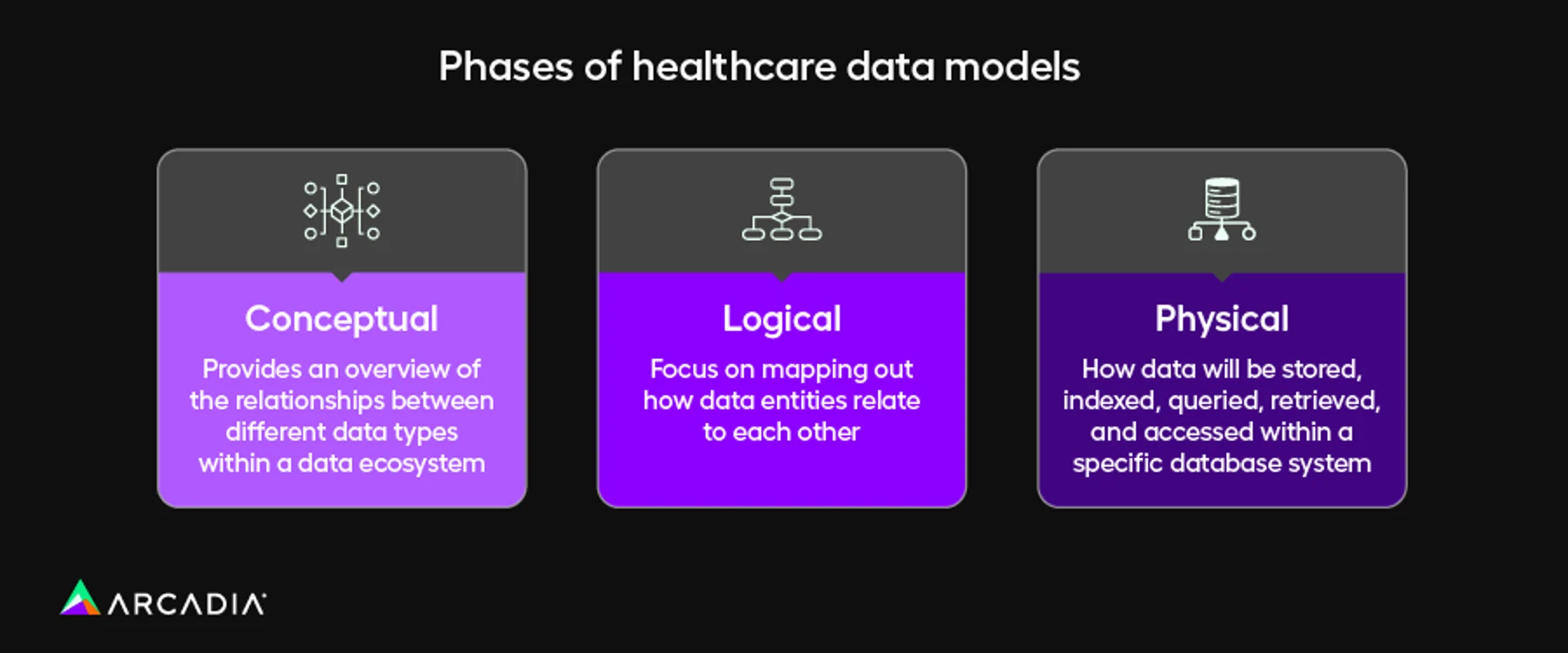
- Conceptual models provide a high-level view of the relationships between different data types within a healthcare technology ecosystem. They define master data categories such as patients, providers, encounters, claims, and facilities. These healthcare data models serve as overarching business blueprints that stakeholders can use to understand the organization’s information landscape without technical expertise.
- Logical models iterate on conceptual models by adding strict structure, attributes, and business rules. They focus on mapping out how data entities relate to each other and operate independently of the actual database software being used. For example, a logical healthcare data model might define that a “patient” entity must have a “date of birth” attribute.
- Physical models are the technical implementation of the logical model. They dictate how data will be physically stored, indexed, queried, retrieved, and accessed within a specific database system. A physical data model can also help organizations demonstrate compliance with data privacy laws.
Together, these three tiers form a critical bridge from abstract healthcare concepts to structured, queryable databases. A single healthcare data model encompassing all three phases empowers health organizations to move away from rigid, disconnected legacy software and build the flexible data architecture required for seamless interoperability and modern value-based care.
Centralized vs. decentralized healthcare data models
In addition to having three different phases, healthcare models can be either centralized or decentralized as follows.
Centralized healthcare data model
- What it is: A centralized data model consolidates all data architecture and analysis within a single platform or team.
- Benefits: Having a single team and a single solution responsible for your data modeling results in more consistent data governance, security, and practices, thereby improving data quality and compliance.
- Drawbacks: A centralized approach may be less effective for individual department needs, as staff may need to use a solution they’re unfamiliar with or ask the data team for assistance. These challenges can also create a bottleneck that slows down data-reliant workflows.
Decentralized data model
- What it is: A decentralized data model allows each department or business unit to manage and analyze its own data, sometimes with its own independent software.
- Benefits: Since each team is responsible for its own data, they can access and leverage the exact information they need whenever they need to. Data is also always formatted in a way that is most beneficial to the team that generates and uses it.
- Drawbacks: Decentralized data models can lead to data silos when teams don’t collaborate to bring the data together. Disparate information may then make it difficult for key stakeholders to get the full picture of how a healthcare organization is performing. It may also result in inconsistent data definitions, governance gaps, and duplicated technological efforts.
Centralized and decentralized healthcare models have their own benefits and drawbacks, making it difficult to recommend a specific approach that’s best for all healthcare organizations. However, if your goal is to fully understand your organization’s performance and how best to improve patient outcomes, a centralized healthcare data model will provide the framework you need.
Types of healthcare data architecture
Healthcare data models are stored in data architecture, which refers to the overarching infrastructure and data strategy for an entire healthcare organization. Data architecture encompasses the hardware, cloud platforms, data pipelines, and storage systems that an organization uses to aggregate, manage, and analyze its data.
Just as there are multiple different phases and types of healthcare data models, there are also different types of healthcare data architecture. The most common types include:
- Clinical data repositories (CDR) provide real-time storage for frontline clinical use. They are highly structured, transactional databases designed specifically to support electronic health record (EHR) systems, but they’re usually not built for heavy analytics.
- Enterprise data warehouses (EDW) are foundational reporting engines for payers and providers. They aggregate structured data from multiple different silos or sources, process that data, and organize it into a query-optimized format. This consolidation allows business executives to run complex reports on their data, but the trade-off is that this architecture can be expensive to maintain, slow to update, and poorly equipped to handle unstructured data.
- Data lakes are storage repositories designed to hold large amounts of raw, unstructured, or semi-structured data in its native format. They provide highly flexible, scalable, low-cost storage, but consistently analyzing and reporting unstructured data can be challenging.
- Data lakehouses offer the scalable, low-cost storage of a data lake paired with the strict governance, reliability, and fast querying capabilities of an EDW. This type of architecture allows health organizations to run reporting and AI algorithms on the same platform for maximum flexibility.
Today’s industry leaders are rapidly migrating to modern, scalable data lakehouse frameworks. By pairing a highly structured healthcare data model with a modern, agile architecture, health systems can eliminate historical data silos, fuel predictive AI, and deliver actionable, real-time insights directly to the point of care.
Examples of industry-standard frameworks for global interoperability
The healthcare industry has long recognized the importance of its data and has built global, industry-wide healthcare data models to promote data sharing and collaboration among different healthcare organizations, including payers, providers, life sciences organizations, and even the government.
The primary industry standard frameworks include:
- The Fast Healthcare Interoperability Resources (FHIR) model enables real-time data exchange between software systems without the need for clunky file transfers. Developed by Health Level Seven International (HL7), FHIR organizes and standardizes information and acts as the backbone of critical interoperability regulations.
- The National Patient-Centered Clinical Research Network (PCORnet) is a nationwide resource in the U.S. that accelerates clinical research and population health studies. This healthcare data model connects real-world data from routine clinical encounters and billing events, enabling healthcare systems, health plans, and patient-powered research networks across the country to collaborate.
- The Observational Medical Outcomes Partnership (OMOP) Common Data Model is designed to support large-scale observational research by mapping diverse, localized healthcare vocabularies into a standardized, internationally recognized vocabulary. Once data is translated into the OMOP framework, researchers can run queries to extract real-world evidence from millions of data points without accessing the underlying protected health information (PHI).
Each of these models exists to facilitate an improved flow of healthcare data, transforming fragmented or siloed data into a unified asset. This allows healthcare organizations nationwide (and even globally) to access key insights that they might otherwise have a difficult time gleaning.
Primary uses of healthcare data models
The primary uses of healthcare data models include:
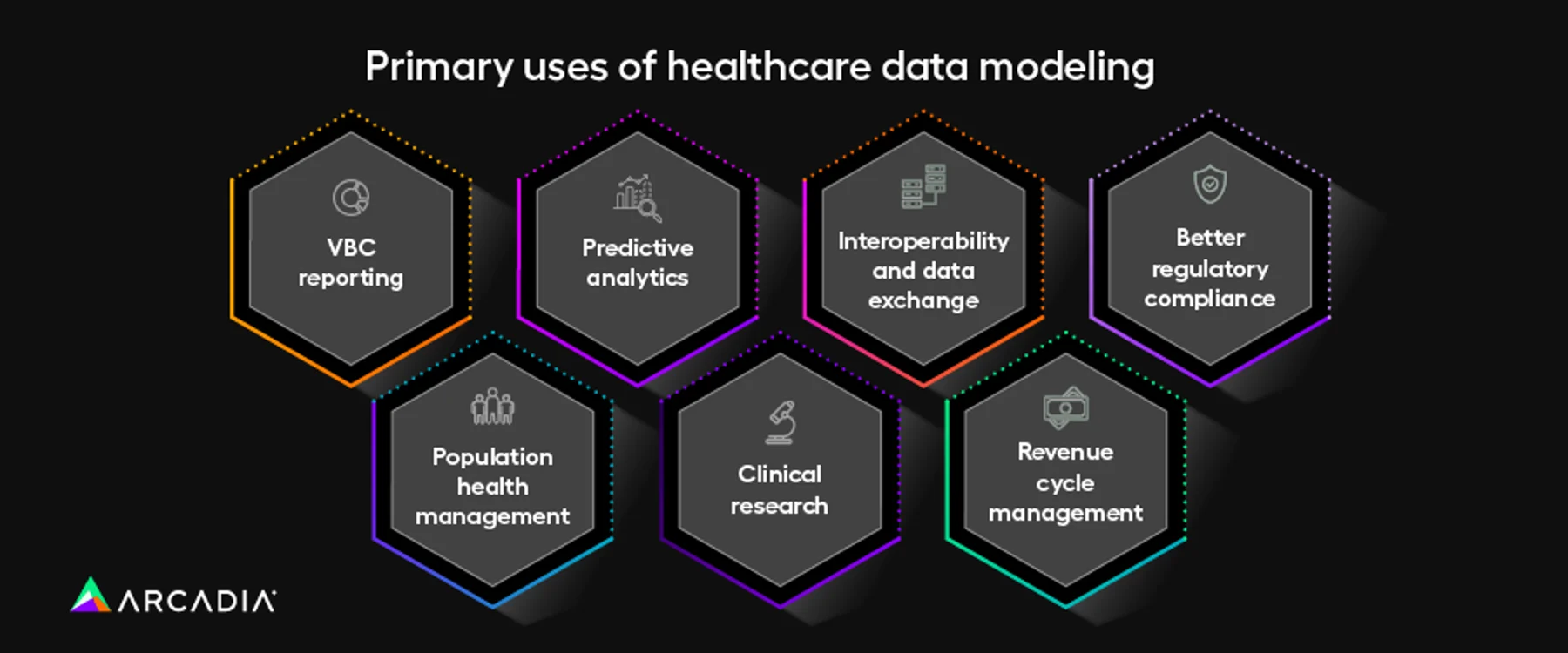
- VBC reporting: Transitioning away from fee-for-service (FFS) models requires payers and providers to share risk. Healthcare data models allow organizations to track the total cost of care, manage care gaps, and generate the exact reporting required for successful VBC contracts.
- Predictive analytics: Structuring historical data allows healthcare organizations to glean insights to improve future operations and even predict future trends. Organizations can feed structured data from models to AI and machine learning algorithms, helping predict patient no-shows, identify individuals at high risk for readmission, forecast disease progression, and gain various other insights.
- Interoperability and data exchange: With healthcare data models, organizations can unify all of their data for a complete picture of their performance and patient populations. They can also leverage industry-standard schemas so patient data flows seamlessly between disparate hospitals, labs, and insurance payers.
- Better regulatory compliance: Creating a strict, modeled data lineage makes it easy to automate data masking (to protect patient privacy) and generate transparent audit trails for regulatory compliance.
- Population health management: Healthcare and life sciences organizations can group and query massive datasets to track health trends and optimize patient care delivery across specific demographics or geographic regions.
- Clinical research: Research-focused healthcare and life sciences organizations can use standard healthcare research data models to normalize global patient data, accelerating clinical trials and pharmaceutical research.
- Revenue cycle management: Organizations can model financial data alongside clinical data to identify patterns in denied insurance claims, spot revenue leakage, and optimize billing operations, thereby improving revenue cycle management and patient outcomes.
Ultimately, proper healthcare data modeling enables organizations to unify their data and shift their patient care approach from reactive to proactive. With a comprehensive understanding of their data, teams can actively work to lower costs and improve patient outcomes.
Main challenges of healthcare data modeling
Despite the process’s many benefits and uses, data architects face many challenges in healthcare data modeling, including unstructured data, siloed data, inconsistent data quality, constantly changing targets, and strict regulatory burdens.
Let’s break down each of these unique hurdles:
- Unstructured data: Over 80% of healthcare data is unstructured, meaning it doesn’t have a predefined data model or framework. Therefore, a large amount of data needs to be organized and processed before it can be modeled.
- Siloed data: Most healthcare organizations use multiple disconnected and often proprietary software systems. This means that data from each of these systems is siloed, making compilation and aggregation expensive and time-consuming.
- Inconsistent data quality: Data entry often falls to busy frontline workers, who are prone to errors. This manual burden can result in inconsistent data quality or even inaccurate data. For example, if a nurse logs a patient’s height in feet but the database expects it in meters, your healthcare data model may break down, leading to inaccurate information.
- Constantly changing targets: ICD-10 code sets and classifications are updated constantly. This means that healthcare data models must be highly adaptable to avoid becoming obsolete.
- Strict regulatory burdens: Architects must build healthcare data models that securely process data while adhering to strict regulatory frameworks like HIPAA, TEFCA, and GDPR.
However, with the right architecture and software provider, healthcare organizations can mitigate many of these challenges. And that’s where Arcadia can assist.
Arcadia and healthcare data modeling
Arcadia is dedicated to helping healthcare organizations turn data into better patient outcomes by enabling clear, aligned action across performance priorities. The primary way it does this is through a comprehensive, lakehouse-style data platform that unifies data across the healthcare ecosystem, including clinical EHRs, claims, real-time ADT events, and population health insights. Arcadia’s platform unifies data, engines, and workflows into a core system, ensuring that analytics, care delivery, financial modeling, and AI tools all operate on a single source of truth.
In addition to its primary platform, Arcadia offers the following features for healthcare data modeling:
- AI capabilities: Arcadia’s agentic AI capabilities are integrated throughout its platform. In terms of data modeling, its AI tools enable care teams to make informed decisions on patient care based on patient data, deliver valuable insights for population health management and value-based care, monitor data pipelines and improve data quality, and even provide predictive analytics for future forecasting.
- Quality and risk models: Designed to ensure complete, accurate, and timely capture of quality and risk data, Arcadia empowers healthcare organizations to achieve revenue accuracy, regulatory compliance, and better patient outcomes. Its quality and risk capabilities deliver a unified data model for quality measurement, risk adjustment, and prospective documentation workflows.
- Care management connections: Connect patient data with Arcadia to gain new insights, support population prioritization, and improve follow-through. Care teams will have a clearer understanding of each patient’s clinical context based on the provided data, empowering them to deliver interventions when needed.
- Financial analytics and forecasting: Based on existing patient, financial, and contract data, Arcadia can provide contract modeling, forecasting, and financial optimization workflows for healthcare providers and payers. These features support contract negotiation and strategy, ensuring that providers and payers enter into contracts that work for them.
If you want a tool that can support and even simplify your healthcare data modeling, Arcadia has the capabilities you need.
Final thoughts on healthcare data modeling
With the rise of healthcare frameworks like value-based care and an increased emphasis on better patient outcomes, healthcare data modeling is becoming more and more important. No matter if you’re a healthcare provider or payer, data models will help you uncover the insights you need to improve your performance. By shifting from fragmented data silos to an integrated data model, organizations can stop chasing down the data they need and focus on improving patient outcomes.