12 min
 Whether you’re a healthcare provider considering adopting a value-based care (VBC) model at your organization or a payer that’s already offering this model, tracking VBC metrics is foundational to success—both in terms of improving patient outcomes and achieving financial sustainability. There’s a common saying in healthcare performance improvement: “You can’t manage what you don’t measure.”
Value-based care metrics are specific, quantifiable data points used to evaluate a healthcare organization’s performance in a VBC contract. In this guide, we’ll discuss how value-based care metrics improve patient health outcomes and help your organization succeed under a VBC model.
FAQs about value-based care metrics
What is value-based care?
Value-based care (VBC) is a healthcare model in which providers are paid based on patient health outcomes rather than the volume of services delivered. Unlike the fee-for-service (FFS) model, which implicitly incentivizes healthcare providers to order more tests and procedures to increase revenue, VBC scales rewards for hospitals and doctors for delivering high-quality care that improves patient outcomes while reducing overall costs.
How is performance measured in value-based care?
Performance in value-based care is measured using standardized, evidence-based benchmarks that track quality outcomes, patient safety, utilization, and cost. Payers and regulatory bodies—such as the Centers for Medicare & Medicaid Services (CMS)—evaluate performance using data extracted from electronic health records (EHRs), medical claims, and standardized patient surveys. Success is determined by hitting specific targets, so it’s essential to track value-based care metrics to ensure your organization achieves those benchmarks.
For an example of how this works, explore our guide to the CMS ACCESS Model, which is a value-based care program dedicated to improving outcomes for patients with chronic conditions.
Why is tracking value-based care metrics important?
Tracking value-based care metrics is critical because they directly dictate payment to providers and payers’ financial risk.
Without rigorous tracking, healthcare providers can’t demonstrate that they meet the benchmarks required to earn payments and shared savings bonuses in VBC models. Additionally, having this information gives organization executives the knowledge they need to reduce administrative waste, optimize resources, and negotiate better payer contracts.
For healthcare payers, a strong understanding of value-based care metrics provides insight into how they can manage financial risks and health trends among the populations they serve. This understanding protects their profit margins and regulatory standing, ensuring they correctly calculate payments and penalties for providers, accurately set premiums and predict risk, curate high-performing provider networks, and earn CMS Star rating bonuses.
What is the difference between HEDIS scores and value-based care metrics?
HEDIS (Healthcare Effectiveness Data and Information Set) is a specific, standardized set of performance metrics used primarily by health plans to compare care quality across the industry. Value-based care metrics are a broader category of data points. While a VBC contract may use specific HEDIS measures as targets, VBC metrics also include customized financial and operational goals specific to the healthcare provider or payer tracking them.
Main value-based care metrics to track
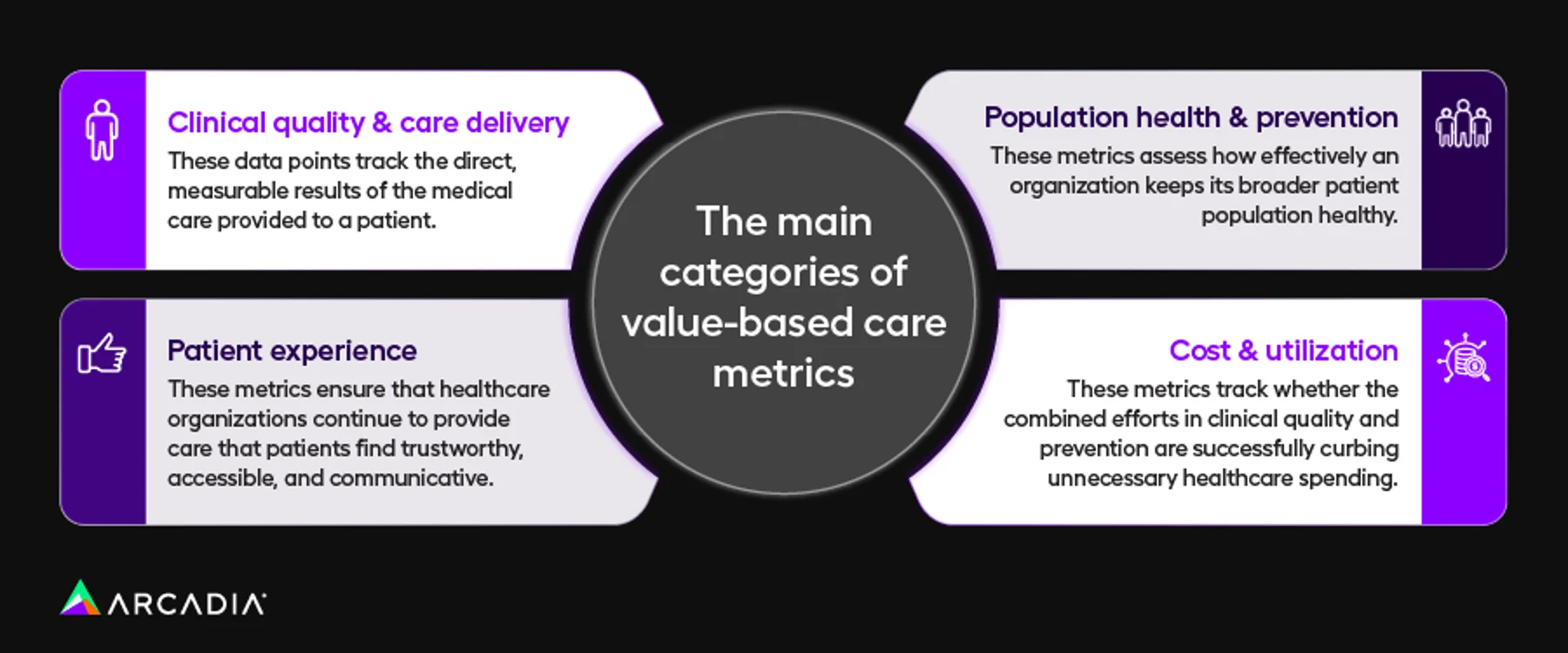
Value-based care metrics are the specific, quantifiable data points that healthcare providers and payers use to evaluate performance under a VBC contract. These metrics generally fall into four core categories:
Clinical quality and care delivery metrics
Clinical quality metrics form the foundation of value-based care. These data points track the direct, measurable results of the medical care provided to a patient and flag systemic failures in patient safety or care protocols.
Commonly tracked clinical quality and care delivery VBC metrics include:
- 30-day all-cause readmission rate: The percentage of patients who return to the provider’s facilities within a month of discharge, indicating potential issues with the initial treatment or discharge planning
- Healthcare-Associated Infections (HAIs): The rate of infections contracted while a patient is receiving care
- Chronic disease control: Clinical benchmarks demonstrating disease management, such as maintaining diabetic patients’ HbA1c levels
- Medication adherence: The percentage of patients who correctly fill and take their prescribed medications for chronic conditions
For providers, tracking clinical quality is about immediate patient safety and workflow optimization. High readmission rates or HAIs could indicate that their clinical protocols are failing, leading to severe penalties under a VBC contract.
For payers, these metrics represent major financial liabilities. A single preventable hospital readmission can generate tens of thousands of dollars in unexpected claims. Payers using VBC models track these quality metrics to determine whether a provider is actually resolving patient health issues or merely putting a temporary, expensive band-aid on them.
Population health and prevention metrics
While clinical metrics focus on patients who are already sick, population health metrics assess how effectively an organization keeps its broader patient population healthy. This domain prioritizes early intervention, routine screenings, and holistic care management.
Commonly tracked population health and prevention metrics include:
- Preventive screening rates: The percentage of eligible patients who receive age-appropriate routine tests, such as mammograms or colonoscopies
- Annual Wellness Visit (AWV) completion: The volume of eligible patients who complete their yearly comprehensive health assessment and wellness checkup
- Vaccination adherence: The rate at which the patient population receives the recommended immunizations, including seasonal flu shots
- Social Determinants of Health (SDoH) screening: The frequency with which care teams screen patients for non-medical barriers to health, such as housing instability or a lack of transportation
For providers, prioritizing preventive metrics shifts their care model from reactive to proactive. By catching a disease early, the provider can act to prevent complications down the line, ensuring better patient outcomes and earning shared savings bonuses for keeping the patient healthy.
For payers, performance is assessed using defined quality and experience measures, including HEDIS and CMS Star Ratings, which are built from standardized clinical, utilization, and patient experience metrics. High performance directly translates into higher revenue.
Patient experience metrics
High-quality care is not purely clinical—it’s also relational. Patient experience metrics ensure that healthcare organizations continue to provide care that patients find trustworthy, accessible, and communicative.
Commonly tracked patient experience metrics include:
- CAHPS scores: Survey responses to the Consumer Assessment of Healthcare Providers and Systems (CAHPS), which act as the industry standard for measuring overall patient satisfaction
- Timely access to care: The logistical ease of receiving care, measured by how quickly a patient can secure an appointment for routine or urgent needs
- In-clinic wait times: The average amount of time a patient spends waiting in the lobby and exam room before seeing a clinician
- Provider communication quality: Surveyed data tracking whether patients felt their care team listened to their concerns, spent adequate time with them, and explained treatments clearly
For providers, high patient experience scores build patient loyalty and directly impact clinical outcomes. Patients who trust their doctors and experience low friction when booking appointments are far more likely to adhere to care plans and attend follow-ups, resulting in better health outcomes.
For payers, patient experience heavily influences member retention. Health plans want to minimize the number of members who switch to a competitor’s insurance during open enrollment. Additionally, patient experience metrics are heavily weighted in the algorithms that determine a payer’s overall Medicare Advantage Star Ratings, which impacts the federal bonus payments the payer receives.
Cost and utilization metrics
Cost and utilization metrics are the ultimate financial scorecard for value-based care. They monitor the efficiency of care delivery and track whether the combined efforts in clinical quality and prevention are successfully curbing healthcare spending.
Commonly tracked cost and utilization metrics include:
- Total cost of care: The total financial amount spent on a patient’s care, calculated on a Per Member Per Month (PMPM) basis, measured against a predetermined budget
- Emergency department (ED) utilization: The number of ED visits per 1,000 members, which is a primary indicator of whether patients have adequate access to primary care
- Network keepage: The percentage of patients receiving specialty referrals, labs, and diagnostics within the payer’s approved provider network
- Average length of stay (ALOS): The average number of days an admitted patient spends in the hospital per episode of care
For providers, tracking utilization is necessary to control the financial variables of their VBC contracts. If a provider’s patients constantly use the ED for non-urgent issues or leak out to expensive out-of-network specialists, the provider will exceed their financial benchmark and may even lose their bonus or owe a penalty to the payer.
For payers, these metrics help them evaluate their core financial model. By tracking utilization, payers can accurately predict financial risk, set appropriate insurance premiums, and continuously optimize their networks by cutting ties with persistently high-cost, low-value facilities.
Top software solutions for tracking value-based care metrics
Tracking value-based care metrics is significantly easier with the right tools. Here are a few types of software that can play a useful role in tracking VBC metrics:
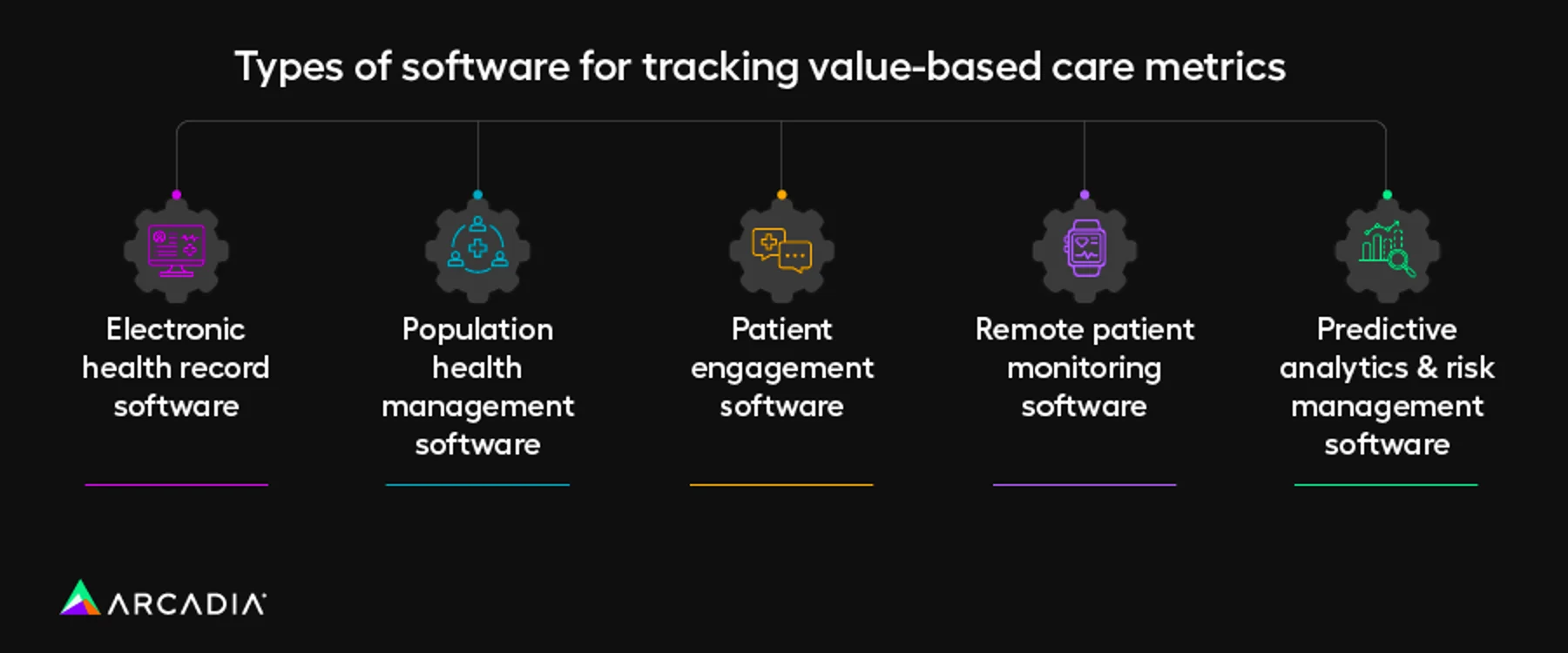
- EHR software: EHR platforms enable you to store information about each individual patient in patient records, plus they help track and analyze patient care data as part of your evaluation of provider care strategies.
- Population health management (PHM) software: PHM software aggregates data from multiple disconnected sources, including EHRs, payer claims, and SDoH data, to provide a holistic overview of your patient population. This software helps healthcare providers and payers stratify patient risk, identify open care gaps across the population, and ensure you hit population-wide benchmarks.
- Patient engagement software: Dedicated patient engagement tools collect data that reveal how patients feel about their interactions with providers, giving you insights into how to elevate the patient experience.
- Remote patient monitoring (RPM) software: RPM tools collect continuous, real-time physiological data—such as blood pressure or heart rate—from patients at home, giving providers deeper insight into how to care for them. These tools help providers accurately monitor chronic disease metrics, intervene early if complications arise, and prevent avoidable ED visits or hospital readmissions.
- Predictive analytics and risk management software: These platforms leverage historical claims data and artificial intelligence (AI) to forecast future health events and utilization rates. By identifying exactly which patients are most likely to develop severe complications or require high-cost interventions, organizations can proactively allocate care coordination resources to manage risk and control the total cost of care.
What makes tracking value-based care metrics more challenging is that the platforms listed above are typically discrete solutions that may not integrate with one another. This separation makes it difficult for healthcare providers and payers to get a complete picture of their VBC metrics, and by extension, how they are performing within the VBC model.
Ideally, providers and payers should look for a data analytics platform that unifies the information from all these tools in a single platform, allowing you to track value-based care metrics in a single location, in real time. And that’s where Arcadia comes in.
How Arcadia can help with value-based care metrics
Arcadia is a leading cloud-based healthcare data platform, purpose-built for analytics. Its team understands that inaccurate, outdated, or incomplete data can lead to serious consequences in the healthcare industry, which is why its software unifies disparate data sources for real-time, accurate tracking of value-based care metrics.
Arcadia’s capabilities include:
- Data unification: Arcadia’s core platform unifies healthcare data, engines, and workflows into a single source of truth. It delivers the analytics, workflows, and AI assistance needed to operate across value-based and performance-driven care models.
- Data analytics: Scale secure data access, automate delivery of trusted insights, and activate key intelligence insights across your organization. Arcadia combines lakehouse-style data architecture with AI-powered analytics to support everything from raw data ingestion to predictive modeling and delivery of workflow-ready insights.
- Quality and risk assessment: Access a model designed to empower organizations like yours to capture accurate, timely quality and risk data. With Arcadia, you can achieve revenue accuracy, regulatory compliance, and better member outcomes.
- Care management: Connect patient insights, population prioritization, and coordinated follow-throughs into one seamless experience. Arcadia gives your care teams a clear understanding of each patient’s clinical context and highlights who needs attention and why, enabling more targeted interventions that boost patient outcomes and your value-based care metrics.
- Finance and contracting: Arcadia provides contract modeling, forecasting, and financial optimization workflows for both healthcare providers and payers. It’s designed to support pre-contract modeling, negotiation, forecasting, and post-signature optimization, helping healthcare organizations determine whether value-based care models are right for them.
- Network optimization: Arcadia enables payers and providers to design, evaluate, and optimize their networks. It combines network modeling, market intelligence, referral analytics, and episode-based performance insights to support network optimization and contracting strategy.
With Arcadia, tracking value-based care metrics is just the beginning. Its tools go a step further by making it easy to pull key insights from your data and then act upon them. Whether your organization provides care or pays for it, Arcadia’s tools will empower you to thrive with value-based care.
Arcadia’s data-backed platform simplifies VBC care.
Access a value-based care software solution that offers comprehensive data management, key insights, predictive analytics, workflow automation, and more.
Final thoughts on value-based care metrics
Without tracking value-based care metrics, it’s impossible for healthcare providers to understand how they’re doing within the VBC framework and for healthcare payers to determine how the model impacts their member populations. If you’re considering adopting VBC or want to optimize your performance within its framework, start by ensuring you have the necessary software infrastructure to support tracking VBC metrics, along with other data aggregation and analysis needs for data-driven value-based care.