12 min
According to the CDC, approximately three in four Americans have at least one chronic health condition. Efforts to manage chronic conditions require timely interventions, lifestyle changes, continuous symptom monitoring, and other sophisticated care plans to manage patient outcomes. Given this complexity, chronic care management software is a crucial tool for delivering high-quality care to patients with long-term conditions, while simultaneously controlling costs.
This article explores everything you need to know about chronic care management software, including:
- Frequently asked questions about chronic care management software
- Top 9 chronic care management software providers
- How to choose the right chronic care management solution
Frequently asked questions about chronic care management software
Here is a quick rundown of things you should know about chronic care management software:
- Chronic care management is the process of monitoring patients’ chronic conditions and implementing better interventions to improve outcomes.
- Chronic care management software is a type of technology that helps healthcare providers manage patients with chronic conditions, improving their quality of life and health outcomes.
- This software helps patients experience better outcomes, providers improve performance, and payers control costs.
- Key features of chronic care management software include data analytics, care coordination, and patient engagement.
- Healthcare organizations can choose software-only CCM platforms for in-house teams or tech-enabled services that include outsourced care coordinators.
- While EHRs capture basic visit notes, dedicated CCM software provides the specialized features needed for continuous, longitudinal care.
What is chronic care management?
Chronic care management is the process of monitoring patients’ chronic conditions and optimizing interventions, such as lifestyle coaching and medication adherence, to improve overall outcomes. Chronic care management programs are the structured approaches providers take to deliver this type of care. They include patient monitoring, education, and ongoing support to help individuals manage their conditions and avoid adverse health events.
What is chronic care management software?
Chronic care management software is a technology that helps healthcare providers manage patients with chronic conditions to improve their quality of life and outcomes.
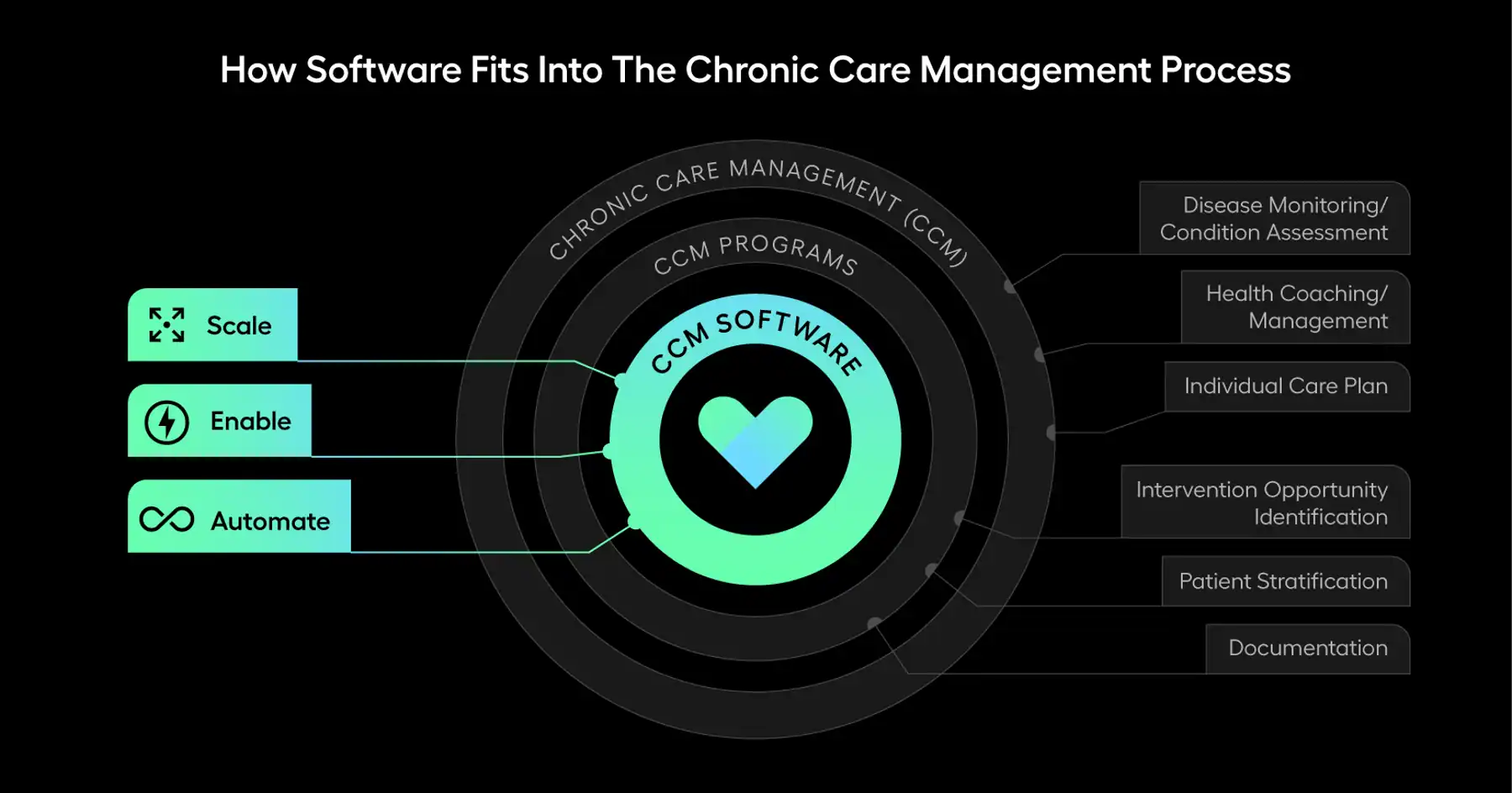
Digital health technologies, such as electronic health records (EHRs) and wearable devices, are growing rapidly in popularity, and it’s clear that these tools can support chronic disease management when the data they capture is harnessed and evaluated effectively. Dedicated software supports patient self-care and addresses barriers for providers, including inadequate infrastructure for health information exchange and limited EHR capabilities for documenting and updating care plans.
How does chronic care management software benefit healthcare systems?
Chronic care management software benefits all involved parties, including:
- Patients: When providers implement chronic care management software, patients experience more personalized treatment plans, fewer avoidable medical encounters, and better overall outcomes. They also take a more active role in their care and gain a greater understanding of their conditions.
- Providers: Chronic care management solutions equip providers with centralized access to patient data, streamlined communication, enhanced care coordination, and other benefits that support informed decision-making.
- Payers: Early interventions, increased member satisfaction, and improved outcomes, driven by powerful software, yield lower costs. Additionally, care management tools provide aggregated care data to help payers gain better population health insights.
What key features does chronic care management software offer?
Chronic care management software offers the following features:
- Data analytics: Effective solutions evaluate signals from various sources to help providers identify patients with high care management needs and update their treatment plans accordingly.
- Care coordination: Health teams can collaborate by using care management tools to push notes back to the patient’s EHR, orchestrate handoffs and interventions, and improve the effectiveness of their operations.
- Patient engagement: Providers equip patients to take an active role in their chronic care management using engagement tools in their software that facilitate ongoing patient-provider interactions.
What is the difference between chronic care management software and a tech-enabled CCM service?
Chronic care management (CCM) software is a technology-only SaaS platform built for clinical teams. Care teams use this software to document care plans, track interactions, and manage patient outreach to improve outcomes for chronic care patients.
A tech-enabled CCM service bundles that software infrastructure with outsourced clinical staffing. Instead of relying on your internal staff, the vendor provides their own licensed nurses or care coordinators who handle patient calls, log clinical minutes, and update care plans on behalf of your practice.
Can an EHR system handle CCM, or do we need dedicated chronic care management software?
No. EHRs store information in static chart notes, making it difficult for providers to track longitudinal health goals, coordinate with outside specialists, or maintain visibility into a patient’s status once they leave a facility.
Dedicated chronic care management software integrates with your EHR to turn passive chart data into active care coordination workflows. It automates patient outreach queues, tracks progress on care plans, surfaces risk alerts, and consolidates multi-source patient data, allowing care teams to proactively manage chronic conditions across entire populations.
Top 9 chronic care management software providers
There are numerous solutions on the market that can support chronic care management processes, including:
| Provider | Main audiences | Standout feature | Core CCM functions |
|---|---|---|---|
| Arcadia | Healthcare providers, payers, accountable care organizations (ACOs), clinically integrated networks (CINs), life sciences organizations, government organizations | Unifying clinical and claims data and delivering AI-powered chart summaries at the point of care | AI-powered patient stratification, 360-degree patient views, care team collaboration, patient prioritization, streamlined administrative workflows |
| Vim | Payers, providers, health tech innovators | Surfacing clinical insights directly inside native EHR charting workflows | Automated diagnosis capture, in-workflow referral routing, point-of-care clinical data exchange, auto-enrolling for care programs |
| J2 Interactive | Health systems, health information exchanges (HIEs), healthcare payers | IT consulting and custom software development for healthcare interoperability projects | Custom integrations, healthcare interoperability, HIE connectivity, healthcare analytics, managed IT services |
| HealthHelper | Primary care practices, independent ACOs, regional health systems | Tech-enabled care coordination that combines automated outreach with patient scheduling | Automated call assistance, scheduling optimization, care gap closure, emergency department utilization and hospitalization tracking, referral monitoring |
| Socially Determined | Health plans, health systems, hospitals, life sciences companies, nonprofits, foundations | Translating social determinants of health (SDoH) to identify vulnerable patient populations | Social risk visualization, SDoH data integration, health equity modeling, socio-clinical intervention design |
| N1 Health | Health plans, risk-bearing provider organizations, commercial insurers | Leveraging clinical and patient datasets and analytics to personalize patient outreach for more effective medical interventions | Predictive member engagement, risk modeling, medication adherence tracking, outreach effectiveness monitoring |
| Atropos Health | Health systems, life sciences companies, clinical research institutions | Generating rapid real-world evidence (RWE) to guide clinical decisions for complex chronic conditions | Real-world evidence generation, care protocol design, clinical decision support, treatment decision benchmarking |
| athenahealth | Medical groups, enterprises and health systems, startup practices, CHCs and FQHCs, urgent care centers | Native EHR care management suite built into daily practice management and patient portal workflows | Care plan documentation, patient portal engagement, chronic care billing, inter-practice care coordination |
| Medisolv | Hospitals, ambulatory clinics, ACOs, health systems | Clinical quality performance tracking and reporting | Electronic clinical quality measure (eCQM) tracking, quality reporting, clinician performance tracking |
1. Arcadia: Leading chronic care management software provider
Data aggregation and analytics are critical for taking informed steps in patients’ care journeys, especially when it comes to chronic care management. That’s why Arcadia is built to lead these long-term journeys, unifying clinical and claims data into AI-assisted workflows that have already helped one Northeast ACO cut ED visits by 41.5% among COPD patients.
Arcadia Ascent™ Care empowers healthcare organizations to create robust, configurable chronic care management programs through a series of automated workflow tools. These tools give providers a clear understanding of each patient’s clinical context, highlight who needs attention and why, and assist with executing and tracking structured interventions. This way, providers can identify risk factors and address health concerns early, allocate resources efficiently by estimating costs and potential savings, and measure impact to refine processes over time.
Arcadia’s platform offers the following essential features:
- Analytics dashboards: Uncover comprehensive, actionable insights to empower data-driven decisions through self-service dashboards.
- Patient engagement tools: Address care gaps and automate outreach for targeted communications and scaled care management programs.
- AI-assisted workflows: Leverage agentic AI features embedded directly within Arcadia’s platform to enable better chronic care management, including chart summarization features, AI-enabled patient segmentation, condition suspecting from patient records, automated patient outreach and scheduling, proactive quality and care-gap closure, and chronic care workflow automation.
- Social determinants of health (SDoH) data: Identify the populations most in need of care through a unified registry of patient-level insights.
- Patient stratification capabilities: Build a comprehensive list of patients with care gaps or access a holistic view of your population so you can reach out as needed.
These tools yield impressive results for organizations that partner with Arcadia, with one organization serving three times as many patients with the same care management team.
2. Vim: Powers integrations
Vim is a middleware platform and clinical workflow integration technology that incorporates essential data, insights, and applications into existing EHR workflows. Payers, providers, ACOs, and other teams across the care continuum can use this tool to:
- Streamline referrals
- Optimize risk adjustment
- Automate chart retrieval
- Expand patient insights
Vim’s integration capabilities fold care opportunities into clinical workflows, allowing providers to implement timely and data-driven chronic care interventions.
3. J2 Interactive: Drives interoperability
While J2 Interactive isn’t a traditional care management tool, this software development and IT consulting firm specializes in customized solutions for teams across the care continuum. Through their services, this team guides health organizations through complex data and interoperability projects such as:
- Extracting data from EHRs
- Integrating and implementing technology platforms
- Data enrichment and management that supports improved data connectivity, completeness, and accuracy
4. HealthHelper: Closes care gaps
Panel management involves proactively addressing your patient population’s health needs, including implementing targeted interventions and improving patient outcomes. Primary care providers need effective panel management to drive proactive patient care, which ultimately supports chronic care management.
HealthHelper’s platform leverages robust data to automate, streamline, and scale panel management workflows. Their technology-enabled service provides:
- Panel analytics
- Attribution cleanup
- Care campaigns
- Patient scheduling
- Care gap closure
- Detailed reporting
By optimizing panel management, HealthHelper ensures that patients facing chronic conditions receive timely follow-up, preventive care, and personalized outreach.
5. Socially Determined: Surfaces SDoH insights
Socially Determined’s platform delivers social risk data and analytics to help healthcare organizations understand the impact of social determinants of health (SDoH) and social risk factors on the populations they serve. Powered by a robust data supply chain, this solution delivers insights that provide complete visibility into a patient or health plan member’s social risk level.
With this platform, organizations can drive strategic programs that deliver measurable improvement in health outcomes at scale.
6. N1 Health: Delivers predictive insights
N1 Health is an AI-driven platform that generates meaningful predictions concerning patient outreach and interventions. From identifying the right audience to informing data-driven interventions, this platform enables better health outcomes, especially for those with chronic conditions.
The ability to anticipate patients’ needs and intervene early is critical for effective chronic care management. A proactive approach improves medication adherence, reduces hospitalizations, and fosters consistent engagement for better outcomes, which N1 Health delivers via predictive analytics.
7. Atropos Health: Provides real-world evidence
Atropos Health’s focus on high-quality evidence is essential for managing complex, long-term conditions. This platform uses real-world data (RWD) to enhance evidence-based decision-making, which has been shown to elevate clinical outcomes, accelerate research, and drive operational efficiency.
These capabilities enable healthcare organizations to:
- Accelerate time to treatment
- Inform rapid drug discovery
- Reduce the cost of care
- Expedite research from months to minutes
- Address car variation
- Augment staff and efficiency
With personalized evidence for every clinical decision and research inquiry, Atropos Health supports informed decisions about chronic disease treatment paths.
8. Athenahealth: Offers general healthcare management tools
Athenahealth offers care management tools to help healthcare organizations coordinate care and engage patients. While they primarily serve providers, the tool also allows providers and payers to exchange information for simplified administrative tasks.
While Athenahealth’s offerings are centered around more generic functionalities, the platform still supports the foundational elements for effectively managing chronic conditions, such as patient tracking and timely updates.
9. Medisolv: Supports care quality and monitoring
Medisolv offers health information technology to help improve the quality of patient care and provider performance. Their CEHRT-certified platform, ENCOR, helps health organizations monitor and manage their quality performance. The platform supports a wide range of quality reporting programs, including the Quality Payment Program.
While not a dedicated chronic care management company, this provider’s tools still include helpful capabilities for addressing long-term conditions.
How to choose the right chronic care management solution
To choose the right solution, healthcare organizations must first evaluate their needs in regard to managing patients with chronic conditions. Then, they’ll be prepared to:
- Identify must-have software features, such as analytics dashboards or risk assessment capabilities
- Flag deal breakers, like an interface that makes it difficult to visualize long-term patient data
- Review case studies to determine the provider’s success with similar organizations
- Consider ease of use and scalability, selecting a tool that the health team can work with comfortably
Once you’ve selected your top contenders, request a demonstration of each solution to experience its features firsthand. This demonstration will also allow you to interact with the provider and gauge the level of support you can expect to receive from their team.
Final thoughts on chronic care management software
The right solution can make the difference between successful chronic condition management and a lacking program. As an award-winning platform for its robust analytics capabilities, Arcadia is the number one solution for improving patient care for those with chronic conditions. Will your healthcare organization be the next to benefit from it?