17 min
In today’s healthcare landscape, leaders are increasingly accountable for improving health outcomes while effectively managing costs. To address these complexities, population health management (PHM) has emerged as a proactive approach for managing the health outcomes of a defined population.
By coordinating care across defined patient and health plan member cohorts, PHM makes it easier to identify clinical gaps, flag rising risk, and address non-clinical barriers before acute medical events develop.
In this article, we’ll explore the goals of PHM and its impact on patient outcomes, quality of care, financial performance, and the healthcare industry.
Population health management FAQs
Population health management is a data-driven approach that aggregates and analyzes patient and member data across healthcare settings to improve clinical outcomes, reduce avoidable utilization, and manage the total cost of care (TCOC) for a defined population.
Rather than waiting for acute events to prompt emergency department (ED) visits or inpatient stays, PHM uncovers clinical gaps, emerging chronic conditions, and social barriers early. This strategy supports a few groups of key stakeholders:
Patients: Without PHM, healthcare is typically reactive — i.e., patients navigate illness alone until a symptom becomes an emergency. PHM enables patients to receive proactive, coordinated care between office visits, helping them stabilize chronic conditions and avoid preventable hospitalizations.
Providers: Population health management surfaces insights into panel-level care gaps and risk tiers directly within clinical workflows. This deeper understanding results in better patient outcomes and improved performance in value-based contracts.
Payers: Through PHM, payers can proactively evaluate patterns in disease progression, medical expenses, and prescription abandonment, then deploy targeted programs to curb preventable emergency utilization or medication gaps. These actions support medical loss ratio management and improve HEDIS scores and Star Ratings.
Ultimately, population health management establishes a unified data foundation that tracks key metrics for healthcare providers and payers, enabling them to proactively close population-level care gaps and thereby boost patient outcomes.
While both PHM and public health strive to improve human well-being, they operate at different scales and with different operational structures. Public health focuses on broad geographic populations — such as an entire municipality, state, or nation — and doesn’t account for insurance coverage or provider affiliation. It relies on epidemiological surveillance, disease-tracking registries, and vital statistics to organize mass vaccination campaigns, combat infectious outbreaks, and design broad civic health policies.
By contrast, population health management concentrates on defined, attributed cohorts of patients and health plan members. It integrates longitudinal electronic health records (EHRs), claims data, and social determinants of health (SDoH) to manage clinical outcomes and financial sustainability across payment models, including traditional fee-for-service and shared-risk contracts. Success hinges on specific clinical quality metrics, patient engagement scores, and total cost of care (TCOC) benchmarks rather than population-wide policy shifts.
Consider a group of 1,200 attributed patients who live with uncontrolled type 2 diabetes. Rather than treating these individuals only when an exacerbation occurs, providers and health plan administrators work together to provide proactive care. Clinic teams review their patient lists to assign nurse care managers for insulin support, while clinic software reminds doctors to schedule overdue foot and eye exams during routine visits.
At the same time, the health plan conducts routine checks of pharmacy claims to identify members who stop picking up their insulin or blood pressure pills. The plan sends automated refill reminders and offers mail-order options before missed medication turns into a crisis.
In population health management, all of these stakeholders work together to improve outcomes for specific patient populations.
In value-based care (VBC) models, health plans and the government pay healthcare providers for keeping people well, not just for ordering more tests and visits. Population health management drives financial return by preventing costly medical problems before they start. When clinics and health plans encourage patients to take their medications and manage ongoing illnesses at home, patients visit the emergency room less often and avoid inpatient hospital stays.
Government programs reward this teamwork with financial incentives. In the Medicare Shared Savings Program (MSSP), provider organizations can earn a share of the savings when they meet quality performance standards while spending below their benchmark. Programs like ACO REACH adjust financial benchmarks upward for ACOs that serve higher shares of underserved beneficiaries, identified by dual Medicare/Medicaid eligibility and neighborhood deprivation data.
For health plans and clinics managing Medicare Advantage contracts, catching illnesses early and accurately recording patient health needs help keep overall spending predictable while protecting operating margins.For health plans and clinics managing Medicare Advantage contracts, catching illnesses early and accurately documenting patient health needs help ensure risk-adjusted payments reflect the true clinical complexity of the population, protecting operating margins under capitated, risk-based contracts.
The Quintuple Aim framework for population health management
Healthcare leaders commonly rely on the Quintuple Aim framework as a compass to guide modern medicine. The concept began as the “Triple Aim,” but has since been expanded to cover five pillars. However, without a clear operating model, healthcare organizations often struggle to balance these five goals.
Population health management is one of the primary strategies for implementing this framework, providing the tools, real-time data, and team-based workflows that tie all five pillars together. Let’s take a look at each aim and how it ties into PHM.
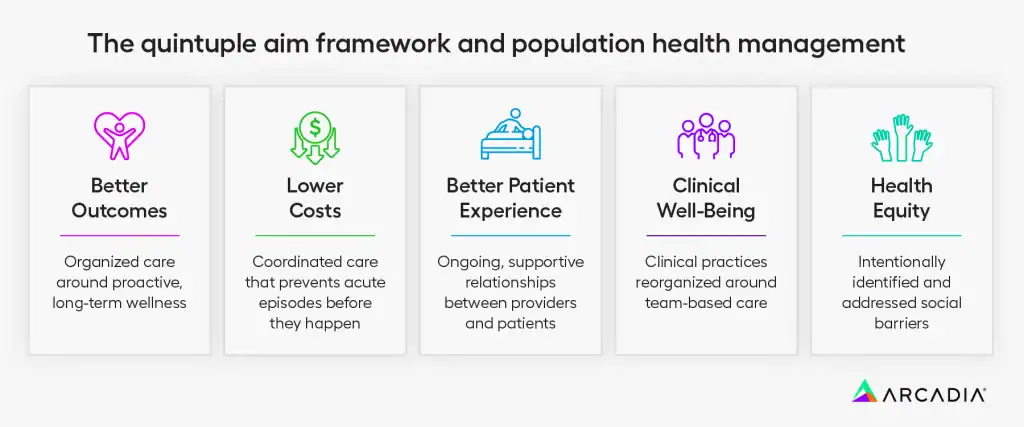
1. Better outcomes
The central purpose of modern healthcare is to help people live longer, healthier lives. However, traditional healthcare processes wait for people to get sick before offering treatment.
Population health management takes a different approach by organizing care around proactive, long-term wellness. Instead of waiting for acute symptoms to appear, care teams work to actively track chronic conditions, coordinate overdue screenings, and identify early warning signs across entire patient groups. By focusing on preventive care, clinical teams help entire groups of patients stay healthier over time.
2. Lower costs
Unplanned hospital stays and emergency room visits generate the highest costs in healthcare. Population health management tackles these expenses by preventing acute episodes before they happen. By coordinating care after hospital discharges, providing strategies for managing chronic illnesses at home, and catching clinical issues early, care teams help patients avoid repeat emergency room visits. This proactive approach reduces overall healthcare spending while protecting patient outcomes.
3. Better patient experience
Patients often become frustrated when healthcare feels rushed, impersonal, and disconnected. Population health management changes this dynamic by building ongoing, supportive relationships between patients and their care teams.
For instance, provider organizations may implement patient portals or other digital systems that enable two-way messaging and provide access to pamphlets on medication or chronic care management, so patients can easily contact their care team and stay informed about managing their health at home. Additionally, care navigators may check in between office visits, answer questions, and help individuals overcome confusing treatment plans. As a result, patients feel heard, valued, and empowered to take an active role in their health.
4. Clinician well-being
Expecting individual physicians to handle every patient task alone leads to exhaustion and burnout. Population health management reorganizes clinical practices around team-based care. Doctors share daily responsibilities with nurse care managers, medical assistants, and pharmacists who handle routine screenings, check-ins, and medication reviews. Sharing these duties gives physicians more time to focus on complex clinical decisions and directly care for their patients, boosting patient outcomes while reducing clinician burnout.
5. Health equity
Certain non-clinical factors make access to care less equitable for different populations. For example, medical care alone cannot produce good patient outcomes if the patient lacks nutritious food, safe housing, or transportation to a nearby doctor’s office.
As a strategy, population health management intentionally identifies and addresses these social barriers. In particular, having insights into social determinants of health (SDoH) enables payers to direct resources toward vulnerable neighborhoods and partner with local community groups. This focus ensures every individual has a fair opportunity to achieve their highest level of health.
The population health management cycle
Typically, successful population health management programs run as a continuous, five-step cycle. Here is an overview of each stage in the PHM cycle:
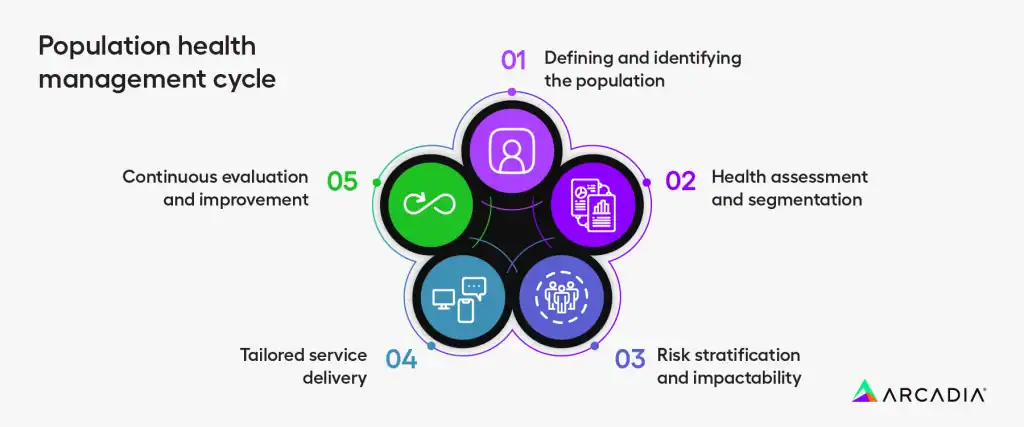
1. Defining and identifying the population
Population health work begins with attribution. Organizations need to set clear rules for determining which patients belong to specific clinic teams and payment contracts, depending on the scope and goals of the PHM process. A patient population might look like one of the following:
- Residents within a geographic community
- Patients enrolled with a specific health insurer
- Patients tied to a specific healthcare system
- Patients with shared health conditions
- Employees enrolled in a specific company’s employer health plan
- Patients served by community health clinics
Steady attribution creates a dependable foundation that care teams and health plans use to track results, close care gaps, and build mutual trust. This operational clarity prevents patients from slipping through the cracks between office visits, protects clinic resources, and positions organizations for lasting success across both fee-for-service and risk-bearing contracts.
2. Health assessment and segmentation
After naming the assigned group, organizations will then build a complete health history for each person. This process combines chart notes, insurance claims, pharmacy feeds, and social screening surveys. The goal of this lifecycle stage is to gather the information required to understand differences within a population and the needs that must be addressed to make the greatest positive impact on the population’s health.
With this data in hand, organizations group patients into smaller categories based on illness type, medical severity, and social risks. Rather than treating thousands of patients as a homogeneous unit, segmentation helps healthcare organizations better understand their populations and group them according to the support they need.
3. Risk stratification and impactability
Not every patient in a group faces the same risk of sudden illness or will respond the same way to the same type of help. At this stage of the population health management cycle, healthcare organizations use computer models to group people by risk level, then apply impactability rules to identify patients whose health trajectories staff can most effectively improve.
Risk stratification
Within an average population, patient health risks and costs fall into three general tiers, based on their likelihood of experiencing negative health outcomes and higher rates of unnecessary or preventable health care utilization:
- High-risk: These individuals manage several severe conditions, have high utilization, and often face social problems impacting their health outcomes. They are much more likely than the average individual to visit the ED.
- Rising-risk: These individuals show early signs of one or two major chronic diseases, such as diabetes or high blood pressure. This group offers the greatest opportunity to prevent further disease progression and avoid high costs before conditions worsen.
- Low-risk: These individuals are mostly healthy or manage their illnesses well. However, they should still be encouraged to undertake preventive health measures, such as primary care checkups, routine screenings, and regular vaccinations.
Grouping patients into these tiers gives healthcare organizations a clear baseline view of their population. Clinical leaders use these categories to forecast clinical staffing, budget preventive resources, and assign general care coordination duties across their panels.
Patient impactability
The bulk of healthcare expenses is typically concentrated among a small proportion of people, with 5% of the United States population accounting for nearly half of total healthcare expenditures. It’s reasonable that many healthcare organizations would want to focus on these individuals to manage costs and make the greatest difference in patient outcomes. However, evaluating risk only tells half the story, because high spending does not always mean a care team can change a patient’s outcome.
Patient impactability measures how much a clinical team’s outreach can realistically alter a person’s health path. Highly impactable patients face manageable health challenges that respond directly to care. They might have characteristics such as:
- Actionable chronic conditions: Patients living with unmanaged illnesses such as type 2 diabetes or high blood pressure see rapid improvements when care teams step in to adjust medications, provide dietary education, and coordinate routine primary care visits.
- Solvable non-clinical barriers: Individuals who skip medication refills because they cannot afford copays or lack rides to the pharmacy gain immediate stability when a clinic pairs them with a pharmacist or social worker who can address their needs, such as finding low-cost prescriptions and mail-order delivery.
- Receptive and motivated attitude: Individuals who actively welcome support from a nurse care manager quickly learn to monitor their vital signs at home and seek help before mild symptoms become acute emergencies.
In contrast, non-impactable patients are those for whom proactive care outreach would not likely alter spending or health outcomes or would have difficulty improving them. Non-impactable scenarios may include:
- One-time acute events: Patients recovering from situations like broken bones generate temporary high expenses, but their costs naturally fall once their bodies heal. Proactive nurse outreach creates little long-term benefit for these patients. Objectively, this impactability can be assessed in part by examining the degree of variation in costs associated with an episode of illness — episodes with low variation are likely to have minimal impactable cost.
- Fixed, specialized treatments: Individuals who need ongoing chemotherapy or organ transplant care require unavoidable specialized medical services that general primary care check-ins cannot prevent. However, variation in complications can be identified, and while the base treatment may be a fixed cost, the mitigation of complications may represent an opportunity.
- Stable patients with historical risk: Patients who suffered a health event such as a heart attack years ago often carry high risk scores based on old insurance claims. If they currently manage their health well and take all their prescribed medications, additional care management outreach yields little gain.
- Patient engagement preferences: Some individuals actively decline care management programs, refuse phone check-ins, or prefer to handle health challenges without clinic intervention.
When healthcare organizations prioritize outreach based on risk and impactability, they can make the greatest difference in patient outcomes and healthcare costs.
4. Tailored service delivery
Once care teams understand who needs help, they can match the right level of support to each individual. For broadly healthy groups, clinics tend to succeed by using digital health tools, text reminders, and automated outreach to encourage routine screenings and annual wellness checkups.
For individuals managing active chronic illnesses or complex social needs, healthcare organizations operating with population health management in mind are more likely to step in with direct, human support. By matching the right service channel to each person’s daily reality, care teams can close care gaps, protect clinical staff from burnout, and help patients stay healthy outside clinic walls.
5. Continuous evaluation and improvement
The final step in the PHM cycle measures results against quality, hospital utilization, and financial benchmarks. Regular reviews show leaders which care plans improve health and which ones need adjustments. In particular, PHM-focused healthcare organizations might focus on tracking the following metrics:
| Metric | What it measures | How it relates to PHM |
|---|---|---|
| Clinical quality measures | Percentage of attributed patients meeting specific health targets (like blood pressure control or blood sugar levels) | Reveals open care gaps across patient populations |
| ED utilization | Number of unplanned emergency visits per 1,000 attributed members | Reveals when outpatient care fails to prevent health events |
| 30-day hospital readmission rates | Percentage of discharged patients returning to a hospital within a month | Reveals whether care transitions and post-discharge outreach are successful |
| TCOC | Average healthcare dollars spent per member across all medical services | Comparing against spending benchmarks helps organizations evaluate whether preventive care lowers total costs |
| Medication adherence | Proportion of days a patient has their prescribed maintenance drugs on hand (Proportion of Days Covered, or PDC) | Reveals members who stop taking vital medications and who may suffer complications because of non-adherence |
| Annual wellness visit completion | Proportion of eligible patients completing comprehensive annual checkups | Reveals how successfully healthcare organizations have been in encouraging patients to receive preventive care |
| Patient engagement rates | Share of rising-risk individuals who actively participate in care management programs | Reveals how engaged patients are with their healthcare and whether targeted outreach successfully enrolls patients who need support |
Reliably tracking these metrics requires data. Historically, population health operations relied almost entirely on billing claims, which usually arrived with a 30- to 90-day delay. To improve performance, forward-thinking organizations should combine claims with real-time clinical data, daily admission-discharge-transfer (ADT) feeds, and live pharmacy updates. Pairing timely data with continuous evaluation enables care teams to intervene while they can still change the outcome.
Technology for population health management
Executing a proactive care strategy across large patient panels requires modern population health management software that aggregates diverse records, generates actionable intelligence, and places clear next steps directly inside daily clinical workflows.
When healthcare leaders evaluate population health technology, they should look for software platforms that deliver these five core capabilities:
- Unified data aggregation and normalization: Modern software connects fragmented files from billing claims, outpatient charts, hospital systems, pharmacy networks, and social intake surveys. The platform then cleans, matches, and organizes this data into a single master patient record. In PHM, this complete view gives care teams an accurate history for every attributed individual across different health systems.
- Explainable risk and impactability analytics: Advanced platforms use transparent clinical models rather than black-box diagnostic scores. The software evaluates clinical trends, recent emergency visits, and medication refill patterns to surface actionable patients. In PHM, this capability distinguishes between individuals with fixed, non-avoidable high costs and patients who would benefit immediately from primary care outreach.
- Point-of-care EHR workflow integration: Powerful insights fail to deliver value when they sit inside external reporting dashboards that clinicians rarely open. High-performing platforms deliver insights directly into primary EHR screens to prevent this issue. In PHM, this direct connection enables doctors to review overdue screenings, open diagnostic gaps, and active care plans during regular office visits without switching screens.
- Closed-loop care coordination and social referrals: Managing whole-person health requires tools that extend beyond clinic exam rooms. Modern platforms provide dedicated tracking queues for nurse care managers, social workers, and community partners. In PHM, staff use these workflows to arrange food or transportation aid and receive automatic electronic confirmations once local partners fulfill those requests.
- Agentic AI for proactive workflow automation: Beyond static dashboards or simple chatbots, agentic AI serves as an autonomous clinical co-pilot that plans and completes multi-step tasks across systems. In a robust PHM solution, you can use AI to integrate data from multiple sources to summarize patient histories, identify missed chronic screenings, draft personalized outreach messages, and pre-populate routine care orders for clinician approval. This autonomous support reduces administrative friction and frees clinical staff to focus directly on patient relationships.
Equipping organizations with these digital capabilities turns passive reporting into proactive intervention. When technology handles data integration, predictive analytics, and routine communication, care teams spend less time manually entering data and more time delivering hands-on care that improves patient outcomes. Platforms built for this show it in practice: Arcadia, for example, delivers first insights within 24 hours of partnership and supports a network of more than 50,000 healthcare stakeholders serving 150 million-plus lives, using transparent, explainable analytics rather than black-box scoring.
Building a sustainable population health management strategy
Population health management, powered by healthcare technology, is revolutionizing healthcare delivery by focusing on improving the well-being of entire populations. By embracing the goals of improved individual health, higher-quality care, reduced costs, health equity, and data analytics, healthcare leaders can drive positive change within their organizations.
Are you ready to revolutionize healthcare delivery within your organization? Learn more about Arcadia’s comprehensive population health management solutions and take the first step toward driving lasting change.