12 min
 Health organizations rely on emerging analytics tools to keep pace with the ever-expanding breadth of healthcare data. As the healthcare analytics market continues to grow, projected at a compound annual growth rate (CAGR) of 14.85% through 2033, it’s clear that effective data infrastructure is no longer optional.
In fact, 83% of health tech decision-makers agree that effectively harnessing data helps organizations stay competitive and resilient despite financial and digital transformation forces.
This guide explores the modern healthcare data platform and its larger role as a strategic accelerator for growth.
Whether you’re just starting your organization’s digital transformation or scaling a mature data strategy, the right healthcare data platform can unify disparate sources, reveal insights, and drive better decisions across clinical, financial, and operational domains.
Healthcare data platform FAQs
What is a healthcare data platform?
A healthcare data platform is a digital solution that houses an organized repository of healthcare data, including electronic health records (EHRs), member data, claims data, care coordination data, and more. That said, a “healthcare data platform” is a broad term that can describe three separate digital solutions—the healthcare data warehouse, the data lake, and the modern healthcare data lakehouse.
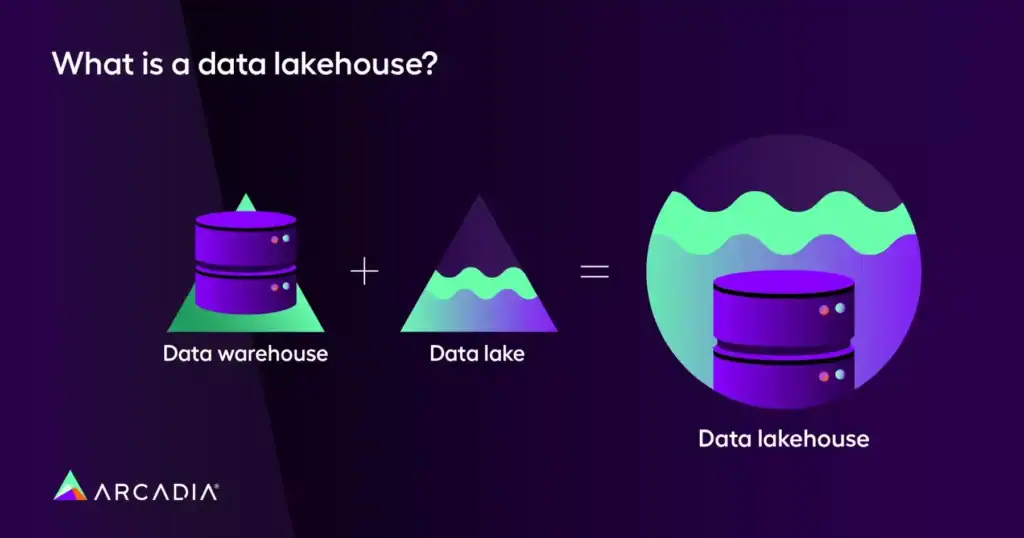
- A healthcare data warehouse is a structured solution that typically uses Extract, Transform, Load (ETL) processes to prepare and load structured data. Warehouses are more performant than data lakes but are relatively inflexible and difficult to scale operationally.
- A data lake is a fluid digital solution that easily captures raw, structured, unstructured, and even semi-structured data. This relatively low-cost storage environment doesn’t have the same management capabilities as a warehouse.
- A healthcare data lakehouse blends the advantages of both platforms into one data management solution. This enables more advanced analytics through one unified storage system.
An agile and expansive data lakehouse offers flexible interactions, supports various data types, and simplifies complex queries to speed up workflows. Built-in data validation processes can streamline tasks like data entry, cleaning, transformation, and analysis.
For more context on what a healthcare data platform is, watch the following video:
What features make a healthcare data platform modern?
Health systems ready to buy a healthcare data platform need to know what to look for before starting their research. You’ll need a modern solution that will meet both your current and future needs. Specifically, you should consider selecting a platform with these built-in features:
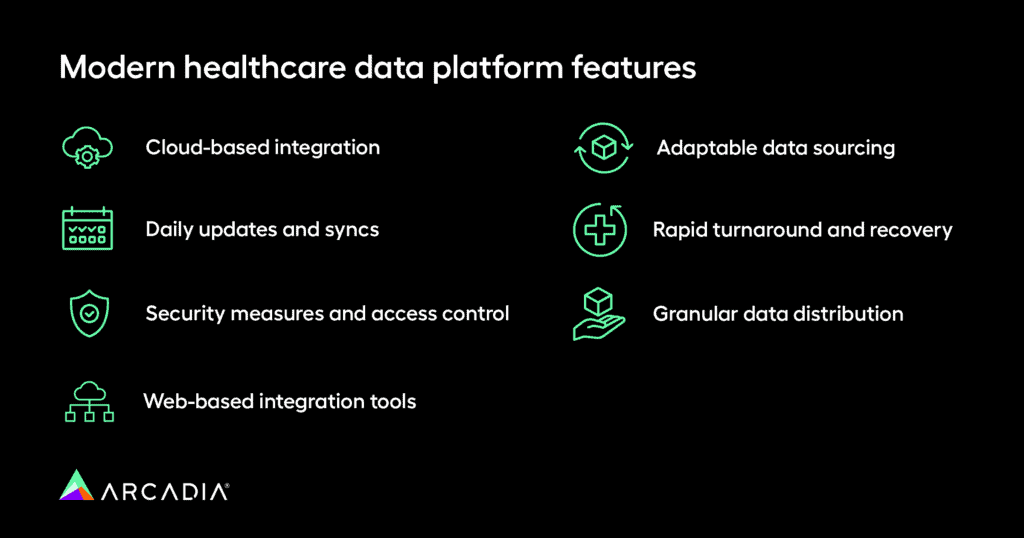
- Cloud-based integration: Cloud-based platforms that scale horizontally will maintain reliability even with multiple users.
- Daily updates and syncs: Daily data refreshes ensure the most relevant and recent data is prepared at the time of use for speedy recovery and synchronization.
- Security measures and access control: Predefined security measures support data access restriction according to user roles and privileges.
- Web-based integrated tools: Built-in development tools keep data querying, uploads, and downloads simple and straightforward.
- Adaptable data sourcing: The right platform will balance the breadth and depth of healthcare data from raw files to detailed data models.
- Rapid turnaround and recovery: Fast retrieval (hours, not days) during unexpected workflows is a must for the right people to make informed decisions quickly.
- Granular data distribution: Enable teams to access their own adaptable “data lakehouses” to foster collaboration across enterprise networks.
Quick, reliable, and low-latency healthcare data platforms can help any provider or analyst find what they need when they need it, whether that be a roundup of all patients with Diabetes or an up-to-date hospital readmission rate.
What are the benefits of a modern healthcare data platform?
Integrating a brand new healthcare data platform, like a datalake, might give you pause either due to the cost or the seeming complexity of adopting a new system.
However, the tangible benefits, such as the combined flexibility and organizational capacity of a healthcare data lakehouse open new opportunities. On a ground level, this means faster pipelines through simple creation of reports and dashboards. For instance, a provider could easily access a breakdown members per cost or SDOH data overview from diverse data sources quickly.
Additionally, by employing machine learning models to understand user behavior, highly intelligent data platforms can tailor content and feature releases accordingly. Therefore, organizations can introduce new content on an ongoing basis without having to consider increased computing demands. Thus, teams can count on rapid updates instead of having to await major release cycles which can be more administratively disruptive and give way to security risks.
Rapid insights and adaptable data sourcing power teams to enhance care coordination and simplify patient stratification. Consequently, care teams can make game-changing interventions and close expanding patient gaps.
What is a build-your-own (BYO) healthcare data platform?
When it comes to choosing the right platform, healthcare organizations face a pivotal decision: purchasing a platform from a vendor or building their own solution. Both options have their merits, but this decision depends on several considerations.
A build-your-own (BYO) healthcare data platform is a custom, in-house solution built on general-purpose cloud infrastructure and commercial database technologies from vendors such as IBM or Oracle. Because these platforms are not designed specifically for healthcare use cases, organizations pursuing a BYO approach typically need to license and integrate additional third-party databases and tools to support healthcare-specific data models, standards, and workflows.
For example, a health system building its own platform may base its cloud infrastructure on Microsoft Azure. However, the health system would also need to license ETL tools, analytics platforms, and other third-party tools to access the full capabilities of a healthcare data platform.
Pros and cons of a BYO platform
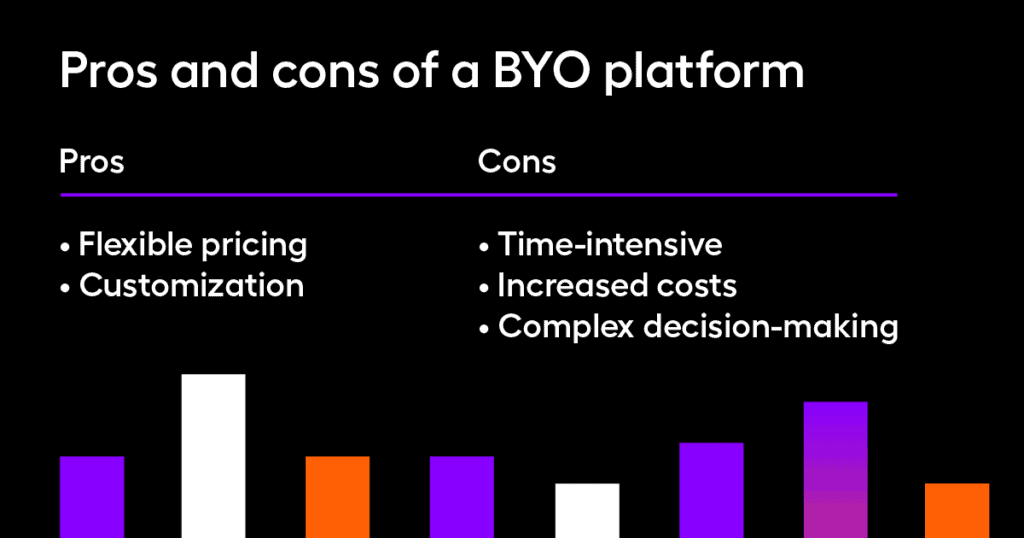
The advantages of a BYO platform include:
- Flexible pricing: Health systems often believe they can more effectively control costs with a BYO platform since they can agree on price points for each aspect of the solution.
- Customization: BYO platforms allow greater control over platform architecture, leading to complete ownership of the platform’s functionality.
The disadvantages include:
- Time-intensive: Healthcare goals are time-sensitive, and building an entire platform from scratch can risk timeliness.
- Increased costs: Between managing multiple contracts, staffing a full-time software engineer, and affording ongoing maintenance costs, BYO platforms are often the more expensive route.
- Complex decision-making: BYO platforms involve several technical factors, including platform choices, data governance standards, and user considerations.
Advantages of purchasing a commercial platform
While some health systems prefer BYO solutions, the more advantageous choice is clear — purchasing the right commercial platform equips health teams with the tools necessary to use their data. These platforms are built with healthcare-specific needs in mind, providing robust analytics tools and pre-built integrations.
As a result, health systems access:
- Faster time-to-value: While commercial platforms take time to implement, health systems can begin leveraging their data much more quickly with an already-established solution rather than a BYO approach.
- Domain expertise: Healthcare-specific vendors understand the intricacies of data analytics in the industry, providing solutions that address these exact needs.
- Reduced complexity: Instead of obtaining multiple vendor contracts and integrations, health systems can easily operate commercial solutions as they include all necessary tools in one platform.
- Predictable costs: Health systems can make informed budgeting decisions when investing in a commercial platform since costs are typically bundled into a predictable subscription or licensing fee.
Top 10 healthcare data platforms of 2026










1. Arcadia
Arcadia is an award-winning healthcare data platform recognized by leading healthcare IT analysts like KLAS Research for its advanced analytics and interoperability. This next-generation data platform is built on an open lakehouse architecture, combining the flexibility of a data lake with the data management and structured querying capabilities of a data warehouse.
Arcadia stands out for its:
- Configurable access: Supports broad enterprise use cases of data and third-party integrations across diverse stakeholders via APIs and web-integrated development environments (IDEs)
- Self-service administration: Enables healthcare organizations to monitor and control job orchestration via modules that configure data and manage infrastructure
- Governance and security: Simplifies provisioning users and democratizing access to information with pre-established governance formats and granular row-level permission controls
- Cloud-native compatibility: Enriches strategic investments in technical ecosystems by supporting major public cloud environments
With Arcadia’s healthcare data platform fueling advanced analytics, payers and providers can focus more effectively on patient outcomes, operational efficiencies, and other organizational priorities.
See the real results of a modern healthcare data platform.
Arcadia has empowered customers to achieve: 81% in-visit diagnosis capture, 59% more closed risk per patient, 24% reduction in inpatient admissions, and more.
2. CareJourney
CareJourney, acquired by Arcadia in 2024, is an analytics platform that helps healthcare organizations assess markets and patient populations to uncover opportunities for improvement. By analyzing this data, providers can make informed decisions regarding performance, contracting moves, and patient care.
3. Atropos Health
While not a dedicated healthcare data platform, Atropos Health is a participant in Arcadia’s marketplace of turnkey enablement tools and services. As such, this platform is a powerful tool that expands the use of health data sets.
Atropos Health converts healthcare data into real-world evidence (RWE), providing immediate access to evidence-based answers for clinical questions. Clinicians and analysts can use these validated answers to accelerate decisions that improve care quality and outcomes.
4. AWS HealthLake
AWS HealthLake is an advanced analytics and AI solution that uses machine learning (ML) models to understand raw data and organize, index, and store it in the Fast Healthcare Interoperability Resources (FHIR) industry-standard format. It’s especially valuable for health organization CIOs and IT leaders seeking to consolidate siloed data and deploy scalable analytics across departments with robust security and compliance.
5. HealthHelper
Another participant in Arcadia’s marketplace is HealthHelper, a platform that facilitates effective panel management so providers can implement targeted interventions and improve patient outcomes. By leveraging clinical data, payer contract incentives, and patient engagement insights, this platform helps providers make data-backed outreach and point-of-care decisions.
6. N1 Health
Health data doesn’t just include historical patient records and real-time updates — it can also refer to future health needs and plans. N1 Health serves this purpose, delivering predictive insights into patients’ health and engagement needs. Powered by predictive AI, this platform analyzes data to detect patterns and recommend interventions that reduce unnecessary utilization and improve patient outcomes.
7. J2 Interactive
J2 Interactive isn’t a healthcare data platform, but rather a software development and IT consulting firm that guides healthcare organizations through complex data and interoperability projects. As healthcare organizations adopt and transition to modern data solutions, J2 Interactive’s services support teams across the care continuum in making the most of their data.
8. Datavant
Datavant is a healthcare analytics company that links proprietary and third-party data. By powering secure health data exchange, this company enables healthcare organizations to de-identify and connect datasets at scale. Plus, its privacy-preserving tools protect patient data in multi-party research collaborations.
9. Athenahealth
Athenahealth is an integrated EHR, medical billing, practice management, and patient engagement solution. This platform specializes in care management tools, helping providers coordinate care, collaborate with payers, and engage patients.
10. Persivia
Persivia is a health data platform that supports care teams with real-time alerts, risk scoring, and population analytics. This solution’s focus on episode-based payment models is ideal for clinical leaders and administrators building effective value-based care pathways.
Common healthcare data platform integration challenges
Before you decide on a platform, you need to ensure that your team is ready to adjust its workflows. This means establishing operational best practices before committing to building or buying a solution. To start, your analyst teams should be prepared to adapt to the following challenges:
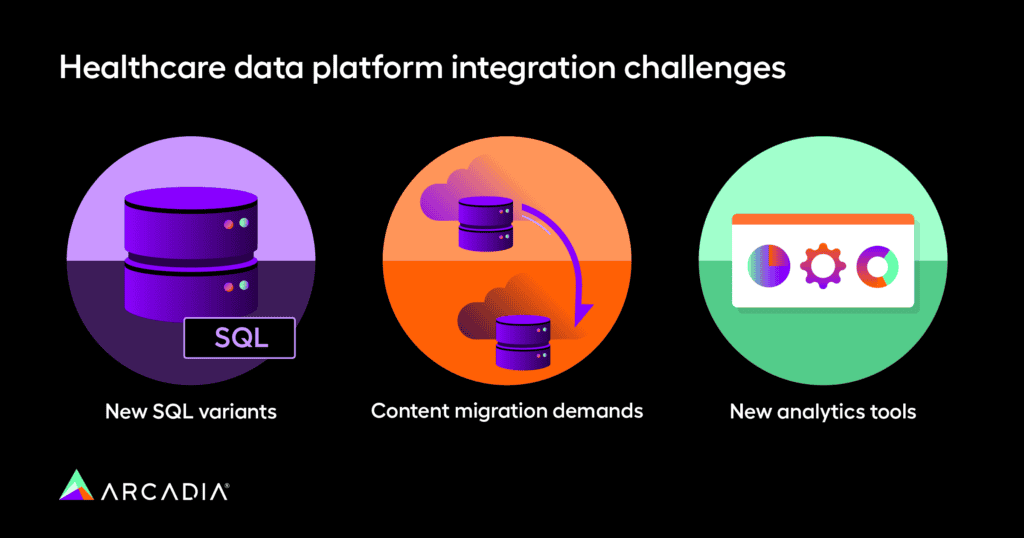
- New SQL (structured query language) variants to ensure your teams are ready for any linguistic shifts. This involves understanding the syntax, function, and capabilities to the new variant. Training programs, workshops, and online resources can all be applied to make sure your team is all on the same page before transitioning.
- Content migration demands that require analysts to transfer existing data onto a new one while maintaining data integrity. Train your team to perform data validation checks to ensure data is not compromised. Then, experiment using retrieval queries, reports, and dashboards.
- New analytics tools which include new user interfaces and advanced features. Encourage analysts to play around with web-based environments and collaborate with other stakeholders to test the usability, efficiency, and effectiveness of the new tools to usher in positive outcomes.
As healthcare organizations begin their implementation journey, they should take note of which workflows best meet their clinical and operational goals. Then, they’ll need to update their internal documentation and guidelines to reflect these best practices.
Solution: Arcadia’s healthcare data model
Even the most sophisticated healthcare organizations can experience tangled data which can spread analysts thin and slow progress. Arcadia’s data model, Foundry, takes these transition pain points into account.
A platform written by analysts for analysts, Foundry can help answer more complex questions faster and more consistently. Our interoperable platform enables:
- Elegant reporting based on wide-table schema for quick analytics.
- Sandbox database capabilities to upload your own data and experiment with workflows.
- Rich data details including clinical and claims models.
- Preferred third-party app integration to access Business intel, query/ERL and data science transfer.
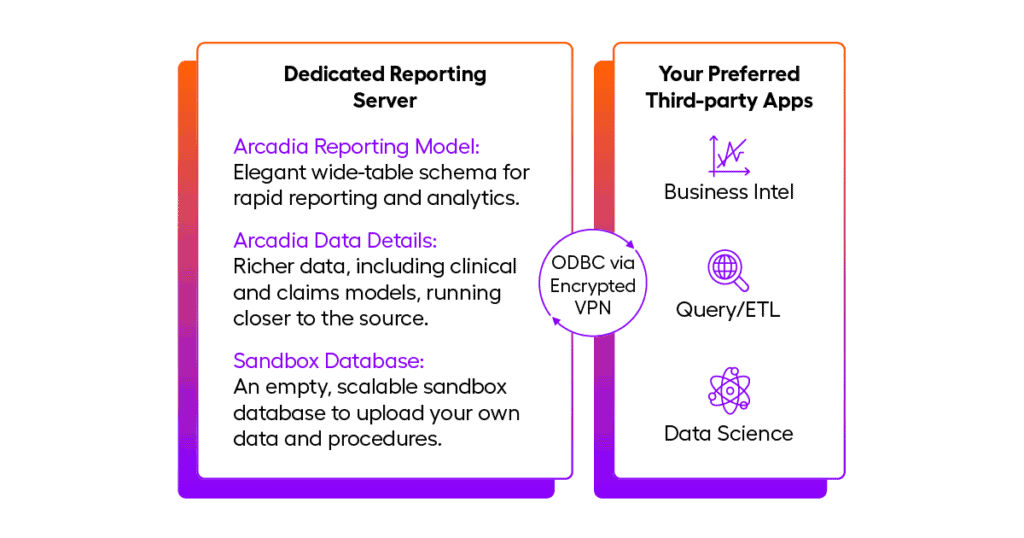
Analyze quality, risk, financials, clinicals, and contracts data using Business Intelligence, or statistical model of your choice. Our hosted data-base provides you with all you need to achieve value-based care at scale with a simplified schema.
The path forward: Unlocking the future of healthcare through technology
Modern healthcare data platforms are propelling organizations forward with advanced analytics and AI. Predictive analysis and natural language processing align care teams and aggregate disparate data into a unified, usable asset.
No longer will organizations be left in the dust by siloed and tangled data. Now, care teams are mobilized with reliable insights so they can intervene with informative, preventive care.