ResourcesInsight

A Guide To Electronic Health Record (EHR) Integration

By Logan Masta, Director, Special Projects at Arcadia
Posted:
Data Interoperability and Integration Healthcare Analytics Patient Outcomes

Given that a single hospital generates approximately 137 terabytes of data per day, health teams need a strong system to organize the vast amount of information scattered across different departments, from health history to labs to imaging. Electronic health records (EHRs) organize fragmented patient information and make it usable. This connectivity transforms disparate data points into a comprehensive whole-person view, which is essential for successful population health management and improved cost and quality outcomes.

To offer a comprehensive view of EHR integration and why it’s relevant to your organization, this article will cover:

As we explore how EHR integration alters and improves workflows, remember that the core objective of EHR management is to provide whole-person care. Millions of data points can create positive, individual health outcomes when connected.

EHR integration FAQs

What is EHR integration?

This image explains the four key benefits of an integrated data system.

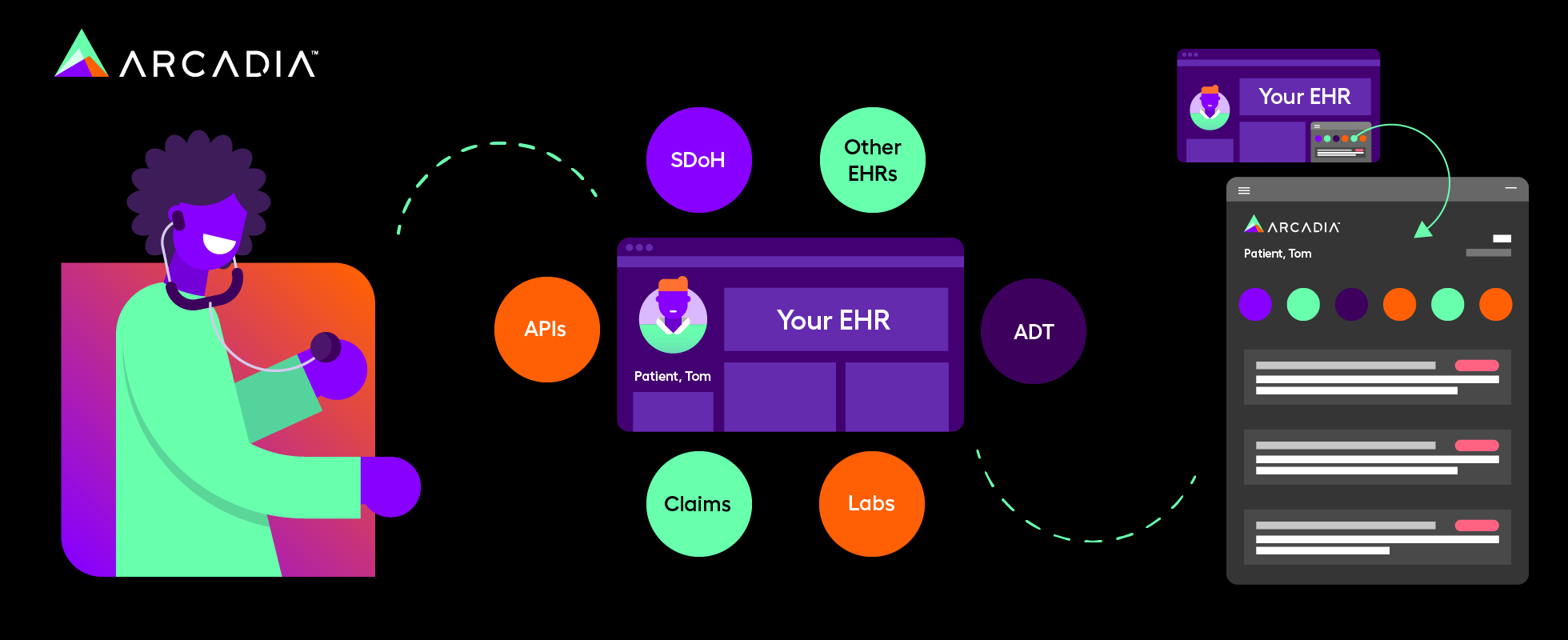
EHR integration is the process of connecting electronic health record systems with other software so that providers can seamlessly exchange patient data. This process involves aggregating data, such as:

  • Medical records
  • Social determinants of health (SDoH)
  • Appointment history
  • Medication records
  • Lab results

What problems does EHR integration solve?

If data is not readily available, healthcare providers cannot leverage insights to take informed next steps for patients. Without proper EHR integration, providers can run into several roadblocks, such as:

  • Administrative burdens. Combing through patient data is an inefficient use of practitioner time. EHR Integration keeps all relevant data in one place through seamless storage and management.

  • Cost and time. Migrating data to a single EHR is expensive, time-consuming, and technically intensive. EHR integration solves the problem of extensive time barriers with built-in data integration at the time of scheduling without lag.

  • Risk gaps and quality gaps. Advanced EHR integration systems surface actionable opportunities to close these healthcare divides. The transferability and management offered by EHR systems simplify collaboration between medical professionals.

Each of these challenges is sufficiently overcome with EHR integration which can empower you to increase patient satisfaction and workflow efficiency simultaneously.

What are the benefits of EHR integration?

EHR integration promises a variety of benefits across the healthcare spectrum, including:

  • Care collaboration. Integrated EHR systems deliver a platform for providers to collaborate and problem-solve through organized file management and transferability.
  • Scalable insights. Gather and compare patient data to investigate demographics, medical history, medications, allergies, and lab results in one place. Use your findings to discover patterns and improve overall performance.
  • Patient engagement and retention. Cleaner, organized patient data supports improved patient engagement and retention rates.

Common challenges to EHR integration

As explained above, seamlessly integrated EHR systems can make a world of difference, but to get there, your organization must undergo implementation. This period of transition can be a make-or-break situation for organizations as your providers, IT team, and other existing workflows must adjust to new processes. Let’s explore a few common challenges your practice might face:

Interoperability roadblocks

Because most organizations use several systems for different functionalities, implementing an EHR system that works compatibly with all of them is a common challenge. Often, compatibility roadblocks are the source of the most resistance when considering EHR integration.

However, with an interoperable solution like Arcadia, your team can access a 360-degree view of patients and populations with aggregated data from payers, patient histories, and population health insights. Our platform standardizes data so you can overcome harmful data siloes and make more informed clinical decisions.

Cost

Healthcare decision-makers must evaluate opportunity costs when considering EHR integration. Should you build an in-house platform with your existing team and resources? Or, would it make more sense to vet a vendor and move forward with a scalable solution?

This is a decision every organization must make for themselves. Before moving forward, align your team on an implementation timeline, rollout and enablement schedule, and projected time to value forecast of your chosen solution. 
 

Staff adoption and training

Regardless of which EHR solution you choose, there will be a period of transition your staff must undergo. Not everyone will share the same interest or familiarity with the new technology, which can cause resistance and frustration among your staff.

With decades of analytics experience, our customer insights team can help you bridge the gap from data retrieval to implementation. Together, we can overcome your pain points and get your staff up to speed.

Data migration

Maintaining data quality during migration is another concern when pursuing EHR integration. Inconsistent formats, coding, or terminology can lead to data siloes and slowed processes. Not to mention, any sensitive data lost in transition can leave your organization vulnerable.

Reduce discrepancies and errors by partnering with a reputable vendor that supports your migration process with strict data quality standards. Lean on knowledgeable customer service teams to ensure data flows efficiently and securely.

Data privacy

In 2023, more than 540 organizations and 112 million individuals experienced healthcare data breaches. Data privacy is paramount when selecting or upgrading EHR technology as sensitive patient data is at risk.

For this reason, your team should choose a HIPAA-compliant, cloud-based platform with strict access requirements and encryption. These security measures will help you avoid both intentional cyberattacks and unintentional data leaks.

Return on investment

You’re going to want to see results from your chosen platform. All the time and resources you’ve spent pouring into a consolidated solution should yield an impressive return on investment. That said, many organizations fear new software may not be worth it.

Considering the costs and benefits of EHR integration, think about it this way: messy data can’t solve pressing problems and will only slow your operations as you scale. A comprehensive EHR integration solution, on the other hand, can improve your data management, unite your care teams, and enhance patient outcomes.

We know implementing healthcare data analytics is no small task. That's why we've provided a list of reputable providers to help you navigate the above implementation roadblocks and see results faster.

7 Apps that integrate with EHR systems

To help you get the most out of your EHR, here is a list of top recommended apps that integrate with EHR systems along with a summary of their specialties. 

Read this section to learn how Arcadia’s EHR integrated analytics can improve your health outcomes.

1. Arcadia

Arcadia is a leading name in healthcare IT and analytics. Built on its proprietary lakehouse architecture, this healthcare performance platform integrates data, analytics, artificial intelligence (AI), and performance benchmarks into a single source of truth.

Arcadia empowers payer, provider, and life sciences organizations to:

  • Access transparent, clinically grounded insights that leaders can explain and act upon with confidence.
  • View a comprehensive evaluation of performance across the entire healthcare ecosystem.
  • Connect teams around shared goals to ensure insights translate into coordinated, effective action.
  • Achieve repeatable, system-level performance that holds as your organization grows and adapts.

Arcadia’s platform serves as the foundational engine that turns fragmented data into measurable impact.


Arcadia_EHR Integration_Vim

2. Vim

Specializes in: Accelerating value-based care by supporting personalized care management through data and insight delivery and customer-owned applications.

Vim’s point-of-care connection platform enhances the provider experience by collecting data, connecting it to your EHR workflows, and digitizing manual tasks. Built to be flexible with data ingestion, this integration technology can swiftly partner with your data platform to empower providers and advance healthcare interoperability.

PatientIQ’s EHR integration solutions can propel your team towards enhanced patient experiences.

3. PatientIQ

Specializes in: Timely EHR integration, push and pull patient data, task syncing, and overall interoperability promotion of clinical data.

Patient IQ is built with your existing EHR in mind with the goal of unburdening administration and improving clinical workflows. Their team has extensive experience working with a variety of EHR vendors and their platform is designed to work in tandem with your existing technology.


Innovaccer uses advanced Health Cloud digital solutions to complement your existing EHR integration workflows.

4. Innovaccer

Specializes in: Providing an advanced Health Cloud solution to accelerate healthcare innovation through digital transformation.

Backed by KLAS Research and Black Book sources, Innovaccer helps leading organizations drive improvements across payer and provider levels alike. Their data activation platform, developer portal, and intelligent application suite accelerate care quality and enhance the patient experience.


This section explores Health Catalyst’s EHR integration technology.

5. Health Catalyst

Specializes in: Offering end-to-end technology integration and administration, self-service data science and reporting, and expert services to curate healthcare data and build actionable analytics.

Another KLAS Research standout, Health Catalyst has achieved continued high-performance scores due to its quality care expertise. Health Catalyst leverages its wide array of service offerings to achieve measurable clinical, operational, and financial improvements.


Redox’s revolutionary EHR integration moves toward a composable healthcare solution to streamline your workflows.

6. Redox

Specializes in: Increasing care coordination through a single API to connect products, payers, and providers.

By providing a composable healthcare solution, Redox aims to free your team from integration hassles. Redox is a revolutionary provider dedicated to moving towards a composable healthcare solution instead of relying on integration. Redox product teams and developer teams turn to their platform for differentiated growth strategies and high-impact developer tools.


Folio3 accelerates EHR integration outcomes through developer-friendly APIs

7. Folio3

Specializes in: Ensuring seamless EHR data integration with all third-party platforms and applications through developer-friendly APIs.

Folio3 minimizes integration barriers by eliminating silos and consolidating different EHR systems and their aging infrastructure. Its EHR systems use advanced machine learning, predictive analysis, and artificial intelligence to convert data into actionable insights. Folio3 even offers a training program so your analysts and in-house teams can understand your data structure.


Final thoughts on EHR integration

Effective EHR integration is the foundational engine that transforms fragmented patient data into a clear, actionable roadmap to better clinical and financial outcomes for healthcare organizations. By unifying disparate records into a single source of truth, providers can move beyond manual data retrieval and begin focusing on the high-value work of healing.

A successful integration strategy bridges the gap between data retrieval and implementation. Whether navigating the complexities of value-based care or seeking to improve population health, the goal remains the same: ensuring that the right data reaches the right teams at the most opportune time.