Event
RISE National 2026
This spring, stop by Arcadia's booth #315 at RISE National in Orlando, where we’ll be on-hand to help you draw a roadmap into the future of healthcare. As regulatory changes and...

As the healthcare industry increasingly focuses on healthcare access and equity to deliver patient outcomes, it’s important for healthcare providers and payers alike to understand these concepts, why they’re critical, and how they can contribute to a more equitable health system.
In this guide, we’ll explore the significance of health equity and provide actionable steps to integrate strategies into your work.
Healthcare equity refers to the principle of achieving equal health outcomes for all individuals, regardless of their social, economic, or demographic backgrounds. It is well documented that each of these domains is associated with differential health outcomes. Efforts to address healthcare equity recognize that some individuals may face unique barriers, such as limited financial resources, geographic location, or systemic discrimination, that impact their ability to receive high-quality care.
Medical providers play an important role in addressing these disparities and advancing a more equitable healthcare system. By doing so, they can improve health outcomes, reduce health disparities, and enhance the overall well-being of a patient population.
While healthcare equality and equity are often used interchangeably, they represent different approaches to improving health outcomes. Equality focuses on providing everyone with the same resources or care, while equity recognizes that patients have different needs and circumstances and may require different levels of support to achieve comparable outcomes.
Under a healthcare equality approach, patients are offered the same services and communication pathways. This framework assumes that all patients start from the same baseline of technological literacy, broadband and transportation access, and primary language fluency, which is rarely the case.
Equity, on the other hand, recognizes and addresses the unique barriers that can affect a patient's ability to access care. For example, an equality-based strategy might require all patients to attend routine follow-up appointments in person. An equity-based strategy recognizes that a rigid in-person requirement can create challenges for patients with transportation limitations, caregiving responsibilities, or inflexible work schedules. Offering alternatives such as telehealth visits or text-based surveys can help these patients receive appropriate follow-up care while reducing barriers to access.
Healthcare access and equity are important because they increase access to preventive services, improve population health, and help mitigate health disparities before they become more severe and costly to address.
When patients face barriers to accessing healthcare, they defer checkups, immunizations, and preventative care. This can lead to chronic or easily treatable conditions going unmanaged, leading to avoidable utilization and increases in preventable hospitalizations.
Furthermore, inequity results in clinical disparities between different groups, such as vulnerable demographics experiencing higher mortality rates for manageable diseases. True equity ensures that a patient's zip code, primary language, technology constraints, or other circumstances do not dictate their outcomes, health status, or life expectancy.
Health equity initiatives are not only beneficial for patients. They can also help healthcare organizations improve quality performance, reduce costs associated with preventable complications, and strengthen financial outcomes.
When organizations remove access barriers, patients can engage with preventive care before their conditions worsen. This proactive approach naturally reduces costly disease progression and preventable emergency department overutilization, enabling health systems to achieve financial sustainability while keeping communities healthier.
Furthermore, modern healthcare frameworks increasingly connect financial performance to human outcomes. Regulatory benchmarks, such as the CMS Health Equity Index (HEI), reward organizations that successfully close care gaps for underserved populations, making equitable care a baseline requirement for revenue protection.
Ultimately, investing in accessible, friction-free patient pathways ensures that doing what is right for the patient is also what is best for the organization's longevity and revenue.
To promote health equity, the first step is identifying existing disparities within a patient population. Collecting and analyzing data related to demographics, socioeconomic status, and health outcomes can help pinpoint areas of concern. By understanding these disparities, healthcare organizations can tailor their services to meet the specific needs of underserved communities and marginalized populations.
In particular, focus on disparities in these categories:
These disparities are the non-medical, environmental factors that dictate a patient’s baseline health outcomes long before they interact with a doctor. Rooted in where individuals live, work, and age, SDoH disparities include:
When a community experiences these disparities, it creates a health vulnerability that traditional clinical care alone cannot address.
Unlike environmental factors, systemic and operational disparities are the barriers in a healthcare organization’s care delivery model. These barriers occur when standard operational workflows inadvertently impact vulnerable populations.
Examples include:
Healthcare organizations can address these issues once identified to create a more equitable healthcare experience.
Promoting healthcare access and equity requires a coordinated effort among healthcare providers and payers. Beyond identifying gaps in care, organizations must work together to address the social, economic, and logistical barriers that can limit access to services. Patient-centered strategies can help reduce disparities, improve engagement, and support better health outcomes.
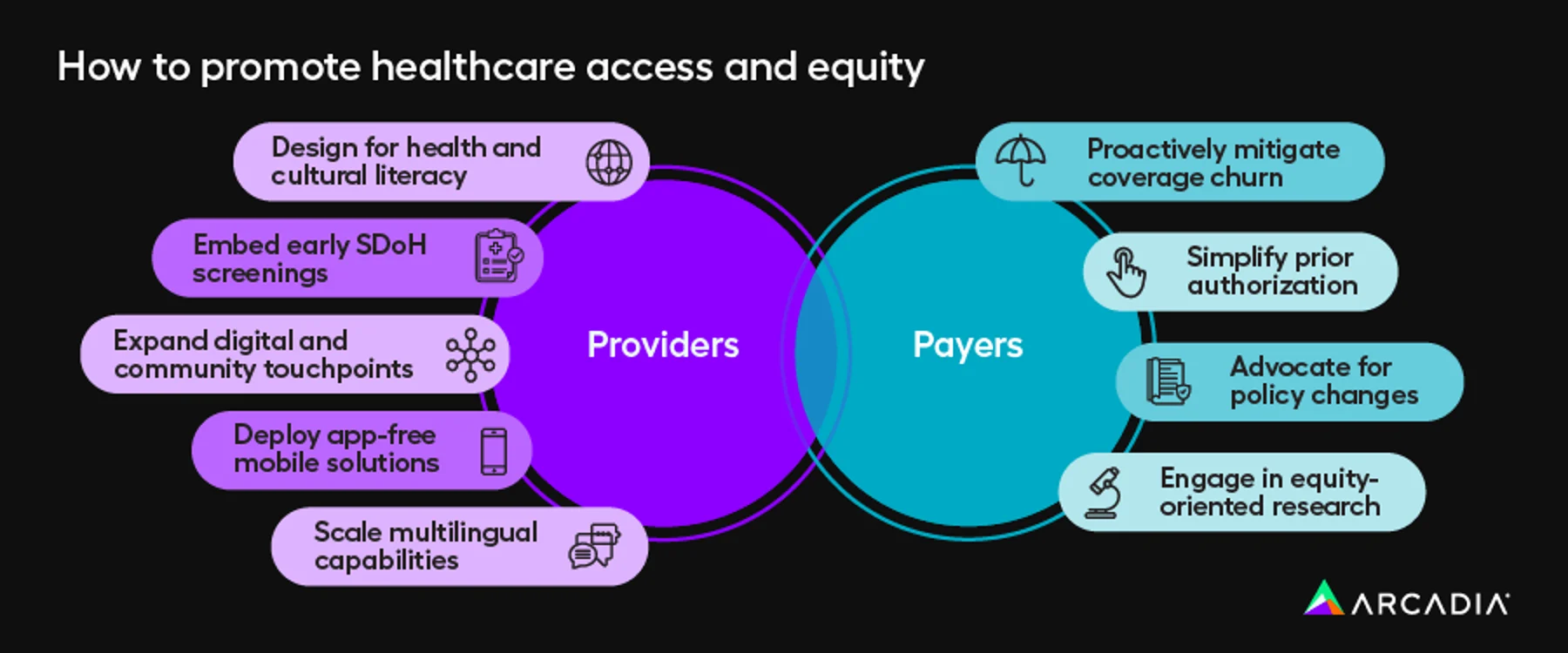
Healthcare providers are on the front lines of the equity gap, meaning their daily operational workflows have the most immediate impact on patient outcomes. To move the needle, providers must transition from a one-size-fits-all approach to an adaptable care delivery model that addresses the lived realities of their patient panels.
Here are a few ways providers can prioritize equitable care:
Promoting equity requires providers to expand their definition of quality care. Clinical excellence matters very little if a patient can’t successfully navigate the administrative labyrinth required to reach the exam table. Ultimate success means treating digital and physical accessibility as core clinical vitals, ensuring a seamless delivery system to improve all patient outcomes.
While providers manage the physical delivery of care, healthcare payers possess the financial and structural levers necessary to drive equity at scale. By aligning financial incentives with human outcomes, payers can transform health equity from a compliance checkbox into a core mechanism for sustainable risk management.
Here are a few ways to strike this balance:
For payers, supporting healthcare access and equity means reframing their role to a proactive supporter of health literacy. When a health plan prioritizes intuitive usability and structural support for its most vulnerable members, it mitigates long-term actuarial risk by stabilizing the health of the entire population and risk pool.
Health equity can only be achieved by analyzing clear, granular data to uncover inequitable areas and transform them into actionable operational insights. Invest in data platforms (like Arcadia’s healthcare performance platform) that capture critical SDoH insights to empower your healthcare organization to remove barriers that lead to costly clinical complications.
By actively addressing disparities, expanding access, and promoting cultural competence, providers and administrators can work toward a more equitable healthcare system. Embracing health equity not only improves patient outcomes but also contributes to a healthier society overall.