15 min
 Risk adjustment, as defined by The Centers for Medicare & Medicaid Services (CMS), is the process of calculating provider reimbursement “based on a patient’s health, their likely use of health care services, and the costs of those services.” The method assigns a patient’s health status a numerical value, known as a risk score, to help healthcare teams predict costs.
Accurate risk adjustment requires the collaboration of both providers and payers, who share responsibility for accuracy and compliance. Providers contribute by thoroughly documenting and coding patient diagnoses, while payers aggregate, model, and submit this data to accurately calculate risk and determine reimbursement.
Risk adjustment software plays a critical role by centralizing and analyzing large volumes of clinical and claims data, identifying documentation gaps, and automating workflows that support compliant, accurate reimbursement across the healthcare ecosystem. This article answers commonly asked questions about this technology and explores risk adjustment vendors currently leading the industry.
Risk adjustment software FAQs
We summarize the key concepts about risk adjustment tools in the video below, but you can continue reading for a more comprehensive review of this software’s capabilities.
Fraud involves intentional deception for financial gain. Waste refers to unnecessary or low-value healthcare spending that may occur without malicious intent. Abuse typically involves practices that exploit payment structures or reimbursement incentives in ways that increase inappropriate utilization.
Organizations participating in value-based care arrangements are financially exposed to inappropriate utilization trends. Fraudulent or excessive spending can affect benchmarks, shared savings calculations, utilization trends, and population health performance.
Healthcare organizations can use claims analytics, benchmarking, utilization monitoring, provider outlier analysis, and interoperability tools to identify unusual utilization spikes, coding changes, or geographic anomalies.
Functionality to look for in risk adjustment tools
To maintain accuracy and compliance in risk adjustment, analytics software is essential for both providers and payers. It supplies access to a variety of data, features, and flexibility by offering the following capabilities.
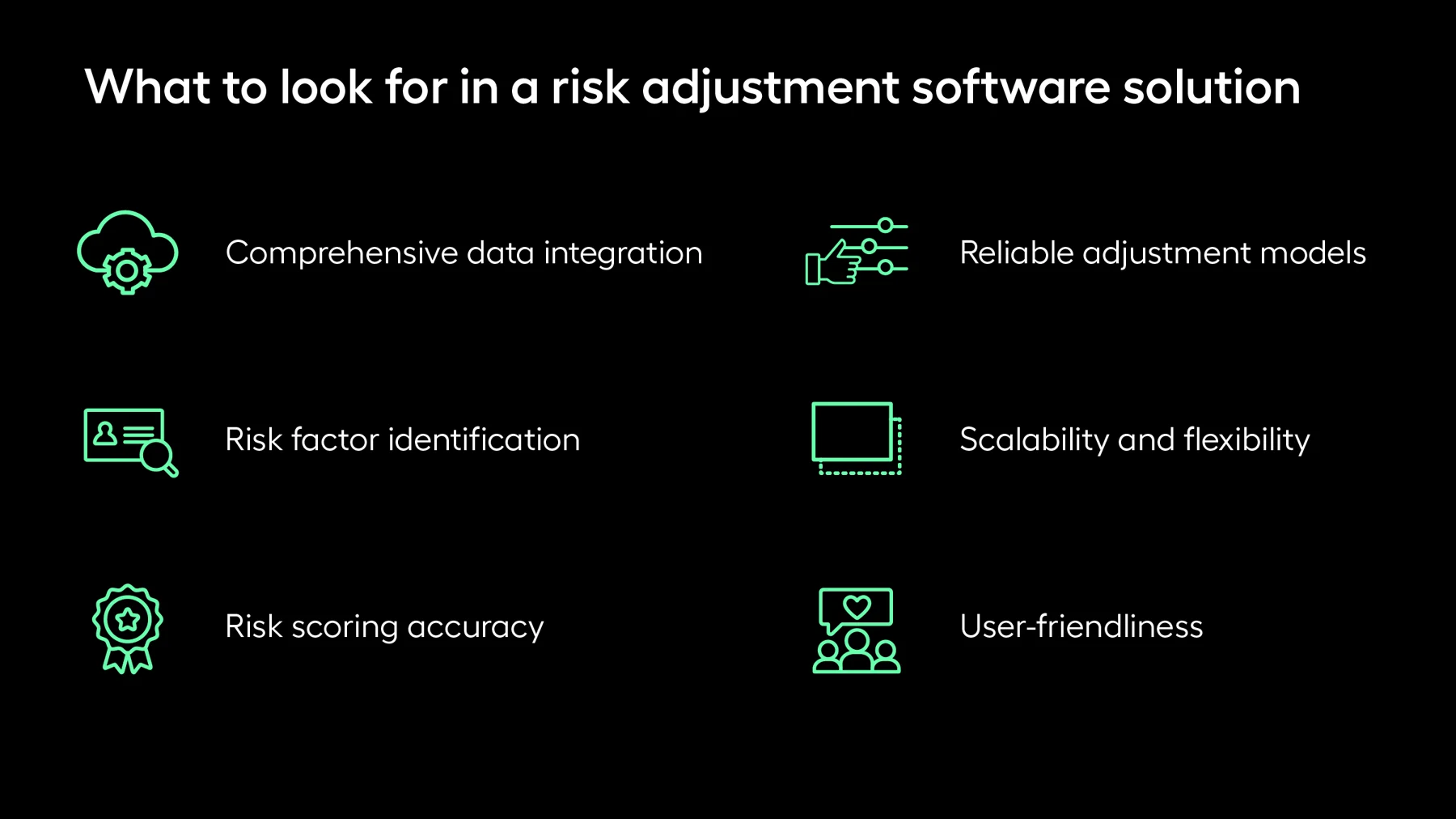
Comprehensive data integration
Providers and payers need systems built on reliable data to easily pinpoint high-risk patients. Risk adjustment software with robust integration capabilities can process data from multiple sources to allow for more accurate risk assessments.
Integration should include, but may not be limited to:
- Electronic health records (EHRs): Clinical documentation, diagnoses, procedures, and medication lists
- Claims data: Detailed medical claims and prescription claims, which record services and medications billed and paid for
- Pharmacy data: Information on medication adherence and high-cost prescriptions
- Health Information Exchanges (HIEs): Broader patient data shared across multiple care settings
- Social determinants of health (SDoH) data: Non-clinical factors that influence risk, such as housing, food security, and transportation access
An incomplete longitudinal patient record compromises clinical decision-making, as teams don’t have all of the information they need to diagnose a patient and close care gaps. Additionally, inaccurate risk scores can result in underpayments or overpayments by misrepresenting expected population-level costs, leading to resources that do not align with patients’ needs.
Advanced integration provides a comprehensive data foundation for accurate risk adjustment and patient stratification, thereby increasing both operational sustainability and excellence in patient care.
AI-powered features
Artificial intelligence (AI) and machine learning are transforming risk adjustment by moving beyond traditional systems’ functionality to enhance suspecting and data validation. By analyzing complex datasets, AI-powered features in risk adjustment software can automate time-consuming tasks and identify subtle patterns that human analysts might miss, leading to more precise risk stratification and accurate payments.
AI-powered features of risk adjustment software can include:
- Actuarial forecasting: AI models analyze historical claims and clinical records to more accurately forecast future healthcare utilization and costs, though these predictive insights do not replace regulatory payment models such as HCC.
- Risk gap identification: Machine learning algorithms cross-reference disparate data sources to surface suspected undocumented conditions and flag unsupported or legacy codes for removal, improving care delivery and compliance with federal audit requirements.
- Clinical evidence verification: Natural language processing scans unstructured provider notes to verify that documented diagnoses meet regulatory guidelines to establish an explicit, auditable chain of evidence.
- Workflow optimization: AI can automate patient prioritization for intervention, guide care teams to the most impactful actions, and streamline compliance reporting so that staff have more time to focus on direct patient care.
By leveraging these advanced capabilities, AI-powered risk adjustment solutions ensure that resources are allocated where they are needed most, moving healthcare systems toward a more data-driven, value-based model.
Scalability and flexibility
As patient conditions evolve, health networks expand, and population trends shift with time, risk adjustment solutions must remain flexible to adapt as needed. Scalable platforms offer:
- Innovation: The solution must keep pace with changes in patient population trends, regulatory mandates, and increasing operational demands.
- User-friendliness: A user-friendly interface allows healthcare providers to efficiently navigate the platform and integrate the system into existing workflows with minimal training. Intuitive features like analytics dashboards also make it easy for teams to interpret complex data.
- Benchmarking: The right solution should offer a standardized approach for accurate and meaningful comparison across diverse patient groups, providers, and timeframes. This ensures confidence in performance assessment, benchmarking results, and strategic healthcare planning decisions.
The top contenders among risk adjustment vendors will have a well-established reputation within the industry and the flexibility to meet both immediate and long-term needs. In addition to accessing the right features, it’s essential to find a vendor who has helped similar teams achieve the outcomes you’re looking for.
16 Leading risk adjustment vendors
| Provider | Best for | Standout risk adjustment features |
|---|---|---|
| Arcadia | Prospective-first point-of-care and risk adjustment workflows that reduce dependency on outsourced coding or professional services | Vast datasets to capture and analyze patient health information, which provide a fuller understanding of risk, drive more precise risk scores and stratification, and facilitate better patient care |
| Socially Determined | Quantifying social risk data to guide resource allocation | Social determinants of health (SDoH) metrics integrated directly into patient records to map patient risk and predict resource needs |
| N1 Health | Optimizing patient outreach engagement for risk-bearing entities | Predictive analytics that merges clinical histories with consumer behavior data to pinpoint optimal outreach channels |
| Atropos Health | Rapidly generating real-world evidence (RWE) through observational clinical research studies | Automated query engine that aggregates anonymized medical records to generate the observational clinical data needed to justify treatment pathways |
| HealthHelper | Closing open clinical care gaps and booking preventive visits | EHR chart tracking to find open coding gaps paired with patient outreach to schedule wellness visits |
| J2 Interactive | Healthcare IT consulting for interoperability | Building data integrations that establish secure FHIR and HL7 connections between conflicting hospital systems |
| Advantmed | Conducting retrospective medical record retrieval and risk adjustment chart audits | Medical record retrieval and chart coding workflows built to deliver high diagnostic coding accuracy |
| Cotiviti | Auditing financial payment integrity and monitoring quality metrics | Chart analysis that intercepts incoming claims to identify missing or unsupported risk adjustment codes before they are billed |
| Pareto Intelligence | Identifying risk adjustment encounter data errors and forecasting premium revenue variations | Reconciliation software that cross-references clinical records to isolate unsubmitted codes and prevent revenue losses |
| Vatica | Driving point-of-care clinical documentation compliance for prospective risk adjustment | Point-of-care software tools paired with visiting clinical staff who help doctors thoroughly chart disease severity during patient visits |
| Datavant | Connecting separate healthcare datasets securely without exposing protected health information (PHI) | Secure record-linking software to safely match databases across different networks and extract missed diagnoses from unstructured clinical notes |
| Signify Health | Executing large-scale in-home health evaluations (IHEs) and risk assessments | Mobile clinician network conducting in-home physical evaluations to document active chronic illnesses and capture risk data for hard-to-reach member panels |
| Optum | Managing patient care networks and clinical financial risk budgets across large medical groups | Risk tracking software and targeted analytics consulting to improve chart documentation and prospective coding accuracy |
| Reveleer | Automating retrospective chart review and defending against billing audits | Chart retrieval and review workflows built to identify missed diagnoses and prepare submissions for audits |
| Persivia | Routing real-time care alerts to staff managing complex chronic diseases | Real-time electronic medical record (EMR) scanning that evaluates clinical variables during patient encounters to route live diagnostic prompts and other alerts to providers |
| Inovalon | Processing large-scale clinical database analytics for annual quality and risk submissions | Data analytics software that tracks risk score accuracy, patient assessments, and encounter data submissions |

Arcadia
Arcadia is the trusted healthcare performance platform powering outcomes, purpose-built for healthcare and recognized by KLAS Research for its work in value-based care. The platform connects more than 3,000 distinct data sources, processing records for upwards of 150 million individual patients.
With expertise in aggregating comprehensive data, Arcadia simplifies risk coding and documentation to provide clear visibility across entire networks. Its risk adjustment application library helps teams unearth meaningful data points and drive healthier outcomes through:
- Intelligent risk suspecting and documentation: Arcadia’s platform uses advanced AI to analyze both structured and unstructured clinical data, accurately identify care gaps, and surface the actions needed to close them.
- Comprehensive analytics dashboards: Data visualizations consolidate quality, risk, financial, contract, and clinical data into simplified views, enabling clinical and operational teams to extract insights from massive volumes of data.
- Seamless point-of-care integration: Arcadia integrates risk adjustment workflows directly into existing EHR systems, allowing providers to capture complete diagnoses and address care gaps at the time of treatment.
- Embedded agentic AI: AI clinical assistant capabilities, including chart summarization and coding gap insights, pull data from multiple sources to provide a 360-degree view of patients. This enables providers to more easily assess patient risk and provide targeted interventions.
- Unified quality and risk workflows: Arcadia’s platform delivers a unified model for quality measurement, risk adjustment, and prospective documentation workflows, ensuring complete, accurate, and timely capture of quality and risk data without the complexity of fragmented tools.
- Full CMS data reconciliation and competitive benchmarking: Arcadia ingests and reconciles CMS submission files against medical and pharmacy claims, and benchmarks provider- and plan-level performance against a large base of Medicare Advantage and fee-for-service claims data for competitive and program-design insight.
- Provider-payer collaboration: Cloud-based, configurable workflows accommodate real-world variations between payers, health systems, and state requirements.
Additionally, Arcadia’s HCC Risk Suspecting App aggregates data from multiple sources (e.g., claims, EHR, APIs, and SDoH) and enriches it with a proprietary risk-suspecting engine. The app integrates payer and EHR data into a single data asset, enabling risk suspecting from notes, labs, orders, and vitals.
What sets Arcadia apart from other risk adjustment solutions is its focus on prospective-first workflows, rather than retrospective-only risk management. With Arcadia’s tools, you can pinpoint interventions and potential risks for patients before medical incidents occur, enabling providers to improve patient outcomes more effectively.

Socially Determined
Socially Determined provides social risk data to improve the accuracy and predictive power of risk models. The solution focuses on quantifying the impact of SDoH data, providing individual-level and community-level social risk scores across seven domains:
- Finances
- Food
- Housing
- Transportation
- Health literacy
- Digital
- Social
Ultimately, Socially Determined equips organizations with essential context on social risk factors so teams can accurately stratify patient populations and ensure more equitable and comprehensive documentation.

N1 Health
N1 Health is a predictive AI platform that supports risk adjustment by providing a holistic view of members through:
- A cloud-based, AI infrastructure
- Third-party and training data from more than 30 data sources
- Healthcare-specific predictive models
This solution generates meaningful insights that enable precision in member outreach, which indirectly supports the closure of care and coding gaps. N1 Health’s mission is to transform data into actionable consumer insights to drive engagement and appointment attendance.

Atropos Health
Atropos Health provides on-demand real-world evidence (RWE). The platform’s credible reports support two indirect (yet vital) components of a strong risk adjustment program:
- Clinical decision-making: Personalized insights support diagnosis and treatment selection, helping providers make more confident care decisions.
- Provider education: Users can ask clinical questions and receive answers with publication-grade observational research studies in minutes.
By providing rapid, evidence-based answers to clinical questions, Atropos Health empowers providers to make more precise diagnoses, ensuring more complete and defensible risk documentation.

HealthHelper
HealthHelper is a technology-enabled service that supports risk adjustment by providing:
- Proactive panel management: HealthHelper offloads tedious but important staff work through proactive patient outreach and management.
- Risk coding support: The platform surfaces recapture and suspect codes to ensure providers accurately document risk and members receive the necessary care to treat their diagnoses.
- Intelligent scheduling: By using appointment scheduling and multi-channel care campaigns, this solution optimizes patient visits for continuity of care.
HealthHelper functions as a critical service layer, optimizing provider workflows and driving essential patient visits that are necessary to capture timely and accurate risk documentation.

J2 Interactive
As an award-winning IT consulting firm, J2 Interactive offers strategic interoperability services that are essential for unifying fragmented data. While not a dedicated risk adjustment vendor, J2 Interactive specializes in complex systems integration necessary for risk adjustment solutions to function properly.
Their areas of expertise cover:
- Technology strategy
- Healthcare interoperability
- Health information exchange
- Integration
- Patient and provider engagement
- Virtual health applications
J2 Interactive’s goal is to provide the essential technical consulting layer needed to unify disparate data sources required for accurate risk adjustment processing.

Advantmed
Advantmed offers end-to-end risk adjustment solutions with 98% coding accuracy to provide accurate risk profiles for enhanced results. Here’s an overview of its risk adjustment services:
- Advanced analytics
- Medical record retrieval
- Medical record coding
- Claims and data validation
- Health assessments
With Advantmed, providers can access understandable, actionable analytics that improve Risk Adjustment Factor (RAF) scores to close documentation gaps and utilize prevention and predictive modeling.

Change Healthcare
Change Healthcare’s comprehensive risk adjustment platform, Risk View, helps healthcare insurers understand risk score trends and opportunities, optimize financial results, and identify targets for appropriate risk-adjusted reimbursement. Its risk adjustment solutions include:
- Risk adjustment software and strategy tools
- Targeted advanced risk analytics
- Risk adjustment activity management
- Standardized and customized reports and dashboards
Change Healthcare offers comprehensive reports to inform strategic planning based on end-of-year and end-of-project metrics. Models used AI, big data, and chart selection to assess and target appropriate members.

Cotiviti
Cotiviti’s risk adjustment solutions ensure compliant, accurate compensation for member risk burdens. The platform provides advanced tools to optimize risk-associated revenue while maintaining transparency at every stage of the process with the following services:
- Suspect analytics
- Medical record retrieval
- Medical record coding
Cotiviti also recently acquired Edifecs, a big name in healthcare interoperability. This acquisition combines Cotiviti’s innovative health technologies with Edifecs’s data exchange capabilities, furthering their shared mission to drive advancements in health data analytics.

Pareto Intelligence
Pareto Intelligence’s risk adjustment solution is a cloud-based data environment built by business experts that transforms and enriches raw, disparate data assets into business-ready analytics. The solution’s core capabilities include:
- RADV mock audit and support
- Program evaluation and strategy
- Compliance risk assessments
- Coding services
- Medical coding compliance evaluations
- In-home assessments
- Virtual home visits
- Advisory services
Pareto’s Data Management Platform enables data ingestion of all formats and types at scale with built-in governance mechanisms that maintain compliance and efficiency.

Vatica
Vatica’s solution takes a unique approach to risk adjustment — combining comprehensive data and health technology with expert clinicians at the point of care. Its provider-centric approach places PCPs at the center of interventions through capabilities such as:
- Actionable, automated provider alerts
- Intuitive coding and documentation
- Automatic transmission of accepted diagnosis codes to the EMR
Vatica receives feedback and insights from its physician advisory board, which is comprised of active Vatica clients who know the needs that providers face firsthand.

Datavant
Datavant is a data connectivity solution that helps health plans turn members’ health records into valuable assets for risk adjustment. This provider enables intelligent data exchange by linking:
- Proprietary data: Pharma trials data, social determinant data, etc.
- Third-party data: Lab data, claims data, etc.
Datavant has also partnered with Arcadia to help organizations connect Arcadia’s vast data sources with other types of real-world data.

Signify Health
Signify Health takes its risk adjustment offerings to the frontlines of patient care by facilitating in-home health evaluations and preventive services. By bringing risk adjustment to patients’ doorsteps, this vendor helps health teams connect with members and better understand patients’ current health status through:
- Medical history analysis
- Physical examination
- Medication review
- Preventive screenings
These evaluations support accurate clinical documentation for appropriate reimbursement.

Optum
Optum is a big name in healthcare analytics, delivering risk adjustment software that emphasizes RAF accuracy and documentation quality. Their full suite of solutions includes:
- Analytics consulting
- Medicaid risk adjustment and quality
- Member engagement solutions
- Prospective solutions
- Quality solutions
- Retrospective solutions
- Risk view
Additionally, Optum provides a community where health professionals can connect, discuss questions, and share resources to improve their risk adjustment approaches collaboratively.

Reveleer
Reveleer is another player in the risk adjustment game that is leveraging AI to transform HCC capture and RAF accuracy. This solution boasts up to 99% accuracy in identifying potential missed diagnoses, as well as beneficial features like:
- CMS and HIPAA-compliant workflows
- Advanced medical record retrieval
- Early CMS and RADV-IVA submissions
- Real-time dashboards to monitor coding accuracy
- Chase prioritization, suppression, quick clinical review, and one-click validation
With Reveleer’s platform, health teams can improve reimbursement accuracy by predicting future revenue adjustments and surfacing missed opportunities.

Persivia
Persivia offers AI-driven risk adjustment software that supplements accurate medical record documentation with the power of unstructured data for more point-of-care insights. This solution’s top features include:
- Real-time data aggregation
- Coding opportunity identification
- Risk analytics
- Care management tools
- Provider engagement
By delivering valuable insights such as care gaps and HCC scores to the provider at the point of care, Persivia’s solution empowers informed decision-making and increased provider satisfaction.

Inovalon
Inovalon’s SaaS suite of solutions encompasses various aspects of health plans’ efforts to manage and improve health outcomes. Primarily, its risk adjustment software delivers real-time analytics for prospective and retrospective gap identification. Its tools include:
- Risk score accuracy software
- Converged risk surveillance analytics
- Converged patient assessment
- Healthcare data lake
- Electronic record on demand
- Converged submissions
Inovalon’s cloud-based approach to analytics also supports scalable health programs, making it a great option for large-scale health plan management.
Final thoughts on risk adjustment software
Accurate risk adjustment requires several moving parts to work simultaneously, including data collection and analysis, standardization, predictive modeling, and continuous monitoring. A robust solution can automate many of these processes, resulting in enhanced collaboration, accurate reimbursement, and improved patient care.