7 min
7 min For over a decade, the healthcare industry has discussed the concept of value-based care and ideas for programs that finally align payment with patient outcomes. Now, the Centers for Medicare & Medicaid Services (CMS) has articulated a model that reflects administrators’ vision to improve patient well-being through technology.
On December 1, 2025, the CMS Innovation Center announced the Advancing Chronic Care with Effective, Scalable Solutions (ACCESS) Model. This 10-year voluntary program, launching July 1, 2026, does something no major Medicare initiative has done before: it pays providers based on whether patients actually get healthier after receiving care.
In this article, we’ll provide an overview of the CMS ACCESS Model, including why it matters, what makes it different from previous value-based care proposals, and who should apply.
Why value-based care and the CMS ACCESS model matter
The concept of value-based care often carries a tagline like “pay for good outcomes, not the volume of services.” It’s a vision the healthcare industry has been trying to realize for decades. While programs like MSSP consistently produce savings and better patient outcomes, we haven’t yet achieved the full potential of value-based care at scale.
One reason is that it has historically been difficult to pay based on outcomes, because:
Patient behavior is notoriously difficult to influence
You can prescribe the best medication, design the perfect care plan, and provide continuous support—and your patient might still eat a poor diet due to difficulties obtaining and preparing healthy food, forget to refill prescriptions, and miss follow-up appointments because they don’t have reliable transportation. Providers have long felt that tying their compensation to patient outcomes is unfair because they can’t control what happens once the patient leaves the office.
Organizations disagree on measures
Even in value-based care programs like MSSP and ACO REACH, the risk largely centers on managing utilization and total cost of care, not on achieving clinical outcomes for specific conditions. Providers can influence emergency room visits and unnecessary hospitalizations through care coordination. But being held financially accountable for whether a patient’s A1C drops from 9.5 percent to 7.0 percent is a different level of exposure.
To make matters even more complex, physicians continue to debate which outcome measures are the “right” ones to track for many chronic conditions. That disagreement has largely led to an avoidance of direct payment for good outcomes.
Measurement infrastructure has been lacking
Until recently, tracking condition-specific outcomes at scale required either burdensome manual data collection or expensive technology solutions that weren’t worth the investment under fee-for-service. Now, healthcare analytics companies enable tracking of the required measurements.
Historically, the industry’s attempts to provide value to patients rather than volume have led to confusing payment models that often do not deliver what Medicare patients really want: to feel better, to have more good days, to be more active, and to take those vacations.
However, the cost of healthcare, specifically Medicare, is growing at untenable levels. With ACCESS, CMS is creating an exciting opportunity to see what happens when we do exactly what value-based care was intended to do.
What the CMS ACCESS model does
The CMS ACCESS Model creates a new category of Medicare Part B providers—ACCESS organizations—that can receive Outcome-Aligned Payments (OAPs) for managing qualifying chronic conditions. Notably, these are not fee-for-service payments for specific activities. They are recurring payments for managing a patient’s condition, with each amount tied directly to whether the patient meets defined health outcome targets.
The model organizes conditions into four clinical tracks:
| Track | Conditions |
|---|---|
| Early Cardio-Kidney-Metabolic (eCKM) | Hypertension, dyslipidemia, obesity/overweight with central obesity marker, prediabetes |
| Cardio-Kidney-Metabolic (CKM) | Diabetes, CKD (Stage 3a or 3b), atherosclerotic cardiovascular disease |
| Musculoskeletal (MSK) | Chronic musculoskeletal pain |
| Behavioral Health (BH) | Depression and anxiety |
CMS will measure performance through biomarkers, and each track has specific outcome measures and targets. For eCKM, that might mean getting a patient’s blood pressure to target. For CKM, it may be achieving HbA1c control. For MSK and BH, validated improvements in patient-reported pain, mood, and function are a few potential metrics to track.
Then, CMS will determine payment based on the overall share of an organization’s patients who meet the outcome targets compared to a minimum threshold that increases each year. If your patients aren’t getting better, you won’t get paid—at least not fully.
Technology: The key difference of the CMS ACCESS model
What makes ACCESS different from prior experiments in outcome-based payment is the explicit recognition that technology-enabled care is the key to scalable chronic disease management. The model allows—and expects—care to be delivered through:
- Virtual and asynchronous modalities
- Remote patient monitoring
- FDA-authorized devices and software (including digital therapeutics)
- AI-supported interventions and care coordination
The CMS ACCESS Model acknowledges that meaningful chronic disease management requires meeting patients where they are, with the right level of support delivered at the right time. The organizations that succeed in this model are those that deploy technology to scale high-touch care in cost-effective ways.
In addition to technology, success under the CMS ACCESS Model will require operational capabilities, including:
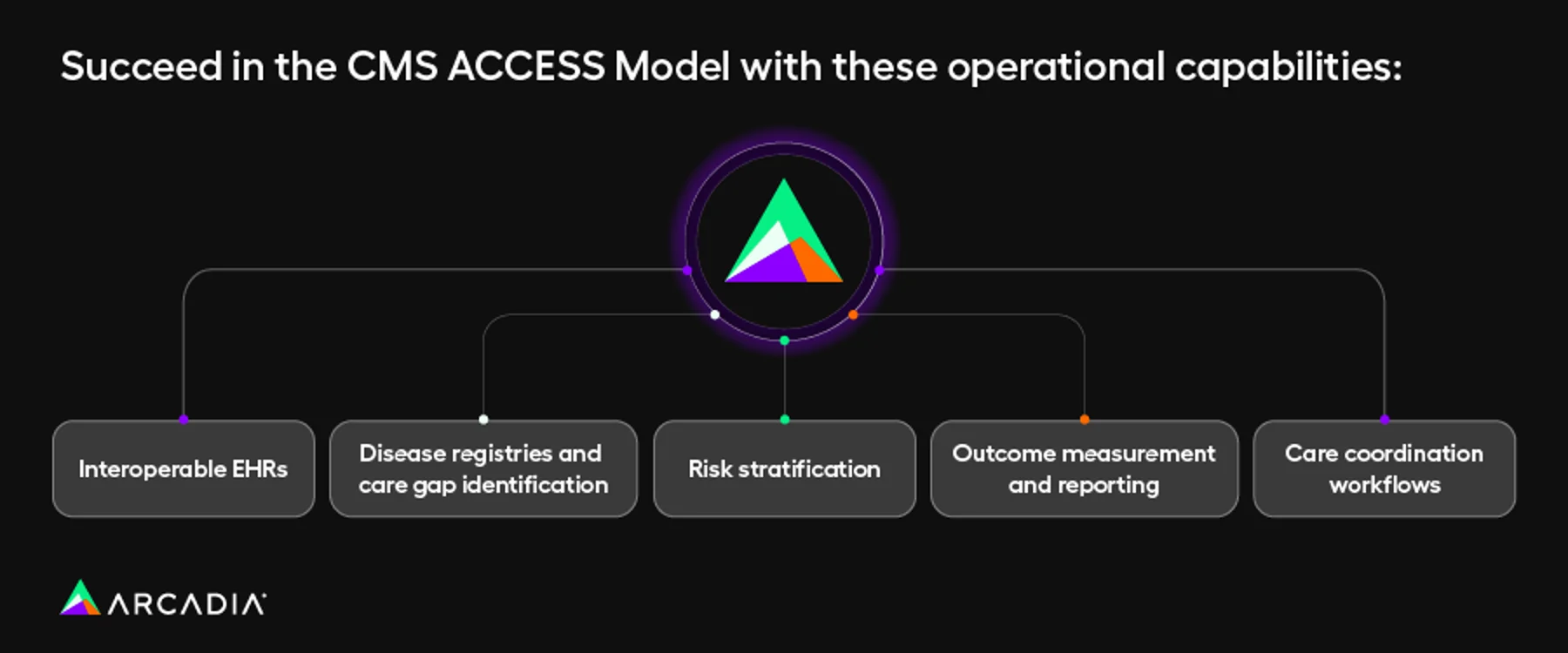
- Interoperable EHRs or data platforms that create a unified view of patient data across clinical and claims systems to provide a complete picture of each patient’s health, including comorbidities, medication adherence, and social risk factors.
- Disease registries and care gap identification to proactively identify which patients are off-track and need intervention, rather than waiting for them to experience health crises.
- Risk stratification to prioritize resources toward patients who are most likely to benefit from intensive intervention.
- Outcome measurement and reporting to track performance against targets in real time—not six months later when it’s too late to course correct.
- Care coordination workflows to ensure the right care team members engage with the right patients at the right intervals.
Audit your technology tools to ensure that your healthcare organization is prepared to succeed under ACCESS.
Who should apply to participate in the CMS ACCESS model
Not every organization is ready for ACCESS. Those who will thrive have already made the philosophical shift to population health. This means that:
- Financially, they’ve allocated prepaid revenue toward improving programs for better patient outcomes.
- Clinically, they’ve invested in care management.
- Technically, they’ve established robust data and analytics capabilities.
- Culturally, they understand that managing chronic disease relies on consistent, systematic, technology-enabled engagement that compounds over time.
New participants in the CMS ACCESS Model will be empowered to pursue new opportunities in new modes of chronic disease care, funded by ACCESS. This will impact current participants in value-based payment models, and those participants should carefully consider the risks of sitting on the sidelines.
CMS has made the trade-off explicit: if you can consistently improve patient outcomes, you can receive meaningful, recurring payments without the administrative burden of documenting and billing for every discrete activity.
But this opportunity will be budget-neutral, meaning there may be competition to own the credit for performance and savings. Organizations that take a hands-off approach to medical expense management or that manage quality in legacy CMMI models may find their margins impacted by new entrants who are driving squarely at disease-specific value opportunities via the ACCESS model.
A new value-based care approach
The operationalization of value-based care represents a moment of disruption, in the sense that it is a new approach that starts at the margins, addresses needs the existing system struggles with, and has the potential to fundamentally change how an industry operates. With the CMS ACCESS Model, outcome-based payment is here and available to healthcare organizations. The question now is whether you’re ready to begin the journey toward better patient outcomes.