Artificial intelligence (AI) is revolutionizing the healthcare industry at a rapidly increasing pace. As of 2026, 75% of U.S. health systems are using at least one artificial intelligence application, and 94% of payers are either leveraging or actively adopting AI. Health leaders are using AI tools to identify trends, create intervention strategies, optimize electronic health record (EHR) workflows, and improve many other processes at their organizations.
However, concerns about adopting AI in the healthcare industry are still present. That’s why, in this article, we’ll address the most frequently asked questions about AI tools in healthcare and the leading platforms for payers and providers to consider.
FAQs about AI tools in healthcare
What types of AI tools are used in healthcare?
Generally speaking, AI tools in healthcare include generative AI, predictive modeling, natural language processing (NLP), computer vision and medical imaging, intelligent robotic process automation (RPA) solutions, and agents. Here is a breakdown of each of these types of AI tools:
Generative AI
Generative AI uses advanced algorithms to create new content to support enhanced decision-making and workflow automation. There are several generative AI models, but the two most commonly used in healthcare are:
Large language models (LLMs): A type of AI model designed to understand and generate human language, such as text generation or language translation
Generative adversarial networks (GANs): A class of machine learning model framework designed to generate new data, such as images or audio
Generative AI in healthcare has proven especially useful for administrative use cases, helping providers and payers automate routine communications, draft documentation, and surface relevant clinical context from complex records. It also plays a growing role in clinical summarization, which reduces cognitive burden by streamlining chart reviews.
Predictive modeling is the process of using mathematical algorithms to predict what will likely happen in the future. This process involves four stages:
Data collection: Gathering information from various sources, including proprietary structured and unstructured data, public health records, and cutting-edge technologies like wearable devices
Preprocessing: Cleaning data to ensure accuracy and relevancy
Modeling: Using data algorithms to make predictions and recommendations for specific patient populations
Interpretation of results: Moving forward with strategic decision-making and policy formulation based on data
Natural language processing (NLP)
Computers understand human language through natural language processing (NLP) technology, which is highly beneficial in helping health leaders extract insights from unstructured medical data. This AI uses algorithms to analyze and interpret text from medical records or notes.
Computer vision and medical imaging
Computer vision and medical imaging AI tools are trained on millions of images so they can identify anomalies and flag critical, urgent, or concerning patient conditions. For example, a medical imaging AI might analyze a radiology practice’s chest MRIs and CT scans and notify the provider if the patient’s scans show they might be experiencing an aortic aneurysm or pulmonary embolism. These insights help physicians effectively triage their patients, resulting in better care delivery and better patient outcomes.
Intelligent robotic process automation (RPA)
Intelligent RPA upgrades traditional, rule-based bots by integrating machine learning and natural language processing. This way, the software can process unstructured data and handle decisions and complex exceptions that would normally require human intervention.
For example, rather than having a human billing specialist manually review a chart to submit a prior authorization request, an intelligent bot can extract the necessary clinical evidence from a scanned PDF, log in to a payer's portal, verify insurance eligibility, and automatically submit the required paperwork. This automation drastically reduces administrative overhead, accelerates the billing cycle, and minimizes the human data-entry errors that frequently lead to claim denials.
Agentic AI
While generative AI synthesizes information to answer user prompts, agentic AI can take autonomous action. A professional first gives AI “agents” a goal, and they can independently plan steps, interface with external software (like EHRs), and adapt to new information to complete that goal. Essentially, they operate as an active, digital co-worker capable of executing multi-step workflows.
How is AI used in healthcare?
AI tools offer wide-ranging capabilities that improve efficiency and drive better outcomes across the healthcare ecosystem. Providers can use AI to enhance clinical workflows and decision-making, while predictive models help payers stratify member risk and optimize utilization management.
Let’s look at a few specific applications and benefits of AI across the healthcare sector.
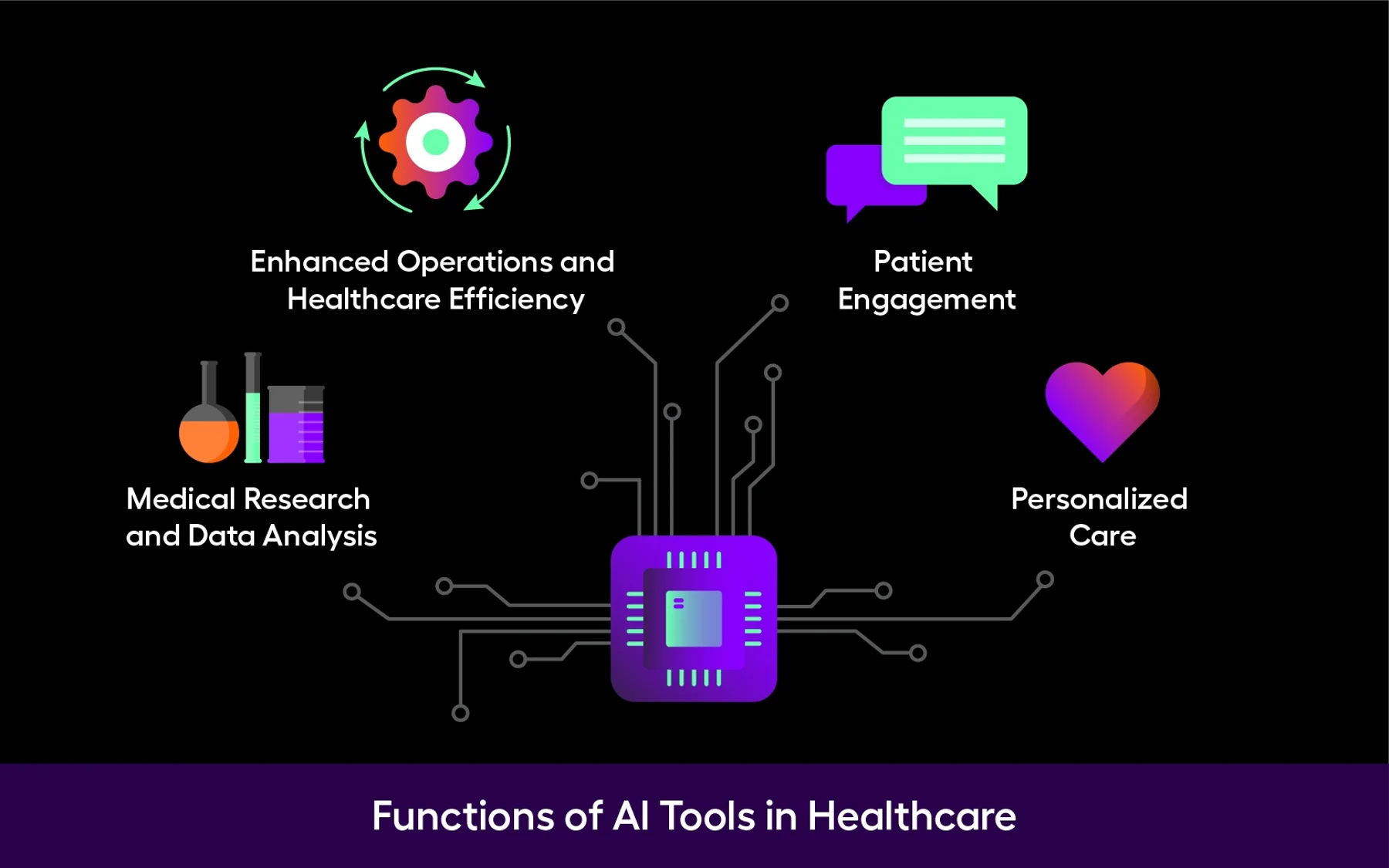
Enhanced operations and healthcare efficiency
Health teams across the care continuum can use AI-powered analytics platforms to analyze their performance and identify opportunities for improvement. Specifically, AI tools can:
Streamline administrative tasks. Since more than half of a clinician’s time is spent on activities outside of patient care, AI tools have a significant opportunity to streamline workflows by automating essential administrative tasks, such as patient scheduling and data management
Accelerate data analysis. LLMs, in particular, can automate the process of summarizing patient data by reading through EHRs to understand patients’ medical histories and identify trends or diagnoses
Reduce medical errors. Integrating AI into EHRs could reduce medical errors, such as misdiagnoses or prescription mistakes, by ensuring health teams don’t miss important information
Smaller organizations have a significant opportunity to optimize their limited resources and use AI to fill administrative gaps. Watch the clip below for an explanation from Jake Hochberg, Chief Data Officer at Arcadia:
AI tools have the potential to optimize workflows and efficiency across many healthcare functions.
Medical research and data analysis
Generative AI’s ability to analyze and glean insights from vast amounts of healthcare data can uncover hidden patterns and correlations not immediately apparent to human researchers. These insights can offer new understanding and breakthroughs, driving medical research through:
Drug discovery: AI can analyze the chemical structure of successful drugs and generate formulas for potential drug candidates, accelerating the drug discovery process
Clinical trial simulation: By creating virtual patient populations and identifying potential problems that may arise during clinical trials, generative AI can aid in predicting the safety of new drugs
Plus, this technology can significantly speed up research by automating data analysis and generating hypotheses for testing.
Patient engagement
Health organizations can leverage generative AI in healthcare to reach more patients in the ways they feel most comfortable. Such tools enable providers to communicate with and serve more patients without adding more burden to current staff.
“”
AI can help us with chatbots starting to reach out to patients more directly. Email is archaic; they don’t use it anymore. Calling people; they don’t answer the phone. But chatting they feel really good about.
Luis M. Ahumada
Director of Health Data Science and Analytics at Johns Hopkins All Children’s Hospital
This is especially helpful for sharing personalized educational content or interactive learning experiences. For example, generative AI can produce information about managing blood sugar levels to share with a patient with diabetes. The AI tool can also generate responses to the patient’s questions about their diagnosis, helping them better understand their condition.
Personalized care
Data analysis can inform decisions on patient care. AI optimizes this process by analyzing a patient’s genetic makeup and medical history to create personalized treatment plans that address each stage of a patient’s care:
Diagnosis: Researchers can train generative models to identify patterns related to diseases based on medical records and imagery
Treatment: Generative AI can apply its analysis to decision-making tasks, such as proposing a treatment plan. It can also help organizations make better decisions about which facilities or specialists to direct their patients to for care.
Follow-up: AI can leverage real-time data from monitoring devices to offer personalized recommendations based on patients’ adherence to post-treatment advice
In addition, analyzing patient data using AI can uncover social determinants of health (SDoH) and help patients overcome transportation or financial barriers that prevent individuals from getting care.
What challenges surround AI implementation in healthcare?
Despite AI’s clear benefits to the healthcare ecosystem, AI tools are not yet fully accepted and adopted across the healthcare sector. Hesitations typically result from:
Mistrust: Research suggests that many patients are uncomfortable with providers using AI for care delivery, particularly because they doubt the technology can improve outcomes.
Staff limitations: According to market research by Arcadia and The Harris Poll, only 54% of IT leaders are confident in their ability to implement a solution successfully. Furthermore, 40% of health leaders cite a lack of talent as a top challenge for adopting AI, indicating a shift in the skills CIOs expect from their teams.
To address these obstacles, it’s critical to understand that AI tools require accurate data to perform well. By leveraging vast amounts of healthcare data, this technology can ultimately transform patient care. A healthcare data analytics platform can deliver a high-quality data asset to AI models by aggregating and storing data in a single platform and then feeding it to AI models and tools across your ecosystem.
1. Arcadia — Best AI-first healthcare data analytics platform
Arcadia is a leading healthcare data platform that activates data, workflows, and AI to fundamentally change what administrative and care teams can do. Its AI-first capabilities support rapid, scalable data acquisition and aggregation in a single platform. These agentic AI capabilities are integrated throughout its ecosystem and include features like:
Chart Summarization: Arcadia offers a generative AI assistant that pulls from multiple data sources to provide a 360-degree view of patients. It enables care teams to make more informed decisions about patient care—including interventions, behaviors to highlight, and social service recommendations—resulting in better patient outcomes.
Quality Engines: Enrich your data with AI-powered analytic engines designed for population health management and value-based care. Arcadia’s tools deliver valuable insights for improved predictive analytics and patient stratification.
Patient Engagement: Efficiently target and automate patient communication with Arcadia’s AI-enabled audience segmentation algorithms and insights, which can empower patients to take control of their health journeys.
Conversational Analytics: Speed up the flow of insights and lighten your analytics team’s research workload with an AI analytics chatbot, which allows your team to ask time-sensitive data questions. There is no need to build code and run queries—Arcadia’s AI will process your data and deliver you the answers you need.
Data Quality: Arcadia’s healthcare AI tools will improve data quality by monitoring data pipelines for abnormalities, helping you identify and resolve issues.
Document Pipeline: AI will process your SOAP notes and visit summaries to extract condition suspects, making diagnosis easier and ensuring patients get the care they need as soon as possible.
Beyond these features, Arcadia’s platform also offers an ecosystem of over 100 AI models that support various media types, including text, images, video, and audio.
“”
Arcadia allows Baptist Health Arkansas to cut down development time and charged hours, saving them weeks to months of development and prioritization time and allowing analysts to turn requests around quickly and get increased familiarity with the data.
2. AWS HealthLake — Best for modernizing data architecture
Amazon Web Services' HealthLake enables health teams to understand, organize, and store raw health data in the Fast Healthcare Interoperability Resources (FHIR) industry-standard format. This analytics and AI solution uses machine learning (ML) models to extract structured data from unstructured text, which is ideal for large systems looking to modernize their data architecture.
3. N1 Health — Best for predictive patient engagement
N1 Health’s AI platform specializes in predictive modeling, combining clinical, social, and behavioral data to identify members’ health and engagement needs. With this technology, payers can build targeted patient personas to strategically plan engagement approaches that improve patient satisfaction.
4. Atropos Health — Best for real-world clinical evidence
Atropos Health leverages the power of generative AI in healthcare to deliver real-world evidence and precision medicine insights. By accelerating access to evidence-based answers for clinical questions, Atropos Health empowers clinicians and analysts to make data-driven decisions about patients’ needs.
5. Persivia — Best for collaborative care delivery
Persivia’s AI-powered tool combines real-time analytics with powerful AI models to automate workflows and improve outcomes. This integrated platform enhances collaboration between providers, payers, and members by integrating all functionalities needed for the care delivery process into one solution.
6. HealthHelper — Best for automated patient scheduling
HealthHelper provides an AI-enabled care coordination platform that acts as a virtual extension of the clinical front desk. The technology integrates directly with existing EHR systems to autonomously identify patient care gaps, conduct multi-modal outreach, and seamlessly schedule appointments, keeping patients in-network and boosting quality scores.
7. Snowflake — Best for healthcare data warehousing
Snowflake brings your healthcare organization’s data into an AI data cloud, connecting you to your entire data estate. Its built-in Snowflake Intelligence allows users to ask complex data questions to an AI assistant, helping all types of healthcare and life sciences organizations understand what’s happening, why it matters, and what to do next.
8. Vim — Best for point-of-care EHR integrations
Vim connects data, applications, and AI within its EHR to ensure you have all the tools you need directly at the point of care. It integrates with AI medical scribe tools and provides a marketplace for AI-powered apps that can be instantly deployed to your EHR for a seamless experience.
9. Merative — Best for employer health analytics
Merative built its Truven solution to deliver key insights and actionable recommendations to large employers, health plans, and benefits advisors. Its Springbuk Health Intelligence™ platform uses AI to process employee health and benefits data. These tools give employers and benefits advisors the information they need to make confident decisions about employee health plans and benefits.
10. Ada — Best for patient symptom triage
Ada is an AI-powered symptom assessment tool for clinicians and patients. Ada asks users a series of personalized medical questions and evaluates symptoms against a vast medical knowledge base to guide patients to the appropriate care. This in-depth understanding empowers patients to make informed decisions about their health and helps healthcare providers optimize clinical routing.
Next steps: The future of AI tools in healthcare
AI tools in healthcare are no longer just a possibility—they’re a reality, and they’re transforming the industry. To keep up, healthcare organizations must implement technology that supports an unshakable data infrastructure and, therefore, informed decision-making.
The American College of Surgeons (ACS) and Arcadia announced a new collaboration to support the ACS Clinical Data Strategy, modernizing how surgical clinical data is collected,...
Healthcare analytics software transforms raw data into actionable insights. Explore these top providers to choose the best solution for your healthcare team.
Healthcare analytics refers to the thoughtful use of data and statistical analysis techniques in the healthcare industry. Read this guide to learn more.