19 min
 For many healthcare organizations, limited visibility into contract performance can lead to revenue leakage from underpayments, missed contract terms, and reimbursement variances. Healthcare contract management software streamlines the entire contract lifecycle, from creation to execution to continued performance monitoring. With the right solution, healthcare providers can reduce financial losses, while healthcare payers can improve payment accuracy and better manage the financial performance of value-based care contracts.
This article covers everything you need to know about contract management in healthcare, including:
- FAQs about healthcare contract management
- Essential healthcare contract management software features
- 9 Best healthcare contract management solutions
- Steps to implement contract management software for healthcare
FAQs about healthcare contract management
Here is a quick overview of what we’ll cover. Click on any question to learn more about the answer.
- What is contract management in healthcare? The process of creating and executing contracts between vendors, payers, and providers.
- What are the stages of contract lifecycle management (CLM) in healthcare? Request, draft, negotiate, approve, execute, comply, and renew a contract.
- Why is effective contract management important in healthcare? Benefits include increased operational efficiency, improved financial performance, risk mitigation, and compliance.
- What is healthcare contract management software? Solutions that streamline contract lifecycle processes by centralizing and automating key workflows.
- How does contract management software benefit healthcare organizations? It centralizes data, automates workflows, drives financial efficiency, informs performance strategy, and ensures compliance.
- What are the challenges of implementing healthcare contract management software? Data standardization, system integration, and resistance to adoption.
What is contract management in healthcare?
Contract management in healthcare is the process of creating and executing contracts between providers, payers, and/or vendors. It involves overseeing every step of the process, including initial contract development, negotiation between parties, and ongoing monitoring to ensure optimal performance and compliance with the agreement.
What are the stages of contract lifecycle management (CLM) in healthcare?
Request, draft, negotiate, approve, execute, comply, and renew are the seven steps of contract lifecycle management. Here is a breakdown of each of these steps:
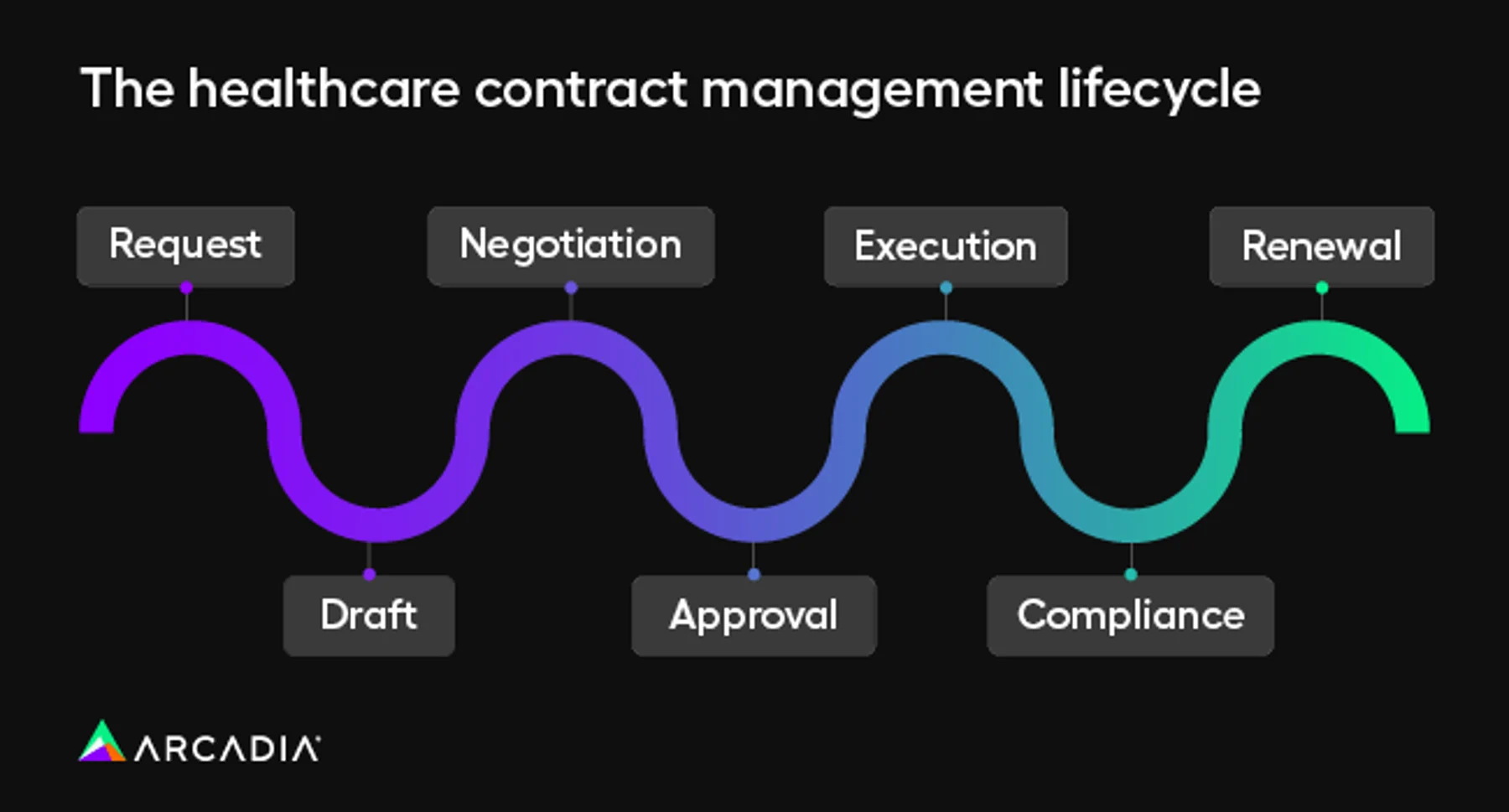
- Request: When a healthcare organization wishes to expand a line of business, like risk-bearing Medicare Advantage arrangements, it first defines key details such as the contract’s purpose and term.
- Draft: Once a department head or executive leader approves the request, the organization’s legal team drafts the initial contract.
- Negotiate: The contract initiator and the counterparty discuss and adjust terms as needed to reach a mutually beneficial agreement.
- Approve: Relevant stakeholders, like legal and financial departments, review and approve the agreed-upon contract.
- Execute: All parties involved sign the contract, finalizing the agreement.
- Comply: Contract managers and compliance officers continuously monitor performance to ensure all parties meet their contractual obligations. In this stage of contract execution, performance management—such as achieving quality performance benchmarks—is critical to maximize revenue.
- Renew: As the contract approaches its end date, the parties involved decide whether to renew it or let it expire.
Why is effective contract management important in healthcare?
Effective contract management improves many aspects of healthcare administration, including:
- Operational efficiency: By standardizing contracting workflows, organizations achieve greater accuracy and efficiency, resulting in faster approvals and significantly reduced administrative overhead.
- Financial performance: Proactively monitoring contract performance healthcare organizations to identify, act on, and maximize revenue opportunities.
- Risk mitigation: Contract oversight empowers organizations to track and maximize performance, helping them avoid penalties for not achieving their goals in downside risk.
- Compliance: Efficient contract management ensures that all contracts follow industry regulations, including HIPAA and the Stark Law.
The most effective path to strong contract management is implementing software dedicated to managing the contract lifecycle.
What is healthcare contract management software?
Healthcare contract management software describes solutions that streamline contract lifecycle processes by centralizing and automating key workflows. This software centralizes all contracts and tracks obligations to provide insight into performance and other metrics.
How does contract management software benefit healthcare organizations?
Healthcare contract management software delivers value in the following ways:
- Centralizes data: Contract management software consolidates all agreements into a single, secure location, keeping every department on the same page regarding contract terms and obligations.
- Automates workflows: Health teams use contract software to model interventions to understand what scenario(s) achieve their goals and maximize performance.
- Ensures compliance: With features like role-based access, this software comprehensively protects sensitive data.
What are the challenges of implementing healthcare contract management software?
Challenges associated with implementing healthcare contract management software include data standardization, system integration, and resistance to adoption. These challenges exist because:
- Data standardization remains a primary hurdle when migrating contract data, as legacy systems and disparate formats often present challenges to seamless unification.
- System integration with existing enterprise and financial software is essential for contract management tools to work effectively.
- Resistance to adoption often stems from a preference for established manual processes. Overcoming this hurdle requires robust training and strategic change management to ensure a successful rollout.
Essential healthcare contract management software features
Contract creation
Healthcare contract management software provides a user interface where teams can create new contracts, including metadata that helps team members locate them later. This way, all contracts live in a single interface where different users can access them.
To help healthcare teams create contract templates, this software accepts raw files and uses large language models (LLMs) to analyze the unstructured text and automatically extract:
- Key terms (e.g., expiration dates, renewal terms, and payment schedules)
- Mandatory clauses (e.g., indemnification, termination rights, and confidentiality agreements)
- Metadata (e.g., contract type, responsible parties, and associated departments)
The best solutions are built for scale and can handle a wide range of complex contracts, including MA, MSSP, ACO REACH, Medicaid, and commercial. By automating this complex data extraction process, contract software ensures data accuracy and enables professionals to focus on strategic review and negotiation rather than tedious manual data entry.
Data sharing
Healthcare contract management software centralizes the entire contract lifecycle, enabling authorized team members to collaborate on each phase. The software dismantles data silos, allowing information to flow freely (but securely) between departments and aligning all parties on shared performance goals. It enables health organizations to:
- View all contracts in a single, centralized location
- Add value-based care parameter summaries to contracts
- Tag contracts with statuses, such as negotiation, draft, and active
- Attach contract documents to the corresponding organization
- Create workflows to organize and manage contract-related operations
This transparency enables health organizations to monitor:
- Compliance: The software provides a real-time, auditable trail of all contract activity, amendments, and approvals. It actively tracks adherence to regulatory requirements (such as HIPAA, state laws, and payer mandates), key performance indicators (KPIs), and service-level agreements (SLAs).
- Potential risks: By continuously monitoring contract terms, expiration dates, renewal cycles, and performance against defined metrics, the system proactively identifies and flags potential financial, legal, or operational risks. Risks could include underperforming agreements, clauses that expose the organization to undue liability, and expiring contracts that could disrupt essential services.
- Agreement efficacy: Contract management software measures whether the negotiated terms translate into desired outcomes. Specifically, the software cross-references expected patient outcomes and budgeted costs against actual care delivery costs, claims data, and patient health data.
By providing sophisticated analytical tools to cross-reference current performance against expected outcomes, contract management software empowers users to draft contracts that are fiscally responsible and directly support optimal patient care delivery.
Contract scenario modeling
Real-time data modeling helps health systems forecast the financial outcomes of different contract scenarios before finalizing any terms. With these insights, health systems can:
- Optimize contract terms to achieve the most financially advantageous combinations of rates, incentives, and risk-sharing models.
- Maximize value so that every contract aligns with the organization’s overarching financial goals and strategic objectives.
- Course-correct expense patterns to address any projected expense patterns or revenue leakages that deviate from desired outcomes.
Additionally, healthcare contract management software should have features that organize records by Tax Identification Number (TIN), NPI, practice, or primary care provider to understand how providers are performing and take the next steps necessary to keep results on track.
Contract software empowers stakeholders to have more productive, data-backed conversations during negotiations to develop performance-based proposals that make each contract more beneficial for all parties.
Actuarial forecasting
Total Cost of Care (TCOC) contracts in particular demand precise forecasting and robust performance tracking. Healthcare contract management software provides a comprehensive view of in-year financial performance across all TCOC contract types, including upside-only, downside-risk, and global capitation models.
These solutions combine contract-specific parameters with clinical performance data to calculate quality scores that help health teams understand each contract’s performance. With this information, organizations can leverage actuarial-grade modeling to accurately estimate revenue.
By incorporating contract-specific parameters and clinical data, the software can forecast the following financial outcomes:
- Shared savings projections: Precisely model the potential for shared savings by comparing performance to established benchmarks.
- Penalty risk assessment: Proactively identify and quantify potential penalties arising from quality failures or overutilization, enabling timely intervention.
- Cash flow visibility: Predict the timing and magnitude of contract-related cash flows to optimize financial planning and resource allocation.
Contract management software automates many of the complex, repetitive, and manual tasks associated with performance monitoring and financial modeling. This way, health systems can free up valuable staff time to focus on strategic initiatives, performance improvement, and patient care.
9 Best healthcare contract management solutions
| Provider | Target audience | Standout feature | Core contract capabilities |
|---|---|---|---|
| Arcadia | Finance, contracting, and actuarial leaders at ACOs, CINs, health plans | Contract modeling, forecasting, and financial optimization workflows that support pre-contract modeling, negotiation, and post-signature optimization | Data aggregation and interoperability, embedded agentic AI architecture, contract modeling, network modeling, quality measurement, risk adjustment |
| Quest Analytics | Health plans, payers, health system regulators | Evaluating provider network adequacy, steerage, and fee structure performance across geographic regions | Provider network design, contract adequacy analysis, fee schedule impact modeling, tiering optimization |
| Serif Health | Healthcare payers, provider groups, health system contracting teams | Ingesting machine-readable price transparency files to benchmark in-network commercial reimbursement rates | Rate benchmarking, transparency data analysis, fee schedule comparison, contract negotiation intelligence |
| symplr Contract | Hospitals, health systems, complex medical groups | Automated physician contracting and operational compliance management | AI-driven approval workflows, physician compensation tracking, clause libraries, e-signatures |
| Agiloft | Health systems, pharmaceutical companies, medical device organizations | No-code contract lifecycle management platform with custom healthcare workflow configurations | Contract request intake, AI-assisted clause analysis, obligation tracking, vendor lifecycle management |
| Ironclad | Large healthcare enterprises, health systems, digital health companies, enterprise legal teams | Complex cross-department approval routing and BAA management | AI contract intake, digital repository search, real-time collaboration |
| Contract Logix | Hospitals, health systems, health plans, managed care organizations, physician practices, ambulatory care centers, home health and hospices | Centralized cloud contract repository featuring automated OCR search and healthcare compliance audit trails | Automated contract repository, renewal alert tracking, clause management, custom reporting, contract profitability |
| Icertis Contract Intelligence | Enterprise health systems, large payers, pharmaceutical manufacturers, global healthcare organizations, life sciences organizations | Enterprise-grade AI contract platform managing complex multi-party risk-sharing agreements | Enterprise contract management features, commercial rate modeling, regulatory clause tracking, and obligation fulfillment monitoring |
| ContractWorks | Independent medical groups, ambulatory surgical centers, community healthcare facilities | Simple, affordable cloud contract repository with quick-setup OCR search and milestone alerts | Centralized document storage, automated email renewal reminders, basic clause tagging, and e-signature execution |
1. Arcadia
Arcadia Ascent™ is an AI-native healthcare performance platform that unifies trusted data, analytics, and workflows to improve quality, financial performance, and outcomes. As a single source of truth for your organization, Ascent is the trusted foundation that all of your health operations, including contracting, can rest upon.
Key Features
- Ascent™ Platform: Arcadia’s core platform aggregates data, AI engines, and workflows into a core system, ensuring that analytics, delivery, financial modeling, and AI all operate from the same insights.
- Ascent™ Connect: This component is what makes data interoperability possible. It enables seamless data ingestion, normalization, and operationalization, bridging the gap between raw data, advanced analytics, and meaningful clinical and operational action.
- AI Architecture: Arcadia embeds AI directly into workflows throughout its platform, rather than treating AI as a bolt-on to existing solutions. For example, contract files are automatically ingested and matched to contracting parameters, so you can monitor financial performance and forecast impact before they hit the bottom line.
- Ascent™ Finance: This module functions as a system of record for value-based care contract portfolio visibility, contract year-to-date performance, and forecasting. Built primarily for CFOs, finance, contracting/strategy, and actuarial users, it supports pre-contract modeling, negotiation, and post-signature performance optimization.
- Ascent™ Network: Arcadia’s network solution combines network modeling, market intelligence, referral analytics, and performance insights to enable healthcare organizations to design, evaluate, and optimize provider networks. Through these capabilities, it supports network growth and contracting strategy.
- Ascent™ Performance: This solution delivers a unified model for quality measurement, risk adjustment, and prospective documentation workflows, all of which can inform healthcare contracting. Ascent Performance™ empowers organizations to access accurate and timely quality and risk data.
Benefits
- Model complex contract terms, risk corridors, quality gates, and utilization assumptions in one environment
- Easily quantify upside and downside risk across contracts before financial exposure begins
- Enter contract negotiations with data grounded in historical and projected performance
- Strengthen board and executive communication with transparent, defensible contract forecasts
- Gain clear visibility into how contract strategy impacts organizational risk, return, and growth
Considerations
- Less focused on general legal contract workflows than some other tools
- Full contract modeling value depends on clean, well-governed source data
Arcadia’s data foundation is built to support this, but organizations with highly fragmented source systems may need a data readiness assessment first.
2. Quest Analytics
Quest Analytics is designed for situations in which contract management centers on provider network design. It’s a trusted leader in network design and management, focusing on assisting health plans, regulators, and health systems in building high-performing, compliant networks that improve access to quality care.
Key Features
- Provider network adequacy and geographic access modeling
- Contract impact simulation for provider additions, terminations, and tiering
- Data enrichment combining claims, attestation, and fee schedule metrics
- Automated regulatory compliance monitoring
- Integrated provider directory accuracy and attestation tools
Benefits
- Enables pre-negotiation modeling of provider contract terms and network impacts
- Ensures provider networks satisfy CMS and state adequacy requirements
- Provides clear visibility into geographic coverage and member steerage
Considerations
- Specialized for network design rather than end-to-end legal contract lifecycle management
- Less focused on direct longitudinal care coordination or patient-facing clinical workflows than some tools
3. Serif Health
Serif Health is designed for situations in which contract management relies on price-transparency intelligence and rate benchmarking. Payers and providers can use Serif Health to parse machine-readable files, compare commercial reimbursement rates, and negotiate data-driven fee schedules.
Key Features
- Machine-readable price transparency data parsing
- Commercial rate benchmarking and comparison
- Fee schedule modeling across geographies
- Payer-provider negotiation intelligence tools
- Contract rate analytics dashboards
Benefits
- Provides clear visibility into competitor and market reimbursement rates
- Strengthens payer-provider contract negotiation leverage
- Replaces estimated rate benchmarks with actual price transparency data
Considerations
- Does not directly aggregate EHR clinical data or track care quality
- Targets large and enterprise-level health systems and may be cost-prohibitive for smaller healthcare organizations
4. symplr Contract
Enforcing strict healthcare regulatory guardrails is the primary focus of symplr Contract’s solution. Purpose-built for hospitals and health systems, this platform automates the entire legal contract lifecycle and embeds mandatory compliance checks directly into physician agreements.
Key Features
- Automated healthcare contract lifecycle workflows
- Physician compensation and FMV compliance tracking
- Pre-approved clause and template libraries
- Electronic signatures and approval routing
- Centralized healthcare contract repository with audit trails
Benefits
- Purpose-built to protect health systems against healthcare regulatory violations
- Streamlines physician contract creation, approval, and renewal tracking
- Reduces legal risk through standardized compliance guardrails
Considerations
- Requires extensive upfront configuration, metadata mapping, and onboarding timelines for enterprise deployment
- Complex, rigid reporting views often necessitate technical support for custom audit trail exports
5. Agiloft
For health systems and life sciences companies with non-standard approval hierarchies, Agiloft offers a highly customizable, no-code contract management environment. Legal and procurement teams can use Agiloft to build custom intake forms, automate vendor agreements, and track internal obligations without writing custom code.
Key Features
- No-code platform customization and workflow builder
- AI-assisted clause extraction and risk analysis
- Automated contract request intake and approval routing
- Vendor and supplier lifecycle management
- Obligation, milestone, and renewal tracking
Benefits
- Adapts easily to unique organizational and approval structures
- Provides strong AI capabilities for scanning contract risks and clauses
- Scales across clinical, legal, procurement, and vendor contract types
Considerations
- High initial setup complexity and administrative burden
- Lack of pre-built healthcare compliance rules out of the box
6. Ironclad
Ironclad brings modern AI automation and collaborative features to high-volume healthcare legal departments. This platform helps eliminate administrative bottlenecks around business associate agreements (BAAs), streamline cross-departmental reviews, and speed up signature cycles for digital health providers and hospital systems.
Key Features
- AI-powered contract drafting, redlining, and clause analysis
- Automated BAA generation and tracking
- Dynamic workflow builder for legal and business teams
- Centralized smart repository with advanced metadata search
Benefits
- Accelerates contract turnaround time with modern user experience and AI tools
- Simplifies BAA and vendor compliance tracking for healthcare teams
- Fosters seamless collaboration between legal, procurement, and operational departments
Considerations
- High subscription pricing models favoring enterprise health systems over mid-market groups
- Steeper onboarding curve for non-legal clinical staff unaccustomed to real-time digital redlining tools
7. Contract Logix
Contract Logix is designed for mid-market to enterprise healthcare organizations and outpatient networks where contract management requires secure document centralizing, automated optical character recognition (OCR) search, and compliance tracking. This platform can also digitize contract archives, enforce approval policies, and track key renewal deadlines.
Key Features
- Centralized cloud repository with OCR full-text search
- Automated contract approval workflows and e-signatures
- Built-in clause library and document template builder
- Compliance auditing and historical revision tracking
Benefits
- Simple to implement and adopt across mid-sized healthcare administrative teams
- Minimizes missed renewals through automated email and system alerts for expirations
- Ensures tight security and user permissions for sensitive contract documents
Considerations
- Less advanced AI-assisted redlining and risk-scoring engines compared to other contract management software
- Static dashboard visualizations with limited out-of-the-box analytical customization
8. Icertis Contract Intelligence
Built for global healthcare conglomerates, enterprise health systems, and large payers, Icertis handles multi-party contracting at massive scale. This enterprise platform uses AI to convert complex commercial agreements, pharmaceutical rebates, and multi-tiered supplier contracts into structured data that feeds back-office ERP systems.
Key Features
- Enterprise AI for contract risk assessment and clause extraction
- Complex multi-party and multi-tier contract structure modeling
- Commercial rate modeling and rebate management
- Integrations with enterprise ERP, CRM, and procurement suites
Benefits
- Translates unstructured contract terms into measurable operational obligations
- Strong compliance coverage across international and federal healthcare mandates
- Integrates seamlessly into enterprise back-office architectures
Considerations
- Lengthy, resource-intensive deployment cycles often require assistance from third-party implementation partners
- Steep learning curve and complex interface for regional health systems or independent groups
9. ContractWorks
When independent medical groups and ambulatory centers need straightforward contract tracking without the overhead of enterprise software, ContractWorks provides a low-cost solution. The platform allows small clinical teams to upload documents, execute digital signatures, and set automated renewal reminders within minutes.
Key Features
- Fast-setup cloud contract repository with OCR search
- Built-in electronic signature capability
- Automated renewal and expiration alert notifications
- Role-based access control and folder permissions
- Built-in reporting and contract summary dashboards
Benefits
- Low entry cost and fast implementation timeline
- User-friendly interface requiring minimal training for clinical administrative staff
- Straightforward security controls and HIPAA-compliant storage
Considerations
- Minimal workflow routing for multi-department approval chains or conditional sign-offs
- Basic reporting capabilities with no advanced obligation tracking or custom analytic views
Steps to implement contract management software for healthcare
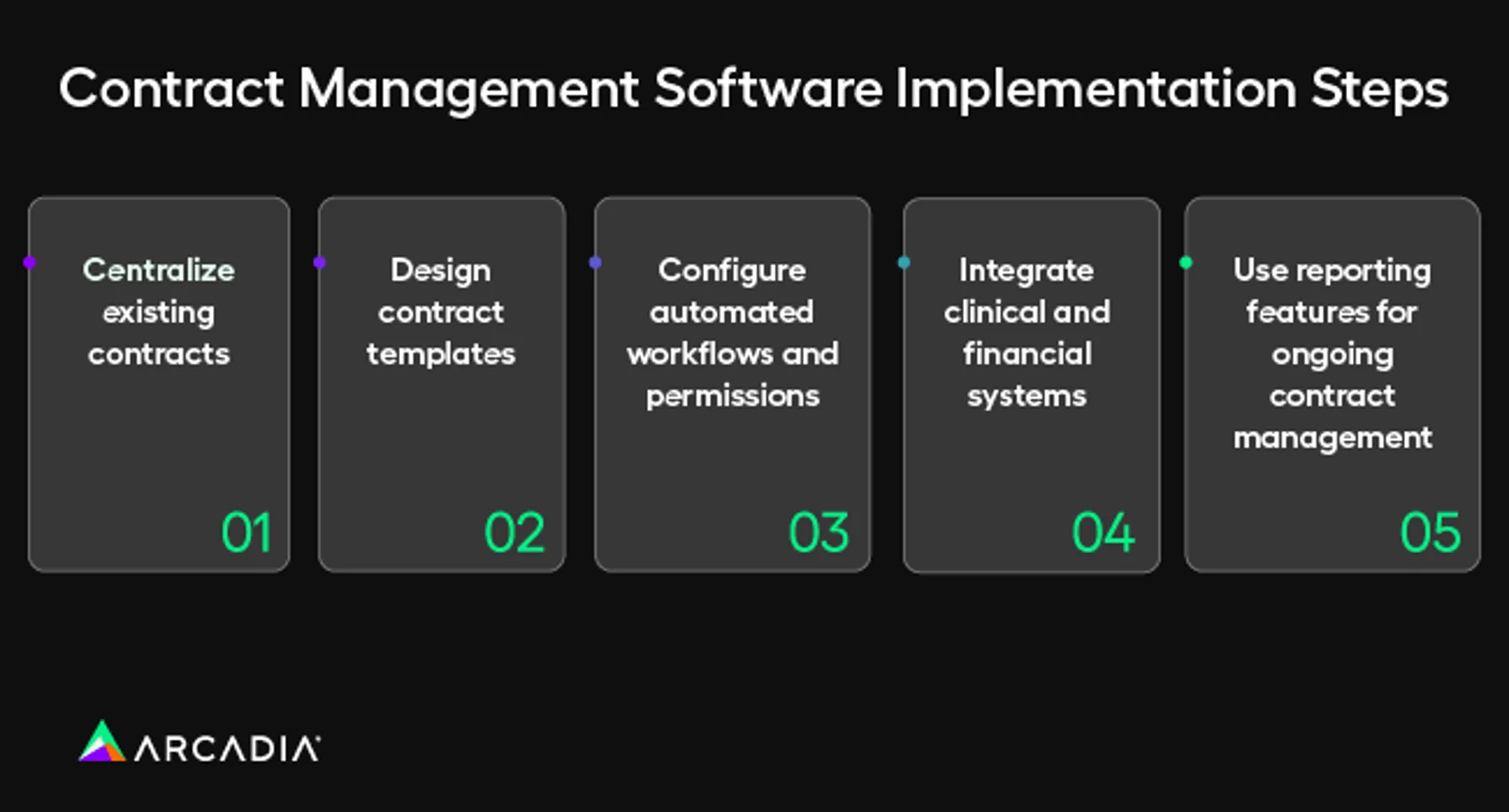
Centralize existing contracts.
When implementing contract management software, healthcare organizations must first take stock of any agreements that are already in place. Gather all existing contracts into a single secure location, removing any duplicates or expired agreements that no longer require active management.
Design contract templates.
Compiling existing contracts can give you an idea of what types of contracts you create most often. Then, you can use your software’s templating tool to develop standardized versions for high-volume agreements, such as:
- Physician employment contracts
- Procurement contracts
- Business associate agreements (BAAs)
Additionally, develop a “playbook” of pre-approved clauses and language for common points of contention, such as indemnification or data breach notification timelines. This allows non-legal staff to safely handle initial drafts without constant legal oversight.
Configure automated workflows and permissions.
At this stage, you should map out approval paths based on contract type or value. For example, any contract over a certain dollar amount might automatically trigger a notification to the CFO for approval.
Also, implement role-based access controls so that only authorized staff can view relevant data. For example, the organization’s human resources department will need to see employment terms, while a procurement team should have access to vendor agreements. Ensure the system is configured with Multi-Factor Authentication (MFA) and Single Sign-On (SSO) to meet SOC 2 and HIPAA security standards.
Integrate clinical and financial systems.
Linking contract terms to clinical and financial data allows healthcare organizations to track performance against negotiated terms, particularly for value-based agreements. Connect your contract management software with the rest of your organization’s technology, including:
- Electronic Health Record (EHR) systems to directly draw clinical data points (such as procedure codes and readmission rates) into performance reporting.
- Revenue Cycle Management (RCM) systems to connect contractual payment terms, fee schedules, and reimbursement rates with billing and claims processing data.
- Utilization Management (UM) and Case Management systems to track service authorization, medical necessity, and patient pathways, which are often key factors in measuring contract compliance and shared risk performance.
Use reporting features for ongoing contract management.
To manage existing contracts, leverage the software’s automated alerts and real-time dashboards to monitor performance against benchmarks throughout the year. These reporting features allow users to:
- Identify underpayments
- Track upcoming renewal windows
- Monitor quality performance that yields shared savings
Final thoughts on healthcare contract management software
Transitioning to a dedicated healthcare contract management platform is a strategic necessity for maintaining financial sustainability. By unifying clinical, financial, and claims data, these solutions replace anecdotal decision-making with trustworthy, actionable intelligence. Ultimately, effective contract management ensures that incentives remain aligned across payers and providers, reducing risk and allowing care teams to focus on delivering quality, whole-person care.