Healthcare data management software: A comprehensive guide
Data management in healthcare is critical but complex. As the industry’s data volume grows (at a compound annual growth rate of 36%), managing health data becomes increasingly difficult. Without proper governance from the outset, organizations risk introducing low-quality data and receiving skewed or inaccurate results.
Healthcare data management software offers a promising solution to enhance operational efficiency and improve patient outcomes. These solutions serve many purposes, delivering the tools needed to improve performance across the entire healthcare ecosystem.
This article offers a comprehensive overview of data management solutions and their capabilities, including:
FAQs about healthcare data management software
Here are the main takeaways about data management tools in healthcare:
- Healthcare data management software collects, stores, and analyzes vast amounts of health data.
- Types of data management tools include data aggregation, data analytics, and comprehensive solutions that handle both.
- Effective data management software is interoperable, secure and compliant, scalable, and user-friendly.
- Data management tools deliver benefits such as enhanced operational efficiency, improved patient outcomes, and clinical precision.
What is healthcare data management software?
Healthcare data management software is a category of technology that collects, stores, and analyzes vast amounts of health data. Unlike standard databases, these systems can handle the volume and complexity of healthcare data. Additionally, these solutions use integration analytics features into existing workflows to deliver valuable insights that can improve patient outcomes and increase operational efficiency.
What are the key types of healthcare data management solutions?
The most common types of healthcare data management solutions include data aggregation software, data analytics technology, and comprehensive solutions that handle data collection, management, and analytics.
Data aggregation software
Aggregation is a crucial step in the healthcare data management process. It involves aggregating information from various sources while striking a balance between interoperability and data privacy. Healthcare data management software provides a unified platform for combining and organizing data, making it an indispensable tool for effective information management.
Data aggregation technology is built on robust data warehouses that collect multiple types of data in a central repository. These solutions allow users to break down data siloes and glean insights from various sources.
Data analytics technology
Analytics in healthcare refers to the process of modeling and examining data to draw useful conclusions and inform decision-making. However, 67% of healthcare organizations say the inability to effectively analyze data is their primary obstacle to improving patient outcomes.
Analytics software applies data algorithms, including artificial intelligence (AI) and machine learning technologies, to turn raw data into accurate insights. This technology relies on effective data collection and integration to facilitate powerful analysis.
A strong solution pairs analytics with actionable tools for effective patient care. For example, chronic care management tools enable providers to act on conclusions drawn from data analysis by updating care plans and exchanging information with other providers.
Comprehensive data collection, management, and analytics software
Modern industry leaders are increasingly moving toward end-to-end platforms that handle the entire data lifecycle. These comprehensive systems combine robust integration, high-security storage, self-service analytics, and workflow tools into one interface. This consolidation ensures that individuals making clinical decisions are working from the same data as analysts and executives.
What should healthcare organizations look for in data management systems?
When evaluating software, healthcare leaders should prioritize solutions that exhibit the following characteristics:
- Interoperability: Can the solution you’re considering integrate with your organization’s existing systems, such as your electronic health records (EHRs)?
- Data quality: Does the software deduplicate patient records and "clean" the data so it’s actually usable for reporting?
- Security and compliance: Is the data platform HITRUST-certified and HIPAA-compliant? Does it offer AES-256 encryption and granular audit trails?
- Scalability: Can the system handle the exponential growth of data, including unstructured notes and medical imaging?
- Ease of use: Is the interface intuitive enough for clinicians and administrators to use without needing a degree in data science?
What are the benefits of using healthcare data management software?
Implementing a robust data management strategy can provide the following advantages for your organization:
- Enhanced operational efficiency: Operational efficiency is of utmost importance in combating burnout for health teams, especially considering that physicians are 82% more likely to experience burnout than professionals in other occupations. Data management software enhances efficiency by automating analysis workflows and providing real-time data.
- Improved patient outcomes: Modern data platforms enable predictive modeling, allowing providers to identify at-risk patients earlier and implement timely interventions. Therefore, data management and analysis directly impact providers’ ability to proactively address patient health needs before complications arise.
- Clinical precision: By providing health teams with instant access to comprehensive information, healthcare data management software informs accurate medical decisions. Ultimately, data drives optimized treatment plans and a faster path to effective therapies, ensuring each patient receives the right treatment at the right time.
Healthcare data management challenges (and solutions)
While the value of healthcare data is undeniable, effective management presents significant obstacles.
This is no shock — data is critical, but it can also be a mess. There’s unstructured data, and there’s structured data, and many people know the pains of those systems that don’t allow these types of data to talk to each other.
Healthcare data management software can address these complexities in the following ways:
Challenge: The volume, variety, and velocity of data can overwhelm legacy systems. This makes it difficult to ensure data is accurate, timely, and accessible.
Solution: Healthcare data’s complexity requires advanced tools and strategies to manage it effectively. This approach enables providers to leverage data for better decision-making and improved patient outcomes.
Challenge: In data management, there is a constant balancing act between completeness, accuracy, and timeliness. High accuracy may require more time for validation and verification, potentially delaying access to data. But prioritizing timeliness might result in slightly less accurate data.
Solution: Healthcare organizations need to find a balance that meets their specific needs. This will ensure that data is accurate enough to be reliable while also being available the moment it’s needed.
Challenge: Data silos across disparate systems make it difficult to integrate information and gain a comprehensive view of important data.
Solution: Simplified schemas streamline data models, making the integration and management of diverse sources easier. Also, data management software supports smart visualizations, which turn complex data into easily digestible formats. Clear traceability ensures end users can track data to its source, providing transparency and accountability.
For a more thorough explanation of the solutions presented by healthcare data management software, watch the following video from Arcadia’s byte-sized insight series. In it, Christine Knox, Director, Solution Engineering, and Stephanie Orosz, Technical Solution Architect, explain how these tools and strategies collectively enhance the efficiency and effectiveness of healthcare data management.
Strategies for effectively managing healthcare data
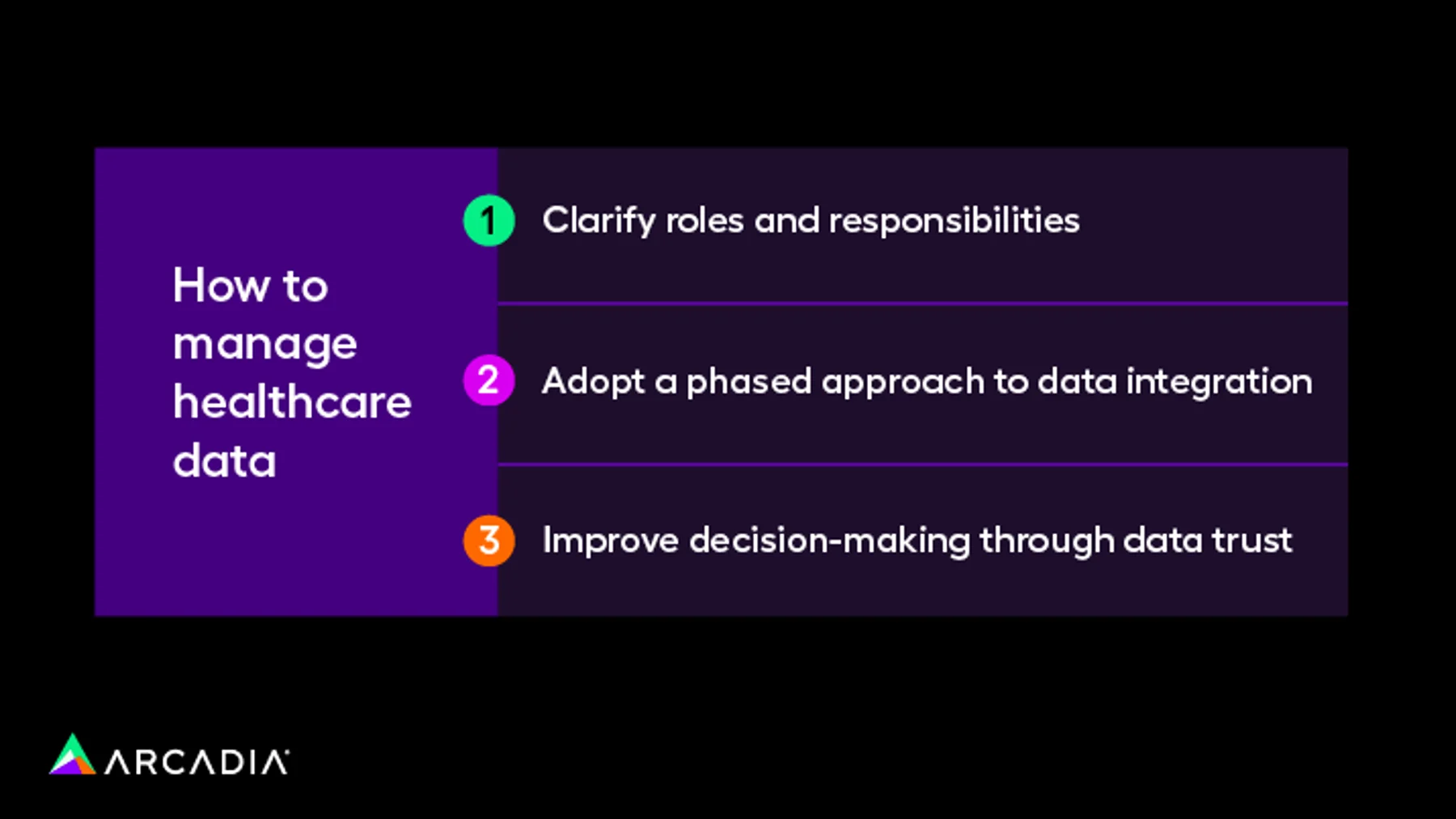
Effective data management in healthcare is a balancing act. Here are three tips to navigate your data complexities:

1. Clarify roles and responsibilities
The first step in effective data management is understanding the roles of data analysts and data managers:
- Data analysts focus on interpreting data, uncovering insights, and providing actionable recommendations that can significantly impact decision-making processes.
- Data managers are responsible for the integrity, accessibility, and security of data. They oversee the systems used to collect, store, and retrieve data to ensure accuracy and availability.
By clearly defining these roles within an organization, healthcare leaders leverage the unique skills of each group, leading to more efficient and effective data management practices.
2. Adopt a phased approach to data integration
A common misconception in data management is the assumption that an organization must aggregate all data sources simultaneously. Instead, a phased approach is more effective, where users can identify the most critical data sources to prioritize for aggregation.
This enables healthcare organizations to develop a robust data infrastructure over time, supporting their objectives and facilitating data-driven decision-making.
3. Improve decision-making through data trust
Data trust is a cornerstone of effective data management. Ensuring the accuracy, completeness, and timeliness of data is essential for making informed decisions. This involves implementing rigorous data validation and verification processes. Trustworthy data enables confident decision-making and reduces the risk of errors.
Creating a transparent, accountable culture within an organization can also increase data trust. By doing so, healthcare teams can ensure their data management practices are reliable, which ultimately leads to better health outcomes.
Final thoughts on healthcare data management software
Data management plays a crucial role in streamlining healthcare operations. Partnering with the right data analytics provider can enhance data trust, give healthcare leaders the confidence to make informed decisions, and streamline operations. By adopting these practices, healthcare organizations can ensure they’re well-equipped to handle the complexities of today’s healthcare landscape.