ResourcesInsight

Top 8 Healthcare Analytics Tools and Tips for Selecting One

By Logan Masta, Director, Special Projects at Arcadia
Posted:
Healthcare Analytics Data Management and Quality

Research indicates that, on average, 47% of healthcare data is underutilized in clinical and business decision-making, resulting in missed opportunities across patient care, staff productivity, and financial performance. Healthcare analytics software offers a promising solution to this challenge.

However, the healthcare data analytics market is expanding at a Compound Annual Growth Rate (CAGR) of approximately 28%, meaning executives have a wide array of options to consider when selecting healthcare analytics tools for their organizations.

This article explores critical considerations that should guide your search for healthcare analytics software, including:

While enhancing care delivery is a critical output of effective healthcare data analytics, it’s not the only benefit. If you’re interested in understanding the full potential of analytics, watch our webinar: The value of data: How to optimize performance, grow provider networks, and improve patient care.

Healthcare analytics software FAQs

What are healthcare analytics tools?

Healthcare analytics tools are software applications designed to aggregate vast amounts of healthcare data, identify relevant patterns and trends, extract actionable insights, and draw conclusions. These platforms enable health teams to understand, address, and even predict common challenges evident in their existing datasets.

What are the benefits of analytics software?

Data analytics significantly impacts the broader healthcare industry. Within your own team, healthcare analytics tools directly influence operational and analytical capabilities, offering several positive outcomes:

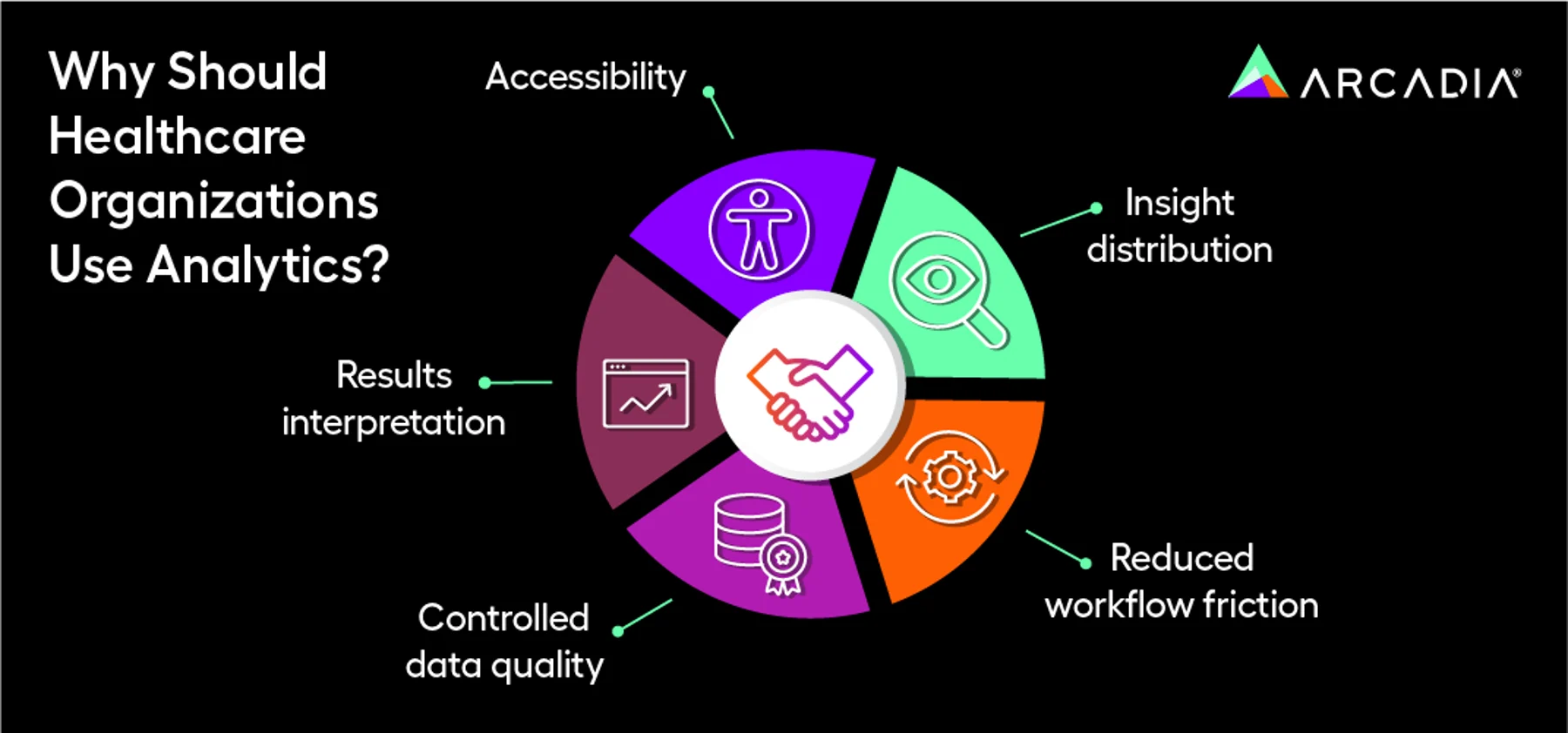
Top benefits of healthcare analytics tools, which are listed in the text below
  • Controlled data quality: Data quality challenges often hinder teams from identifying patterns and uncovering new insights. By contrast, standardized, aggregated data empowers users to curate and enrich data into a high-quality, usable asset. This enables analysts to focus on high-value tasks rather than wrangling with files.
  • Accessibility: Disparate electronic health records (EHRs) and other sources of information can lead to inconsistent or siloed data. Advanced analytic tools combat these issues by enabling teams to easily access and exchange information across an enterprise.
  • Insight distribution: Healthcare analytics tools facilitate data sharing where it's most needed, whether that’s collaborating on patient care or identifying opportunities for organizational performance improvement. Rather than wasting time on ad hoc reports, health teams leveraging this software can focus their efforts on advanced queries.
  • Reduced workflow friction: Analytics tools seamlessly transfer and surface insights across departments and systems. This software complements existing infrastructure, meaning it builds upon health teams’ current capabilities and existing workflows.
  • Results interpretation: A refined healthcare analytics platform surfaces critical insights through detailed dashboard reporting and dependable insight distribution. In other words, these tools collect and organize data while supporting its interpretation.

These benefits create positive momentum, propelling your organization toward improved and cost-effective outcomes. However, given the detailed implementation procedures required for healthcare data analytics, choosing a trustworthy provider is paramount.

Can healthcare analytics tools process unstructured data?

Yes, healthcare analytics software can process unstructured data, often through AI features. About 80% of medical data remains unstructured after it is created, and since this type of data is difficult to handle, it tends to be ignored or unused. Robust healthcare analytics platforms aggregate, structure, and analyze this messy data, offering health organizations a holistic view of patient outcomes, provider performance, and finances.

Is healthcare analytics software HIPAA compliant?

Yes. Healthcare analytics platforms are built strictly to comply with HIPAA and other data privacy and security regulations, ensuring that your patients’ protected health information (PHI) remains safe. Platforms should use HITRUST-certified infrastructure, role-based access controls, and data encryption for maximum security.

As you consider which platform to use at your healthcare organization, look for these security features and ask about them during software demos.

What are the main types of healthcare analytics?

There are five main types of healthcare analytics:

  • Descriptive analytics reviews historical data to identify patterns.
  • Diagnostic analytics focuses on understanding why something happened by identifying relationships, drivers, and root causes.
  • Predictive analytics leverages historical data and statistical modeling to forecast outcomes and trends.
  • Prescriptive analytics builds on predictive analytics to recommend specific actions that are likely to improve outcomes.
  • Discovery analytics investigates data without a predefined hypothesis to uncover previously unknown patterns, relationships, and insights.

Implementation challenges for healthcare analytics software

When leveraged to their full capability, analytics tools can provide the above benefits and more; however, insufficient implementation can limit the tools’ potential. Reliable healthcare analytics tools are well-equipped to mitigate implementation challenges and avoid or eliminate negative outcomes, including: 

  • Provider burnout. In an Arcadia survey, The current state of healthcare analytics platforms, 67% of physicians and nurses reported symptoms related to burnout. Because providers often accept the responsibility of data collection and analysis, platform implementation can become an added burden to their already full plates.
    • Solution: The right healthcare analytics tools can streamline workflows and provide actionable insights, reducing the burden on providers and allowing them to focus on patient care.

  • Data variation: Irregular data structures can hinder analysis and slow down processes. Inaccurate medical information related to diagnoses, medical history, and medicines also presents major roadblocks.
    • Solution: Effective healthcare analytics tools standardize and aggregate data, transforming it into a high-quality, usable asset and enabling analysts to focus on higher-value tasks.

  • Limited interoperability: It's common for even a highly intuitive healthcare analytics platform to be incompatible with other hospital systems or internal systems.
    • Solution: You need a solution that understands how to configure a complementary analytics system to easily share and update data without issues.

  • Inconsistent data standards: Date formats, abbreviations, and units of measure can create inconsistencies within the existing healthcare dataset.
    • Solution: Your chosen platform must take full advantage of standards like the FHIR framework to proactively account for these issues.

  • Security risks: Approximately one-third of all reported data breaches in recent years occurred in the healthcare industry. Health organizations are especially susceptible to ransomware attacks and other security risks due to the sensitive nature of health data.
    • Solution: You need reliable software that keeps up with current data privacy and security standards for strong protection.

Keep these challenges in mind as you assess your organization's unique needs and goals. By being mindful of potential implementation pitfalls, you can plan an informed analytics route that accounts for risks ahead of time. Consider these points as you decide to build or buy your analytics solution.
 

Considerations for choosing healthcare analytics tools

Build vs. buy

Build vs. buy frameworks can be found in product development across almost all major industries and fields, and this topic is especially relevant in today’s healthcare analytics discussion.

It’s shorthand for a choice that stakeholders make time and time again: does a tech team dare build a system from the ground up in-house? Or do they take a chance on an outside solution, trusting a vendor to execute on their timeline and to their standards?

There are arguments in support of (and against) both approaches, but your organization can follow these steps to discern the best path for your use case:

  • Clarify: So you’ve discovered the status quo is no longer an option. What is the breaking point, and why now?
  • Justify: You’re aware of a major hurdle that’s slowing down your team. Knowing that, what will solving it do for efficiency? Cost savings? Time recouped? The justification can be qualitative or quantitative, but it needs to make the intervention of new software or services worthwhile.
  • Solidify: Gather evidence to support the need for new technology and research potential solutions. Comb through reviews on sites like KLAS Research and ask trusted peers outside your institution. Fact-find so that you can cost-compare and narrow down the best options.
  • Consolidate: Armed with lots of information, you’re ready to narrow the field to the best contenders. Side by side, break down the cost of building an in-house fix versus collaborating with another vendor, digging deep into what each course of action can offer.

In the end, this choice comes down to one paramount aspect — cost. It’s not straightforward either — you’ll spend money building from scratch, and you’ll certainly spend it contracting with a vendor. In some cases, the two amounts are roughly equivalent.

It’s challenging to assign a dollar value to serving communities in need or reaching a population that’s otherwise disengaged. On the other hand, it's easy to measure the significant impact of preventive care, proactive outreach, and increased operational efficiency. With a more powerful business intelligence and healthcare data analytics resource at your disposal, there are few goals out of reach.

AI enablement

The integration of artificial intelligence (AI) in healthcare tools is rapidly changing the way health organizations leverage data. AI-powered solutions offer advanced analytical capabilities, such as:

  • Predictive analytics: Predictive modeling evaluates current and historical data to predict what’s most likely to happen in the future. Using these projections, AI-powered tools can make recommendations for specific patient populations.
  • Conversational analytics: AI can analyze human queries and deliver answers based on specific datasets. For example, Arcadia’s Conversational Analytics tool enables users to ask questions such as “How can I break down pharmacy costs by payer?” The platform delivers an actionable answer to that question and follow-up questions in a conversational format.
  • Generative models: Generative AI can understand and produce content, including text, images, and even audio. This functionality helps health professionals with tasks like patient communication, clinical summarization, and other administrative responsibilities.

These applications can influence numerous aspects of care delivery, including early disease detection and personalized medicine. As AI models process vast amounts of patient data, they can identify patterns that may indicate the early onset of specific conditions. Analysis of genetic information, medical history, lifestyle factors, and other patient details can further tailor treatment plans to address health needs early and accurately.

Beyond care delivery, AI-enabled analytics tools also support overall operational efficiency by automating routine tasks and reducing administrative burden.

Top 8 healthcare analytics tools on the market

Provider Name

Best For

Standout Feature

Arcadia

Comprehensive healthcare data analytics across clinical, financial, and operational domains

Closing the gap between insight and execution with AI-enabled analytics and workflows

N1 Health

Proactive patient engagement and treatment

Predictive AI models for individual patient behavior

Atropos Health

On-demand clinical evidence

Real-world evidence (RWE) reports

Socially Determined

Assessing social determinants of health (SDoH)

SDoH data that helps identify risks and close care gaps

IBM SPSS

Large-scale statistical analysis

Advanced statistical modeling algorithms

Flatiron

Oncology-specific research and clinical data

Deep real-world oncology datasets

Sisense

General-purpose business intelligence dashboards

API-first embedded analytics (industry-agnostic)

Clarify Health

Provider performance tracking

Case-mix adjustment and claims analytics


Arcadia: Best for comprehensive healthcare data analytics

Arcadia is a cloud-based healthcare data platform that closes the gap between insight and action by unifying data and enabling execution through AI-powered workflows to improve cost, quality, and operational performance. Recognized five times by KLAS Research, Arcadia has connected approximately 2,600 claims and clinical data sources while processing clinical records for upwards of 170 million lives.

“”

Healthcare has no shortage of data, but true front-line execution comes from the ability to turn fragmented data into a structured, AI-ready, reliable signal that care teams can act on in real time. Arcadia unifies that data into a strong analytic backbone that feeds our clinically intelligent workflows, enabling higher quality, lower total cost of care, and sustainable value-based performance that extends well beyond productivity gains. For organizations serious about value-based care, the depth of Arcadia’s data and analytics platform is unmatched.

Sanjay Doddamani
Sanjay Doddamani, MD, MBA l Founder and CEO, Guidehealth

To provide a more holistic view of patient health and organizational performance, Arcadia offers comprehensive healthcare analytics tools encompassing:

  • Care management: Automate care management workflows with tools built on predictive models and comprehensive patient data sets. Prioritize patients and activities, automate tasks with AI, and collaborate with other teams using shared workflows.
  • Finance and contracting: Healthcare providers rely on Arcadia for financial optimization in both value-based care (VBC) and fee-for-service (FFS) payment models. Arcadia’s platform provides contract modeling, forecasting, and financial optimization workflows to help you determine optimal contract types and details for specific patient populations.
  • Data insights: Analyze data across entire patient populations. Arcadia’s easy-to-navigate interface offers customized workflows, allowing providers and payers alike to track clinical data and non-medical factors that influence population health. Unify your healthcare data into a single source of truth, delivering the analytics, workflows, and actionable insights you need to improve patient outcomes.
  • Network optimization: Design, evaluate, and optimize provider networks using Arcadia’s third-party performance benchmarks and market intelligence. These tools combine network modeling, market intelligence, referral analytics, and performance insights to support network growth.
  • Quality and risk performance: Measure care quality and risk to achieve better patient outcomes, revenue accuracy, and revenue compliance. Arcadia’s healthcare analytics software ensures the complete, accurate, and timely capture of your quality and risk data to improve your performance.
  • Agentic AI: Power your analytics with Arcadia’s agentic AI capabilities, embedded throughout its platform. From AI chart summary features that provide a 360-degree view of patients to AI-powered analytics engines for population health and value-based care, you can leverage Arcadia’s platform to accelerate your productivity, improve your accuracy, and deliver better patient outcomes.

With Arcadia, you can unify disparate healthcare data and translate it into aligned action through workflow tools and embedded AI, improving cost, quality, and operational performance.


n1 health

N1 Health: Best for proactive patient engagement and treatment

N1 Health is a predictive AI platform that combines data with predictive models to extract insights about adverse medical events, high costs of care, and barriers to seeking treatment. These insights empower health teams to engage and treat patients proactively, intervening before conditions or costs escalate.

The platform utilizes third-party and training data from over 30 different sources, and it has supplemented user data with more than 2,500 insights about individual patients.


Atropos Health: Best for on-demand clinical evidence

Atropos Health translates clinical data into real-world evidence (RWE) reports, accelerating answers to clinical questions with information uploaded by health organizations, as well as the Atropos Evidence™ Network of approximately 200 million de-identified global patients’ records.

Atropos Health’s partnership with Arcadia enables providers to tap into evidence-generating technologies for better point-of-care decision-making.


Socially Determined: Best for assessing social determinants of health (SDoH)

Socially Determined provides SDoH data to help health organizations identify social risks and close relevant gaps. This HITRUST-certified technology leverages a robust data supply chain to surface risks across seven domains:

  • Economic climate
  • Food landscape
  • Housing environment
  • Transportation network
  • Health literacy
  • Digital landscape
  • Social connectedness

Learn how IBM’s healthcare analytics tools provide advanced analytic capabilities for your team to tackle problems and increase efficiency.

IBM SPSS: Best for large-scale statistical analysis

IBM has been around for a while (since 1911 to be exact) and has obviously solidified its name in the information technology sector for years. SPSS Software is an analytical technology solution built by IBM to tackle healthcare workflow inefficiencies head-on.

The IBM SPSS solution is built with predictive, prescriptive, and descriptive-analytic capabilities. Its user-friendly platform makes scalable solutions readily available for users of every skill level, enabling your team to improve efficiency and minimize risk across all projects. With a recognizable tech footprint, the well-established company stretches across Asia, Europe, and North and South America.


In the healthcare analytics tools sector, Flatiron is a leading player in transforming the infrastructure of cancer research and providing quality care.

Flatiron: Best for oncology-specific research and clinical data

On the other end of the spectrum, Flatiron has been on the market for a relatively shorter amount of time. However, they are making quite an impression on the healthcare sector by accelerating cancer research and improving quality care globally.

Flatiron’s vision to “reimagine the infrastructure of cancer care” relies on its ability to expand the possibilities for point-of-care solutions in oncology. The software’s integrated real-world evidence powers new approaches to evidence generation through a robust engaged care network ready to transform cancer care as a unified team.


This section details how Sisense goes beyond business intelligence by providing valuable healthcare analytics tools for a variety of projects.

Sisense: Best for general-purpose business intelligence dashboards

Sisense seeks to go beyond business intelligence by enabling your team to incorporate analytics into customer and employee workflows. Its highly customizable, AI-driven analytics cloud platform, Sisense Fusion, drives performance with infused insights.

Serving a variety of industries—healthcare, retail, manufacturing, finance, and more—Sisense’s analytics solutions are flexibly configured to handle a range of business intelligence projects. Specifically, its healthcare dashboards make it simple to extract actionable insights from mountains of clinical data, helping your team minimize costs and achieve operational success.


Read this section to discover the ways in which Clarify Health is using its healthcare analytics tools to power your path to value.

Clarify Health: Best for provider performance tracking

Clarify Health provides “technology to power your path to value” for health plans and healthcare providers. The company’s enterprise analytics powers the business of better care by seeking to accomplish four objectives — winning the race to value, building the best networks, reducing medical spend, and accelerating value-based care transformation.

With a large data library and helpful customer support, Clarify Health’s user-friendly platform can make your data more accessible.


Final thoughts on healthcare analytics software

There is a wide selection of healthcare analytics vendors to choose from, each with various levels of expertise. Choose a solution that meets your unique needs — whether that solution involves vendor collaboration or in-house problem-solving.